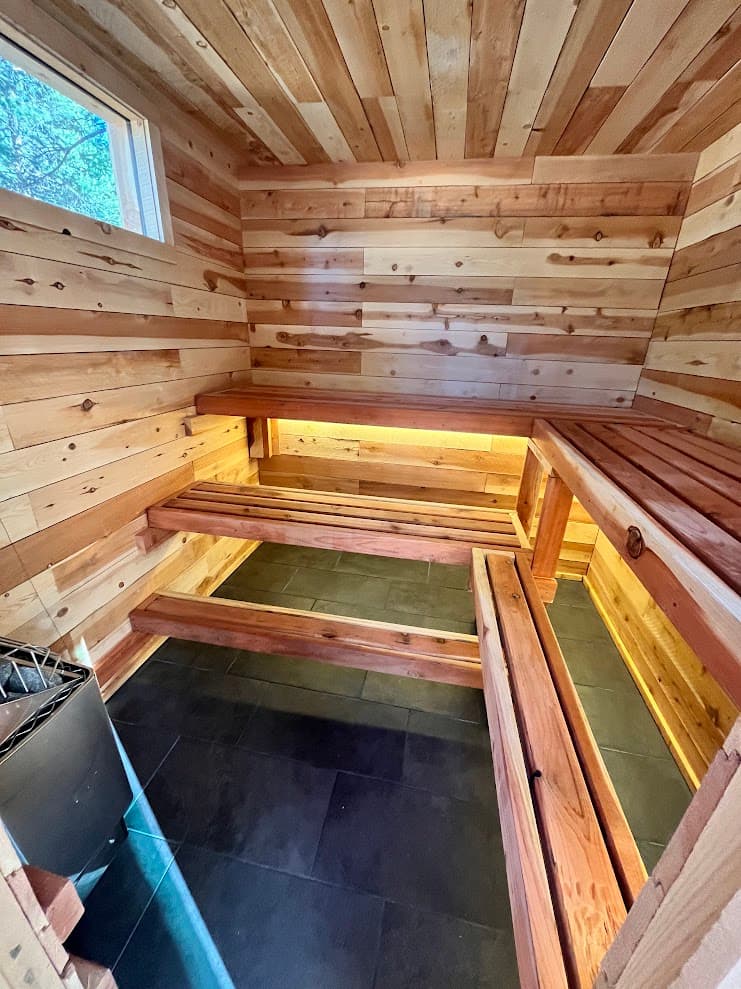
Our Custom Sauna Design-Build Process — From First Call to Finished Build
What Our Custom Sauna Design-Build Process Actually Looks Like
We get a version of the same question pretty often: "What does working with you actually look like?"
It's a fair question. A custom sauna design-build process isn't something most people have been through before, and it's not always obvious where to start or what to expect. So here's the honest, step-by-step answer — what we do, why we do it in this order, and what you can expect at each stage.
Step 1: A Phone Call — No Pressure, Just a Real Conversation
Everything starts with a conversation. Usually 20 to 30 minutes. We ask what you're thinking about, what's driving the interest, and what your property situation looks like. From there, we walk through the real tradeoffs so you can make an informed decision before anyone spends a dollar.
The biggest fork in the road for most people is wood-burning versus electric. Both are excellent options, but they suit different situations. A wood-burning stove takes longer to heat up — typically 1.5 to 3 hours to reach a traditional sauna temperature of 170–200°F — but the heat it produces is deeply radiant and has a quality that's hard to describe until you've experienced it. An electric heater gets you there in 30 to 45 minutes and pairs naturally with a timer or app-based control, which makes it the right call for most primary residences and frequent users. If you want to go deeper on heater selection before we talk, our sauna heating and stoves module covers everything in detail.
We'll also talk through size, features, and realistic cost. A 6×8 sauna with a 7-foot ceiling runs about 336 cubic feet and typically needs a 6–8 kW heater. An 8×10 at the same ceiling height is roughly 560 cubic feet and calls for a 9–12 kW unit. Those numbers matter because heater sizing affects electrical infrastructure, which affects cost. We'd rather surface that on a phone call than after a design is half-built.
The goal of this call isn't to sell you anything. It's to figure out whether a custom sauna actually makes sense for your situation — and if it does, to make sure we're moving in the right direction from the start.
Trusted by homeowners across Tahoe and beyond
Step 2: Site Visit or Video Walkthrough
If the conversation points toward moving forward, the next step is either an in-person site visit or a virtual video walkthrough of your property. For clients in the South Lake Tahoe area and surrounding Tahoe Basin, we make it out in person whenever we can. For clients farther out, a thorough video call works remarkably well.
This step is where the real design work begins, and it's one we take seriously. There are things you simply cannot catch over email.
Views and privacy. In Tahoe, people often have a ridge line, a lake glimpse, or a stand of old-growth firs worth designing around. We're looking at where windows and glass doors can be positioned to frame your best view while keeping you comfortable and private. That balance is specific to every property and every neighbor situation.
Scale and orientation. A sauna that looks right on paper can feel out of place on a property if the roofline doesn't relate to the main structure, or if the footprint reads as too small — or too large — against the landscape. We're looking at how the sauna's height, massing, and orientation fit the style of your home. Tahoe architecture varies a lot, from mid-century A-frames to contemporary mountain modern, and a good sauna should feel like it belongs.
Foundation and electrical. Most outdoor saunas need either a concrete perimeter foundation or a helical pier system — the right choice depends on your soil, your grade, and local frost depth requirements. On the electrical side, we're thinking about your panel capacity, the distance of the run from the panel to the sauna, and whether conduit trenching is going to be straightforward or complicated. These are the unsexy details that quietly determine budget.
The small things. Where does the stovepipe exit if it's a wood-burning unit? Is there a hose bib nearby for the cold plunge bucket? Where does the door swing? A lot of small but important things surface during this step that are easy to miss until you're standing on the ground.
Step 3: The Design Package
After the site visit, we put together a full design package. This includes a 3D rendering of the proposed sauna and a detailed materials list — interior wood species, bench dimensions, insulation spec, vapor barrier approach, heater model, and everything else that touches the build.
On insulation, we design to walls at R-13 to R-21 and ceilings at R-30 to R-38. The ceiling spec matters more than most people expect because heat rises and a poorly insulated ceiling is money leaking out of every session. Vapor barrier is aluminum foil-based sheeting installed on the warm, interior side with seams overlapped at least 6 inches — this is non-negotiable for long-term durability in a Tahoe climate with significant freeze-thaw cycling.
For sauna rocks, we specify olivine diabase or peridotite only. These dense volcanic rocks handle repeated heat cycling without cracking. River rocks and granite look fine but have a real tendency to fracture under the thermal stress of regular use — we never specify them. For a deeper look at materials and wall assembly decisions, our materials and construction module covers the full spec.
Bench layout follows the heat zones in the room. Our upper bench sits 40–48 inches below the ceiling — that's the hottest zone, where experienced bathers want to be. A middle bench at 23–31 inches below the ceiling gives you a cooler option, and bench seating depth of 18–24 inches gives you room to lie down or sit comfortably. We show all of this in the 3D rendering so you can see exactly what you're getting before a single board is cut.
Once we share the design package, you review it, tell us what you'd change, and we revise until it feels right. There's no rush on this step.
Step 4: The Build
When the design is locked in, we connect you with a licensed contractor we trust to carry out the build. We've built relationships with contractors who understand sauna-specific construction — vapor barriers installed correctly, bench heights that actually match the design, heater placement that matches the ventilation layout. These details get lost when a general contractor is working from a vague plan.
We stay available throughout the build to answer questions, review photos, and make sure the finished product matches the design we agreed on together. If something comes up in the field, we're a call or text away.
Every project we've worked on started with a simple conversation. If you've been thinking about building a sauna on your Tahoe property, that's genuinely all it takes to get started.
Frequently Asked Questions
How long does the whole design-build process take? From the initial phone call to a completed sauna, most projects take 3 to 6 months, depending on contractor availability, permit timelines, and how quickly the design comes together. The design package itself typically takes 2 to 3 weeks after the site visit, and revisions are usually resolved within a week. Permitting timelines vary by county and jurisdiction — we factor that in during the planning conversation.
Do I need a permit to build a sauna in Tahoe? In most cases, yes — especially for outdoor structures and any work involving electrical. El Dorado County, Placer County, and the City of South Lake Tahoe all have their own requirements, and TRPA (Tahoe Regional Planning Agency) adds a layer for properties within the Basin. We help you understand what's likely required for your property during the design phase so there are no surprises.
Can I use a wood-burning sauna at elevation in Tahoe? Absolutely, and many of our clients prefer it. Wood stoves are well-suited to the mountain environment — they don't require electrical infrastructure and perform beautifully at altitude. The tradeoff is the longer heat-up time (1.5 to 3 hours vs. 30 to 45 minutes for electric) and the need for a properly flashed and weather-tight chimney penetration, which we design for specifically.
What if I already have a shed or structure I want to convert? Conversions are a great option and we handle them regularly. The key questions are whether the existing structure's framing is sound, whether it can be properly insulated and vapor-sealed, and whether the electrical panel can support the heater load. We assess all of this during the site visit and let you know honestly whether a conversion is the right path or whether starting fresh pencils out better.
Next Steps
Ready to find out what's possible on your property? Start with a quick design consultation — we'll talk through your site, your goals, and what a custom sauna build would realistically look like for you.