The Real Cost of a Sauna Kit (It's Not Just the Sticker Price)
A sauna kit looks like a great deal. You see a "4-6 person outdoor sauna" for $4,000-$5,000 shipped to your door, and it seems like the obvious move compared to a custom build that could run $10,000-$20,000. But the sticker price doesn't tell you what the sauna actually costs to own. Once you factor in the oversized heater, the missing insulation, and what you're actually paying in electricity every time you turn it on, the math changes fast.
We're going to break this down with real numbers using a specific kit as an example — the Backyard Discovery Lennon, one of the most popular sauna kits sold through Sam's Club, Costco, and Bed Bath & Beyond.
The kit: what you're actually getting
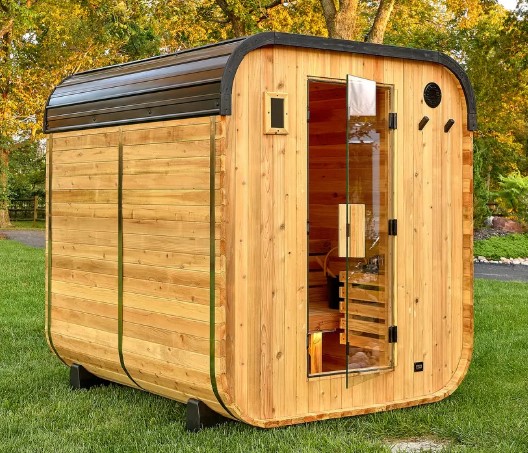
The Backyard Discovery Lennon is listed as a "4-6 person outdoor cube sauna" with a 9kW electric heater. It runs about $4,000-$4,300 depending on where you buy it. Cedar construction, glass door, Wi-Fi controls, and it ships in several heavy boxes for you to assemble.
Here's where it gets interesting. The exterior dimensions are 69.5" x 76.25" x 78.25". That works out to roughly 212 cubic feet of interior volume once you account for the wall thickness. The walls are tongue-and-groove cedar boards — and that's it. No framing, no insulation batts, no vapor barrier. The cedar boards are both the structure and the insulation.
That matters more than most people realize.
The heater tells the whole story
The standard rule for sizing an electric sauna heater is 1 kW per 45 cubic feet of well-insulated room. A 212 cubic foot room needs about a 4.7 kW heater if the walls are properly insulated — R-13 to R-21 in the walls, R-30 in the ceiling, with an aluminum vapor barrier.
This kit has a 9 kW heater. That's 91% more than what the room would need if it were built right.
Why? Because the heat escapes through uninsulated cedar boards and a full glass door almost as fast as the heater can produce it. The oversized heater is compensating for the lack of insulation. A 9 kW heater would be appropriate for a 405 cubic foot room — roughly an 8x8 sauna with proper ceiling height. They're putting a heater meant for a room nearly twice this size because the walls can't hold the heat.
One YouTube reviewer who bought this exact kit and used it daily for two months confirmed the problem: the heater struggled to reach 185 degrees in winter, well short of the 196 degrees it claims. He also had to add an aftermarket fan to improve air circulation — another sign of a design that wasn't thought through.
The capacity claim doesn't hold up either
The listing says "4-6 person." But you need to look at who fits on the top bench, because that's the only bench where the thermal experience is actually good. The lower bench in most kits sits below the heater stones, where it's significantly cooler and where bacteria can thrive because the temperature doesn't get high enough for sanitation.
The top bench on the Lennon is roughly 6 feet wide. At 24 inches per person — which is the minimum for comfortable seating — that's a 3-person sauna. The reviewer confirmed this: 3 people fit comfortably on top, maybe 4 if everyone's close. The "4-6" number only works if you count the lower bench, which is a fundamentally different (and worse) experience.
So this is really a 3-person sauna with a heater sized for a room almost twice its volume.
What a properly built 3-person custom sauna looks like
A custom sauna designed for 3 people on the top bench would have similar interior dimensions — roughly 5x6 to 6x6.5 feet, with a 7.5-foot ceiling. About 225-260 cubic feet. The big difference is what's in the walls.
A properly built sauna has 2x4 framed walls with R-13 to R-21 insulation, an aluminum vapor barrier on the warm side with all seams taped, furring strips to create an air gap, and then cedar paneling on top. The ceiling gets R-30 or higher because heat rises and that's where most of your energy loss happens.
With that wall assembly, you only need a 5-6 kW heater. It heats up in the same 30 minutes, reaches 180-200 degrees reliably in any weather, and the heater barely has to work to maintain temperature because the heat stays in the room.
The energy math: 52% more electricity per session
This is where the real cost difference shows up. Here's what each sauna uses per 90-minute session (30 minutes of heat-up plus 60 minutes of use):
Kit sauna (9kW heater, no insulation):
- Heat-up: 4.3 kWh (heater running at near-full power for 30 minutes)
- Maintenance: 5.4 kWh (heater cycling at about 60% during the session because heat keeps escaping)
- Total: 9.7 kWh per session
Custom sauna (6kW heater, properly insulated):
- Heat-up: 2.8 kWh (smaller heater, same 30 minutes)
- Maintenance: 1.8 kWh (heater cycling at about 30% because the insulation holds the heat)
- Total: 4.6 kWh per session
The custom sauna uses 52% less energy every single time you turn it on. And that 60% duty cycle for the kit is conservative — in winter, with that glass door and uninsulated walls, the heater could easily run 70-80% of the time just to maintain temperature.
What that costs over 5, 10, and 15 years
At the U.S. average electricity rate of $0.16/kWh, here's what a regular user (4 sessions per week) pays annually:
| Kit (9kW) | Custom (6kW) | Annual savings | |
|---|---|---|---|
| Energy per session | 9.7 kWh | 4.6 kWh | 5.0 kWh |
| Annual energy cost | $322 | $155 | $167 |
| 5-year energy cost | $1,610 | $774 | $836 |
| 10-year energy cost | $3,220 | $1,548 | $1,672 |
| 15-year energy cost | $4,830 | $2,321 | $2,509 |
If you're in California or another high-cost electricity market at $0.25/kWh, those numbers get bigger. A kit user paying $0.25/kWh and using the sauna 4 times a week spends $503 per year on electricity. The same usage in a custom sauna costs $242. That's $261 per year — over $2,600 in savings over 10 years just from electricity.
Daily users see even larger differences. At $0.25/kWh with daily use, the kit costs $883/year to run. The custom costs $424. That's $459/year in savings.
Sauna Energy Cost Calculator
Adjust your usage and electricity rate to see how costs compare over time.
| Year | Kit total cost | Custom DIY total | Custom pro-built total |
|---|---|---|---|
| 0 | $5,800 | $6,500 | $13,000 |
| 1 | $6,123 | $6,653 | $13,153 |
| 2 | $6,446 | $6,806 | $13,306 |
| 3 | $6,768 | $6,959 | $13,459 |
| 5 | $7,414 | $7,265 | $13,765 |
| 7 | $8,060 | $7,572 | $14,072 |
| 10 | $9,028 | $8,031 | $14,531 |
| 15 | $10,642 | $8,796 | $15,296 |
| 20 | $12,256 | $9,562 | $16,062 |
A DIY custom build breaks even with the kit at year 4.1. A pro-built custom breaks even at year 42.4.
Assumes 30-minute heat-up + 60-minute session. Kit: 9kW heater at 60% maintenance duty cycle (no insulation). Custom: 6kW heater at 30% maintenance duty cycle (R-13+ walls, R-30+ ceiling, vapor barrier). Upfront costs include typical electrical installation.
The upfront cost comparison most people get wrong
Here's what catches people off guard: for a DIY builder, a custom sauna of the same true capacity costs about the same as a kit.
Kit route (true 3-person sauna):
- Sauna kit: $4,000-$4,300
- Electrical (240V circuit, licensed electrician): $1,000-$2,000
- Assembly: 20-25 hours of your time (or $600 for professional assembly)
- Total: $5,000-$6,300
Custom DIY route (true 3-person sauna):
- Materials (framing, insulation, vapor barrier, cedar, heater, door, windows): $4,000-$6,000
- Electrical: $1,000-$2,000
- Build time: 80-100 hours
- Total: $5,000-$8,000
Custom with a builder:
- Materials plus labor: $8,000-$16,000
- Electrical: $1,000-$2,000
- Total: $9,000-$18,000
The DIY custom build is roughly the same upfront as the kit — and sometimes cheaper on the low end. The difference is you're spending that money on insulation, proper framing, and a correctly sized heater instead of on a branded box with an oversized heater doing the work that insulation should be doing.
Even the professional custom build, which costs significantly more upfront, starts closing the gap when you factor in energy savings. A DIY custom build breaks even with the kit around year 4. After that, every session is cheaper than the kit.
Beyond energy: what else you're paying for with a kit
The energy cost difference is the biggest ongoing expense, but it's not the only one.
Maintenance and repairs. The YouTube reviewer's heater failed within two months. The lights broke. Two boards were warped and didn't fit properly. Backyard Discovery's customer service was responsive, but the fact remains: he had multiple component failures in the first 60 days. Tongue-and-groove boards without framing also expand and contract with heat cycling. Over time, gaps open up, which means more heat loss, water intrusion, and potential insect problems.
The experience gap. A kit sauna with the bench near the floor, no mechanical ventilation, and poor air circulation is a fundamentally different product from a properly designed sauna with raised benches, mechanical downdraft ventilation, and low stratification. You'll use a well-designed sauna more often, which is the whole point of having one at home.
Resale and longevity. A framed, insulated structure built to code is an improvement to your property. A kit sauna sitting on a gravel pad is closer to outdoor furniture — it depreciates, and it won't last as long.
The bottom line
The idea that custom saunas are always more expensive than kits doesn't hold up when you look at the full picture. Kit makers keep their sticker prices low by skipping insulation and compensating with oversized heaters. You pay for that shortcut every time you turn the sauna on, for as long as you own it.
For a DIY builder, a custom sauna of the same real capacity costs about the same upfront and uses half the electricity. For someone hiring a builder, the higher upfront cost starts paying itself back within a few years through lower energy bills — and you get a sauna that actually performs the way a sauna should.
If you're weighing a kit against a custom build, don't just compare sticker prices. Compare what each one costs to run for the next 10 or 15 years. That's the number that matters.
Not sure where to start with a custom build? We design saunas for clients across the U.S. through our remote sauna design process — you get build-ready plans your local contractor can work from.
Want the same math run on a premium kit? See SISU Crew Cabin vs. Custom Sauna Build: What Each Really Costs.
Frequently Asked Questions
How much does a sauna kit cost?
Most outdoor sauna kits from brands like Backyard Discovery, Almost Heaven, and others range from $3,000 to $10,000 for the kit itself. But that's just the starting point. You'll also need a 240V electrical circuit installed by a licensed electrician ($1,000-$2,000), and potentially professional assembly ($500-$600). Total all-in cost for a kit sauna is typically $5,000-$12,000 depending on size, brand, and site conditions.
How much electricity does a sauna kit use?
A typical kit sauna with a 9kW heater and no insulation uses about 9-10 kWh per session (30-minute heat-up plus 60-minute use). At the U.S. average electricity rate of $0.16/kWh, that's about $1.55 per session. A properly insulated custom sauna of the same size uses about 4.5-5 kWh per session — roughly half.
Why do sauna kits have such large heaters?
Kit saunas typically skip insulation — the cedar walls are both the structure and the thermal barrier. Without insulation and a vapor barrier, heat escapes quickly, so manufacturers install a larger heater to compensate. A 9kW heater in a 212 cubic foot kit is doing the job that a 5kW heater and proper insulation would do in a custom build.
Is it cheaper to build a sauna or buy a kit?
For a DIY builder, the materials cost for a custom sauna is comparable to the price of a kit — roughly $4,000-$6,000 for a 3-person sauna. The custom build requires more labor (80-100 hours vs. 20-25 for a kit), but you end up with a better-insulated, more energy-efficient sauna that costs about half as much to operate per session. Over 5-10 years, a DIY custom build is typically less expensive total.
How many people actually fit in a "4-6 person" sauna kit?
Sizing a sauna based on the top bench is the right approach. The top bench is where the heat is best, and it's the only bench where the temperature gets high enough for a real sauna experience. Most kits marketed as "4-6 person" fit 3 people comfortably on the top bench. The larger number assumes people are sitting on the lower bench, which is significantly cooler and less effective.
Do sauna kits hold up in cold climates?
Kit saunas without insulation struggle in cold climates. Without a proper wall assembly — framing, insulation, and vapor barrier — the heater has to work harder to maintain temperature and may not reach full heat in winter. Gaps can also develop in tongue-and-groove boards over time as wood expands and contracts with heat cycling, leading to more heat loss, moisture problems, and higher energy bills.