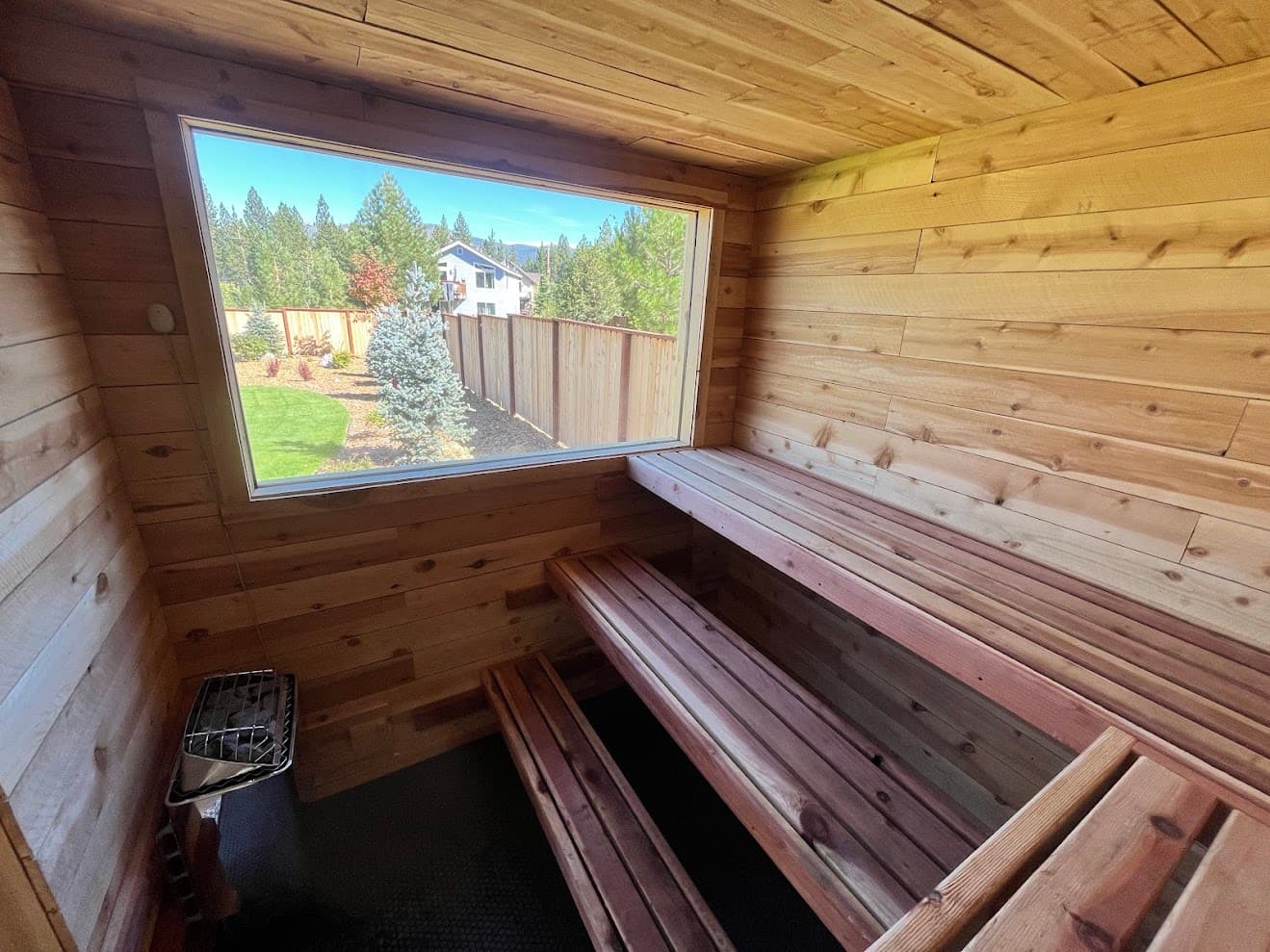
Wood-Fired vs. Electric Sauna Heater: How to Choose the Right One for Your Build
Wood-Fired vs. Electric Sauna Heater: What the Crackling Fire Is Actually Telling You
We get asked about the wood-fired vs. electric sauna heater decision on nearly every build we do. And while we'd love to hand clients a clean, one-size-fits-all answer, the honest truth is that both options are excellent — and the right choice depends on your property, your lifestyle, and what you actually want out of the experience. This post walks through the real factors: the practical stuff like electrical capacity and wood access, and the harder-to-quantify stuff that doesn't show up on any spec sheet.
The Case for Electric: Consistency, Control, and Convenience
In Finnish sauna tradition, the electric heater is called a kiuas — and a quality kiuas is a remarkably capable piece of equipment. You set a temperature, the heater delivers it. Preheat time runs 30–45 minutes, which means a sauna can be ready by the time you're done with dinner or off a long drive up from the Bay. For families with busy schedules, rental properties, or retreat spaces where multiple guests might use the sauna on short notice, that kind of reliability is genuinely valuable.
Sizing an electric heater is straightforward. We use a rule of 1 kW per 45 cubic feet in a well-insulated room with a wood interior. For a 6×8 sauna with a 7-foot ceiling — about 336 cubic feet — that puts you in the 6–8 kW range. Step up to an 8×10 with the same ceiling height (roughly 560 cubic feet), and you're looking at 9–12 kW. Brands we work with include Harvia, HUUM, and Tylö — all Finnish or Nordic manufacturers with long track records and solid warranty support.
The one thing to check before you commit: your electrical panel. A quality electric heater requires a dedicated 240V circuit, and depending on the current capacity of your home, that may or may not be a straightforward addition. If your panel is already maxed out, or if your sauna is located in a detached outbuilding at the far end of the property, running that circuit adds cost and complexity to the project. It's not a dealbreaker — but it's the kind of thing to know on the front end, not after framing is done.
For a deeper look at heater sizing and how different kiuas models stack up, our heating stoves module covers all of it in detail.
Trusted by homeowners across Tahoe and beyond
The Case for Wood-Fired: A Different Kind of Commitment
A wood-fired stove is a different relationship. Heat-up time runs 1.5–3 hours depending on the stove, the load, and how cold the room is to start. You need a supply of dry, split hardwood — dense species like oak, madrone, or ash burn cleanest and hold heat well. In the Tahoe region, firewood access is generally not a problem, but it needs to be part of the plan: stacked, seasoned, and stored somewhere close to the sauna. If you're building at elevation or on a site with limited storage, that's worth thinking through.
There's also the chimney to consider. A properly installed wood stove needs a UL-listed, insulated flue — typically a Class A chimney system — that exits the roof or wall with appropriate clearances. This adds to the build cost, and in some jurisdictions in the Tahoe area, it requires a permit and inspection. None of that is unusual or difficult to navigate, but again: know it going in.
The stove itself needs the right rocks. We use olivine diabase or peridotite exclusively — these dense volcanic stones handle the thermal cycling of a live fire without cracking. River rocks and granite are not suitable; they can shatter under repeated heating, which is both a performance issue and a safety concern.
What the Crackling Fire Is Actually Telling You
Here's the part that doesn't fit neatly into a comparison table.
A wood stove does something to the sauna experience that electric simply doesn't replicate. There's the sound — the low creak and settle of the fire finding its rhythm. There's the smell of wood smoke that greets you when you open the door, before you've even stepped inside. And then there's the löyly — the steam that rises when water hits the stones — off rocks that have been sitting over a live flame for two hours. It is qualitatively different. The heat feels deeper, more radiant, less mechanical. More earned, somehow.
We've talked to clients who've used both extensively, and the ones who have access to good firewood and the patience to build the fire tend to prefer the wood stove in the same way that people who cook over charcoal prefer it to gas. It's not that gas is bad. It's that charcoal is doing something else entirely.
At 170–200°F — the traditional Finnish sauna temperature range — both a kiuas and a wood stove will get you there. But the texture of that heat is different. If you've spent time in a wood-fired sauna, you know what we mean. If you haven't, it's worth experiencing before you decide.
How to Think Through the Decision for Your Own Build
A few practical questions that help clarify the choice:
How often will you use it, and who else will? If the answer is "spontaneously, and sometimes guests who don't know how to build a fire," electric is probably the right call. If you're the primary user and you actually enjoy the ritual of building the fire — the prep, the patience, the process — wood-fired may suit you better.
What's your electrical situation? If running a 240V dedicated circuit to your sauna location is straightforward and affordable, electric is easy to justify. If it involves a long trench and a panel upgrade, that cost gap starts to close.
What's the setting? An outdoor sauna tucked into the trees at a Tahoe cabin, with a cord of split oak stacked against the fence — that's a wood stove setting. A basement or garage sauna in a suburban home near South Lake Tahoe with an updated electrical panel — that's probably a kiuas.
For more on how the heater choice fits into the broader design of your space — ventilation placement, bench layout, insulation specs — our sauna design module on materials and construction covers how all those systems work together.
Neither option is wrong. Both, when built right, deliver the real thing.
Frequently Asked Questions
Can I switch from electric to wood-fired later if I change my mind? It's possible but not trivial. Retrofitting a wood stove requires adding a chimney penetration through the roof or wall, which means modifying the structure and vapor barrier — both of which need to be done carefully to avoid moisture problems. If there's any chance you'll want wood-fired down the road, it's worth planning the rough opening and flue path into the original build, even if you start with electric.
Do wood-fired saunas require more maintenance than electric heaters? Yes, somewhat. Beyond keeping a supply of dry firewood, you'll want to clean the firebox periodically and inspect the flue annually — the same basic maintenance you'd do for any wood-burning appliance. Electric heaters are comparatively low-maintenance: check the element and rock load every few years, and the unit will run reliably for a long time with minimal intervention.
What size electric heater do I need for my sauna? Start with the cubic footage of your sauna room (length × width × ceiling height), then apply the 1 kW per 45 cubic feet rule for a well-insulated room with a wood interior. A 6×8 room with a 7-foot ceiling is approximately 336 cubic feet, which puts you in the 6–8 kW range. An 8×10 room at the same ceiling height is around 560 cubic feet, calling for 9–12 kW. If your room has tile, concrete, or glass walls, adjust upward — those materials require more energy to heat.
Is wood-fired legal in Tahoe? Are there restrictions? Wood-burning appliances in the Lake Tahoe Basin are subject to air quality regulations managed by the Tahoe Regional Planning Agency (TRPA) and the El Dorado and Placer County air districts. On certain high-pollution days, wood burning may be restricted. That said, sauna stoves used in enclosed structures are regulated differently than open fireplaces, and many installations comply without issue. We always recommend confirming local requirements early in the planning process — it affects the permit timeline and sometimes the stove selection.
Next Steps
If you're working through the heater decision as part of a larger sauna build, our full heating stoves module walks through kiuas selection, wood stove options, sizing calculations, and flue design in detail. Or if you're ready to talk through the specifics of your property and what would work best, reach out to us directly — we offer custom design packages for clients in the Tahoe area and would be glad to help.