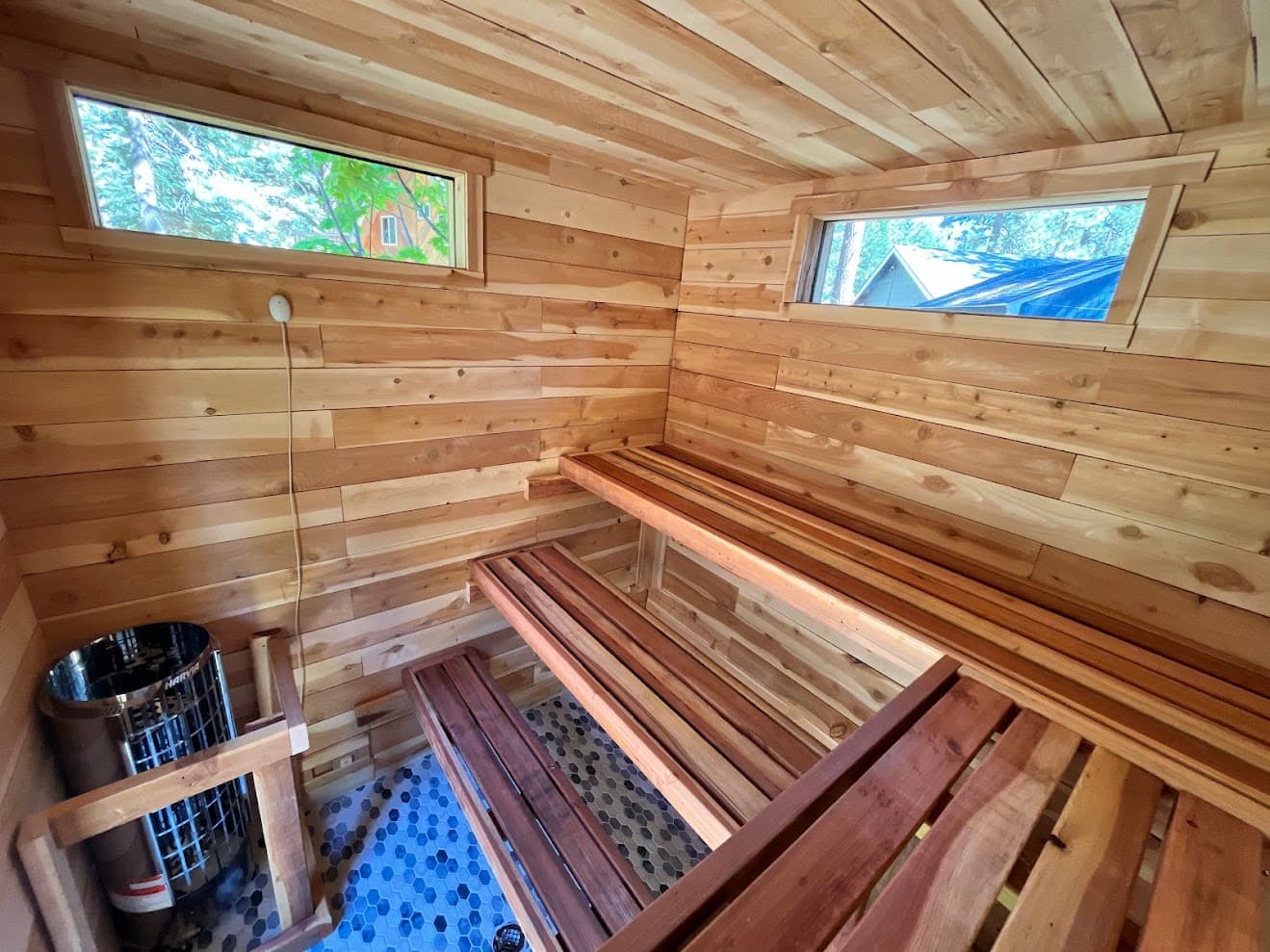
If you're a general contractor or remodeler and a client just asked about adding a sauna, you're probably in unfamiliar territory. Most GCs build one or two saunas in their entire career. The framing is straightforward. The rest — ventilation, vapor barriers, heater sizing, electrical — is where projects go wrong.
This guide covers the critical details that separate a sauna that performs from one that grows mold, overheats unevenly, or makes people feel like they're suffocating. It's written for builders who know how to frame a room but haven't dealt with the specific requirements of a 180°F environment.
We've designed saunas for dozens of residential projects — new builds, garage conversions, backyard structures, basement installs. This is what we've learned about the stuff that trips up experienced builders.
We're putting together a comprehensive PDF version of this guide with additional detail — material specs, vent sizing calculations, bench dimension diagrams, and a pre-build checklist you can use on site. Enter your email and we'll send it to you when it's ready.
Sauna framing is standard 2x4 stud construction at 16" on center. If you can frame a bathroom, you can frame a sauna. The critical difference is ceiling height.
Target 7.5 to 8 feet interior ceiling height. This isn't arbitrary — heat rises, and the goal is to get bathers' feet at or above the midpoint of the heater. If the ceiling is too low, their head is significantly hotter than their feet, which is uncomfortable and reduces the health benefits of the session.
For outdoor saunas with a pitched roof, an 8-foot interior ceiling means your exterior peak will be around 10 feet. Clients are often surprised by this. Flag it early so they can weigh it against sightlines, neighbor setbacks, and backyard scale.
For garage or basement conversions, confirm the existing ceiling height can accommodate 7.5 feet of interior sauna ceiling after accounting for insulation, vapor barrier, furring strips, and paneling. That typically eats 2-3 inches on the ceiling.
The most common residential sauna sizes and what they accommodate:
This is where most contractor-built saunas fail. A sauna operates at 170-200°F with significant moisture from water thrown on hot stones. Standard bathroom waterproofing methods don't apply here. Get the vapor barrier wrong and you'll have mold inside the walls within a year.
Use fiberglass batts or mineral wool. R-13 minimum for interior walls, R-21 or higher for exterior-facing walls, and R-30 or higher for ceilings (heat rises — the ceiling needs the most). Mineral wool is preferred if the budget allows — it's fire-resistant, moisture-resistant, and provides better sound dampening.
Do not use spray foam unless you can guarantee an impenetrable vapor barrier over it. Spray foam traps moisture if the barrier fails, and in a sauna environment, the barrier gets tested every single session.
Use non-adhesive aluminum foil sheeting — not plastic vapor barrier, not Tyvek, not poly. Aluminum foil reflects radiant heat back into the sauna (improving efficiency) and creates a true moisture barrier at the temperatures involved. Sauna Vapor Barrier | Radiant Barrier Roll
Install the foil on the warm side of the insulation (facing the interior). Overlap all seams by at least 6 inches and seal every seam with aluminum foil tape. Extend coverage to the floor and ceiling. Seal around every penetration — wires, vent holes, heater mounting hardware. Any gap is a path for moisture to reach the framing.
After the vapor barrier, install 1/4" to 1/2" furring strips over the foil, secured to studs. The interior cedar paneling mounts on top of the furring strips. This air gap serves two purposes: it prevents the paneling from trapping moisture directly against the foil, and it allows the back side of the paneling to dry between sessions.
Ventilation is the single biggest problem in North American saunas. When people say they feel like they're "suffocating" in a sauna, it's almost never the heat — it's bad air quality. Without proper ventilation, CO₂ accumulates, oxygen drops, and the sauna becomes genuinely unhealthy.
Most sauna kits have zero ventilation. Most custom-built saunas have the vents in the wrong places. Here's how to do it right.
Fresh air must enter the sauna above the heater, not below it. This is the opposite of what most North American guides recommend, and it's the single most important ventilation detail.
Place a 3-3.5" intake vent 6-12 inches below the ceiling, on the wall directly above the heater. Fresh air enters the rising convective plume from the heater, gets heated, and distributes evenly through the sauna before being exhausted. If intake air enters low (near the floor), it flows across the floor as cold air and exits without ever reaching the people sitting on the benches.
The exhaust vent goes on the opposite wall from the heater, below the foot bench. For electric saunas, this must be a mechanical exhaust — a powered inline duct blower (Fantech or similar, 4-6" ductwork). Plan for roughly 20-25 CFM per person plus 15-25 CFM for heater cooling, so about 100-125 CFM for a typical 4-person sauna.
This creates a slight negative pressure that pulls stale, CO₂-rich air out from where it collects — near the floor and breathing zone. It also keeps the foot bench hot enough to kill bacteria and mold (above 130°F). You can validate this with an Aranet4 air quality monitor — CO₂ should stay below 700 ppm during a full session.
If a powered exhaust isn't feasible (budget, wiring constraints), a basic three-hole passive system is still far better than nothing: intake near the stove at floor level, exhaust below the upper bench on the opposite wall, and a closeable drying vent near the ceiling for post-session moisture removal. Not as effective as mechanical downdraft, but a massive improvement over zero ventilation.
Heater sizing is straightforward math, but undersizing is common and the electrical requirements catch people off guard.
Calculate the room volume (length × width × height in feet) and divide by 45. That's your target kilowatt rating for a well-insulated room with wood interior paneling.
Adjust up for: outdoor/exposed walls, glass doors or windows, concrete or masonry walls, insulation below R-11, cold climates. Adjust down for extremely well-insulated rooms (R-20+ walls) or ceilings below 7 feet.
Most residential electric sauna heaters (6-9 kW) require a dedicated 240V circuit, 40-50 amp. Heaters above 10 kW typically need 60 amps. This always requires a licensed electrician. The circuit runs from the main panel to a contactor box (usually mounted outside the sauna), then from the contactor to the heater.
If the building runs 208V (common in commercial or multi-unit residential), a 240V heater will work but output drops roughly 25%. You'll need to upsize the heater to compensate. Always verify with the electrician.
Electric heaters are the most common for residential projects — easy to control, no chimney required, minimal maintenance, and most support WiFi controls. Wood-burning stoves produce a different heat quality (denser, more dynamic) and are preferred for outdoor freestanding saunas, especially in rural areas. Wood-burning requires a proper chimney, non-combustible clearances on all sides, and usually a building permit for the wood-burning appliance specifically.
Bench height is driven by the ceiling and heater position, not arbitrary preference.
The upper bench should be 40-48 inches below the ceiling. The middle bench sits 16-20 inches below the upper. A lower bench or step sits another 16-20 inches below that. The goal is to get bathers up into the hottest zone of the sauna, with their feet at or above the top of the heater stones.
Upper benches should be 24 inches deep (five 2x4 slats with 1/2" spacing). Lower benches can be 16 inches (three 2x4 slats). Allow 18-24 inches of width per person on the upper bench. All bench material should be redwood or cedar 2x4s — these species handle heat and moisture without becoming too hot to sit on.
Western red cedar tongue-and-groove is the standard for interior paneling. It's naturally resistant to moisture and decay, smells great, and handles the temperature swings. Hemlock and aspen are solid alternatives at a lower price point. The paneling goes over the furring strips, creating that air gap behind the wood.
After designing saunas across dozens of projects, these are the problems that come up repeatedly — almost always from builders who are skilled at their craft but building their first sauna.
If you've got a sauna project on the table and want someone to handle the design side — heater sizing, ventilation layout, bench plans, materials list — that's what we do. You send us dimensions, photos, and budget. We send back a complete design package your crew can build from.
You keep the construction revenue. We handle the expertise. Learn more about how we work with contractors, or email us your project details.
Trusted by homeowners across Tahoe and beyond
12 decisions that determine how well your sauna performs — insulation, bench height, heater sizing, ventilation, and more.
Have questions about your project? Send us a message or schedule a free 15-minute intro call.
Schedule a free 15-minute intro call or send us a message about your project.
We'll learn about your space, goals, and timeline — and recommend the right next step for your project.