Location determines whether your sauna is a convenient daily ritual or an inconvenient afterthought. Beyond aesthetics, the site affects thermal performance, safety, drainage, electrical installation cost, and year-round accessibility.
This guide covers the practical and aesthetic considerations for sauna placement.
Site Selection: Key Criteria
1. Level Ground (or Easily Level-able)
Your sauna needs a level or near-level foundation. Uneven ground causes structural stress, affects door function (they won't seal properly if the frame is twisted), and looks awkward.
What counts as "level"?
- Perfectly flat: Ideal, requires minimal prep
- Slight slope (1-2%): Acceptable, easily corrected with minimal grading
- Moderate slope (3-5%): Feasible, but requires site grading or filling
- Steep slope (>10%): Challenging, may require retaining walls, deck framing, or helical piers
For most residential lots, there's usually a spot where the ground is naturally level or nearly so. Prioritize this.
2. Access to Electrical
Electric saunas (and many wood-burning saunas with electric controls or optional heating) need power. Distance from your main electrical panel affects installation cost.
Electrical Considerations:
- Sauna within 50 feet of panel: Relatively simple trenching, moderate cost ($1,000-2,000)
- 50-100 feet away: Longer run requires conduit, more labor ($2,000-3,500)
- 100+ feet away: Very expensive, may require a sub-panel ($3,500-6,000+)
Consider electrical distance early in the planning phase. It can be a cost driver and may influence final location choice.
For wood-burning saunas: No electrical hookup is required, but if you want electric controls or backup heating, plan accordingly.
3. Good Drainage
Your sauna site should naturally drain or have drainage accommodated. Standing water around the sauna leads to wet wood, rot, and pest problems.
Drainage Assessment:
- Does water pool in this spot during rain? If yes, avoid it or plan drainage improvements.
- Is the site at the bottom of a slope? Water runs to low points. A sauna at the bottom of a hill may collect runoff.
- Is the soil sandy/permeable or clay/dense? Sandy soil drains naturally. Clay holds moisture and requires deliberate drainage planning.
Drainage Solutions:
- Site elevation: Build the sauna on a slight mound or raise the foundation 6-12 inches above surrounding grade
- French drain or dry well: Dig a perforated trench around the site to collect and disperse water ($500-1,500)
- Slope grading: Grade the surrounding terrain away from the sauna, creating a gentle slope for runoff
- Permeable paving: Use gravel, pavers on sand, or permeable pavement around the sauna
4. Proximity to House
In cold weather, you'll be damp and warm after a sauna session. Walking far to reach shelter is uncomfortable. Ideally, your sauna is within 50-100 feet of a door to the house, or closer if possible.
A covered pathway or transition space is even better, protecting bathers from rain or snow between sauna and house.
Exception: In warm climates, proximity matters less since you're not rushing inside to escape cold.
5. Views and Ambiance
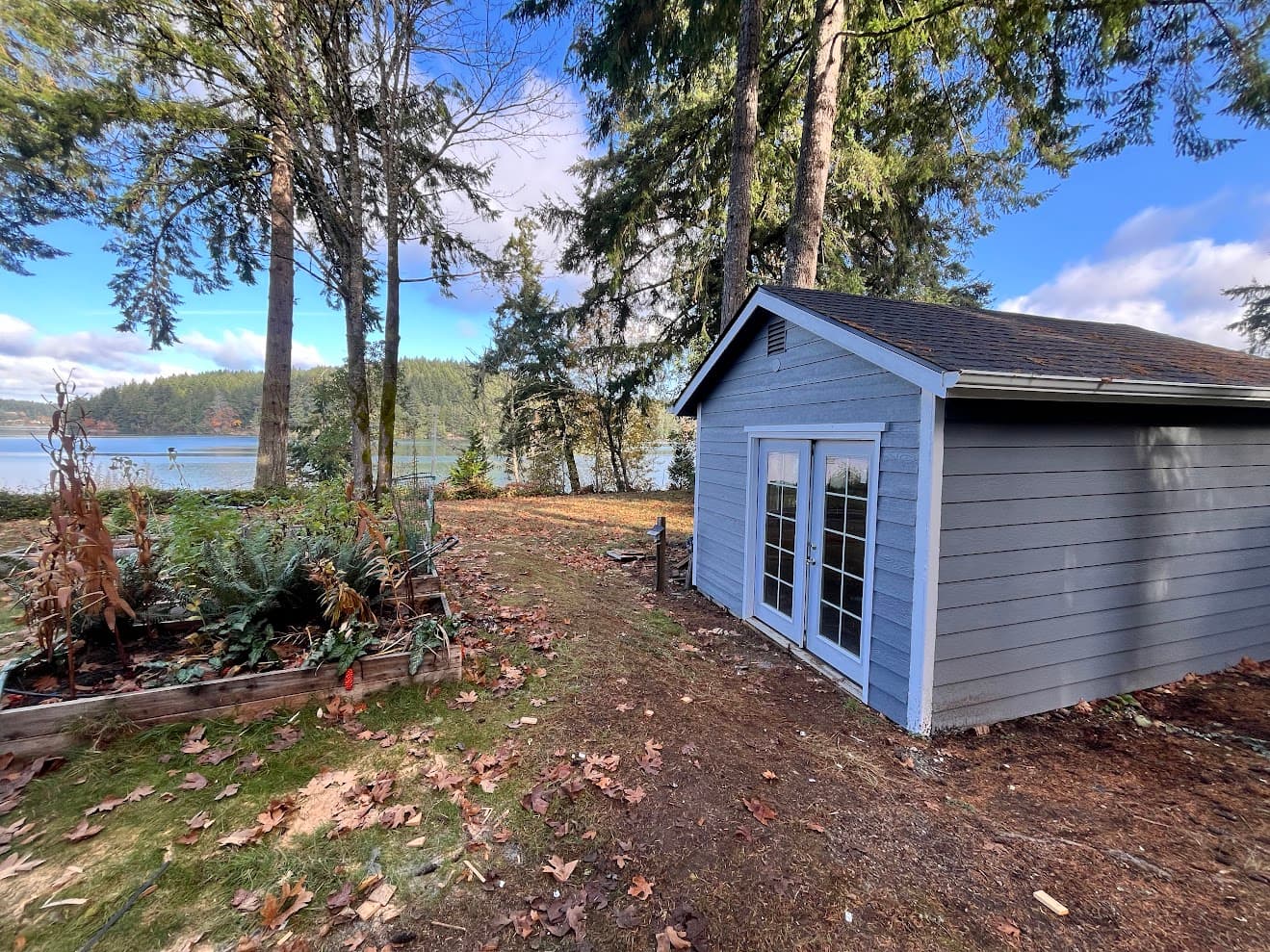
If possible, orient your sauna toward pleasant views. A sauna positioned to overlook your garden, trees, or landscape is more enjoyable than one facing a fence or your neighbor's house.
Sauna with a window (even a small one) allows you to enjoy the surrounding landscape while bathing. This adds immensely to the experience.
6. Privacy from Neighbors
Consider sightlines from neighbors' properties. A sauna exterior, while innocuous to you, may be visible to neighbors, especially if your lot is higher or the sauna is positioned prominently.
Privacy solutions:
- Vegetation screening: Evergreen trees or hedges block sightlines (plant 1-2 years before building to have established screens)
- Position the sauna: Place it on the far side of your property or in a depression where it's less visible
- Fence or trellis: A fence or slatted trellis on neighbor-facing sides creates partial screening
- Blend the design: A sauna that matches your house color/materials is less visually striking than a contrasting color
7. Chimney Clearance (For Wood-Burning)
If you're building a wood-burning sauna, the chimney can reach 15-20+ feet in height depending on roof pitch. This impacts placement.
- Overhead clearance: Ensure no tree branches or structures will interfere with the chimney stack
- Neighbor impact: Smoke and chimney visibility affect neighbors. A chimney 20 feet tall is visible from far away.
- Wind patterns: Consider prevailing wind direction so smoke doesn't blow toward neighbor properties or your house
Foundation Options
Option 1: Floating Deck (Most Common)
A floating deck is a simple, cost-effective foundation suitable for most sauna builds.
Design:
- Material: Pressure-treated 2×10 or 2×12 joists on concrete piers (or deck blocks)
- Piers: Concrete piers spaced 4-6 feet apart, frost-protected (below frost line if in a cold climate)
- Height: Typically 12-18 inches above grade
- Subfloor: Pressure-treated decking or plywood atop the joists
Advantages:
- Inexpensive ($1,500-3,000 for a 6×8 deck)
- Quick installation
- Good drainage underneath
- No digging (minimal site disruption)
Disadvantages:
- Not appropriate for very uneven ground (requires leveling)
- May need adjustments over time if piers settle
Option 2: Concrete Slab
A poured concrete slab provides a solid, long-lasting foundation.
Design:
- Thickness: 4 inches minimum (6 inches in cold climates with freeze-thaw cycles)
- Preparation: Gravel base, vapor barrier, reinforcement mesh or rebar
- Frost protection: In cold climates, the slab should sit below the frost line or have protected edges
Advantages:
- Very durable (50+ years)
- Level, solid base
- Good for very uneven terrain
- Allows integrated drainage or floor features
Disadvantages:
- More expensive ($2,500-5,000 for 6×8 slab)
- Longer installation (requires excavation, curing time)
- In cold climates, freeze-thaw can cause cracking without proper preparation
Option 3: Helical Piers (For Steep or Poor Soil)
For very steep slopes, poor soil, or challenging terrain, helical piers (large metal screws twisted into the ground) provide a solid, adjustable foundation.
Advantages:
- Works on slopes up to 45 degrees
- Can be adjusted to level a sauna on very uneven ground
- Good for poor soil conditions
Disadvantages:
- Most expensive option ($3,000-6,000+)
- Requires specialized equipment and expertise
- Not necessary for most residential sites
When to use helical piers:
Only if your ideal sauna location has significant slope or poor soil, and you've exhausted other options. For most residential lots, a floating deck or concrete slab is sufficient.
Trusted by homeowners across Tahoe and beyond
Orientation and Seasonal Considerations
Orientation for Winter Sun (Northern Hemisphere)
If you want passive solar benefit during winter (warming the sauna exterior, improving ambiance), orient the main face of the sauna toward south or southwest. This isn't critical but is a nice bonus.
In cold climates: Solar warming of the sauna exterior can slightly reduce heating costs. The effect is modest but worth considering.
Wind Exposure
A sauna exposed to constant strong winds loses heat faster and can be uncomfortable to access. If your site is very windy, consider:
- Windbreak vegetation (evergreen trees or hedges)
- Building near existing structures or topography that provides shelter
- Improving the sauna's insulation to compensate
Winter Access
In snowy climates, plan how you'll access the sauna in winter. A sauna on a deck with steps is easier to navigate through snow than one directly on the ground. Consider:
- A cleared walkway or shoveled path from house to sauna
- Raised deck design for easier snow clearance
- Roof overhang to shed snow away from the door
Property Line and Building Code Compliance
Setback Requirements
Your local building code specifies how far a structure must be from property lines. Common setbacks are:
- Front setback: 25-50 feet from the road
- Side setback: 5-10 feet from side property lines
- Rear setback: 5-10 feet from rear property lines
Check your local code before finalizing location. Building without compliance can result in forced removal.
Some jurisdictions treat a detached sauna as a "structure" requiring full code compliance. Others classify small saunas (under 200 sq ft) as "accessory structures" with relaxed requirements.
Easements and Utilities
Before choosing a location, verify:
- Underground utilities: Call 811 (Dig Safe) to locate buried electric, gas, water, and sewer lines
- Easements: Check your deed for easements that may restrict building in certain areas
- HOA restrictions: If you live in an HOA community, confirm the sauna is permitted and review any design guidelines
Permits and Inspections
Most jurisdictions require a building permit for outdoor saunas. The permitting process involves:
- Submitting plans and specifications
- Review by the building department
- Site inspection before and after construction
- Final sign-off
Cost: $200-500 for the permit itself. Do not skip this step. An unpermitted structure can create problems when you sell the house or if an accident occurs.
Cold Plunge or Cooling Area
If you're interested in traditional sauna practice (heat session followed by cold plunge), plan for this during site selection.
- Cold plunge pool: A small soaking pool (2-3 feet deep, 4×6 or larger) positioned 10-20 feet from the sauna
- Natural water: If you have a lake, pond, or creek nearby, this is ideal
- Cold shower: An outdoor shower near the sauna provides cold water without a separate pool
- Space allowance: If considering a plunge in the future, ensure your sauna location leaves room for it
This is a nice-to-have, not essential, but worth planning for.
Sauna Placement Checklist
- Level ground: No more than 5% slope without major site work
- Electrical access: Within 50 feet of main panel if possible
- Drainage: No standing water in this location
- Distance to house: 50-100 feet (or less for convenience)
- Views: Pleasant sightlines if possible
- Privacy: Screened from neighbors if important to you
- Chimney clearance: No overhead obstructions (if wood-burning)
- Setbacks: Complies with local building code
- No utilities: Verified no underground lines in the location
- Access: Easy access in winter and poor weather
- Permits available: Confirmed with your building department that a sauna is allowed