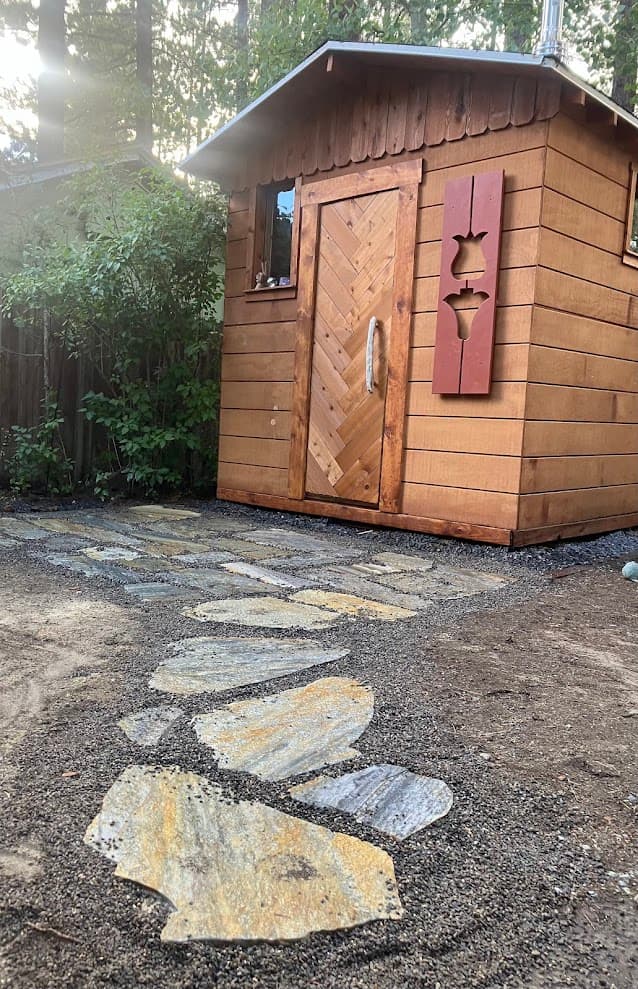
Shed to Sauna Conversion Plans — Turning a Shed Into a Sauna
Converting an existing shed is one of the most cost-effective ways to get a real, custom sauna — and good shed to sauna conversion plans start with an honest look at the structure you already have. A shed gives you a head start: the frame, the roof, and often the floor are already built. But a shed was built to keep tools dry, not to hold 190°F and shed moisture for years, so the conversion is really about building a proper insulated, sealed sauna envelope inside the existing shell. Done right, you end up with a custom sauna for a fraction of a ground-up build. Done without a plan, you end up with rot, heat loss, and a sauna that never gets hot enough.
Here's what a shed conversion involves and the real two-room build our plans are based on.
Start by Assessing the Shed
Before any insulation goes in, the conversion lives or dies on the existing structure. A good plan starts here.
Check the roof and walls for leaks and rot, and repair anything soft before you build over it — sealing a problem inside a finished sauna wall is a guaranteed callback. Confirm the ceiling height gives you 7.5-8 feet of interior sauna ceiling after you frame a flat ceiling below the roof slope; a flat interior ceiling is non-negotiable for even heat, regardless of the roof pitch above it. And look at the floor: a shed floor may need reinforcing or a moisture-proof finish before it can take a tiled, drained sauna floor.
If the bones are good, the rest is a build sequence. If they're not, the plan tells you what to fix first.
What Shed to Sauna Conversion Plans Cover
Once the structure checks out, the conversion is about turning a dry-storage box into a sealed, insulated hot room. Solid shed to sauna conversion plans specify each piece:
- Insulation in the wall and ceiling cavities — R-21+ walls and R-30+ ceiling for a sauna that holds heat
- A continuous aluminum vapor barrier on the warm side, seams sealed, so moisture never reaches the shed's framing
- A flat interior ceiling framed below the roofline
- Cedar tongue-and-groove interior over furring strips for an air gap
- The three-hole ventilation path — intake high near the heater, exhaust low on the opposite wall, and a closeable drying vent for after sessions
- A tiled floor over a moisture barrier, sloped to a drain if you want one
- A licensed-electrician 240V circuit for the heater
The moisture detailing matters more in a shed than almost anywhere, because you're wrapping a sauna inside a structure that wasn't built for wet heat. Our sauna ventilation guide explains the airflow that keeps it dry between sessions.
Trusted by homeowners across Tahoe and beyond
The 11x16 Two-Room Conversion
The build our plans are based on is an 11x16 shed in Olympia, Washington, converted into a custom two-room sauna — a dedicated hot room with a Harvia KIP 80 WiFi heater, plus a separate changing room for cooling down between rounds. It has a cedar interior, a tile floor with a drain, and seats six. Olympia's cold, wet climate is the hardest case for sauna longevity, so the build leans hard on insulation and ventilation with post-session drying. You can see it in our shed-to-sauna case study.
The two-room split is what a larger shed makes possible — the same idea as our 8x12 sauna plans, where a changing room gives you somewhere dry to cool down and keeps the hot room cleaner and holding heat. A smaller shed can skip the second room and run a single hot room like our 8x8 plans.
Frequently Asked Questions
How much does it cost to convert a shed into a sauna?
It depends on the shed's size and condition, but a conversion is typically cheaper than building from the ground up because the structure already exists — figure materials in the $2,000-6,000 range for most builds, plus electrical. The big variable is whether the shed needs repairs before you start. Price your build with our free materials calculator.
Can any shed be converted into a sauna?
Most can, if the structure is sound and the ceiling is tall enough. You need a roof and walls without rot, room for a 7.5-8 foot flat interior ceiling, and a floor that can take a tiled, occasionally wet surface. Repair any rot before building, and confirm you can run a 240V circuit to it.
Do I need to insulate a shed before turning it into a sauna?
Yes, completely. A shed is built for storage, not for holding 180-200°F. You'll insulate the walls and ceiling, add a continuous vapor barrier on the warm side, and finish with cedar over furring strips. Without insulation the sauna won't reach temperature or hold it, and without the vapor barrier moisture will rot the shed's framing.
How long does a shed sauna conversion take?
For a DIY builder, plan on several weekends — the structure is there, but insulation, vapor barrier, interior finish, electrical, and ventilation all take time to do right. A contractor typically completes a conversion in a few weeks.
Get Started on Your Shed Conversion
A dedicated shed-to-sauna conversion plan is on the way — you can get notified when it launches and we'll email you when it's ready. While you're planning, the parts that decide whether a conversion succeeds are covered now: The Sauna Building Guide details insulation, vapor barrier, and ventilation phase by phase ($19), and the free materials calculator prices your specific build. If you want us to design the conversion around your actual shed, a design consultation is the place to start.