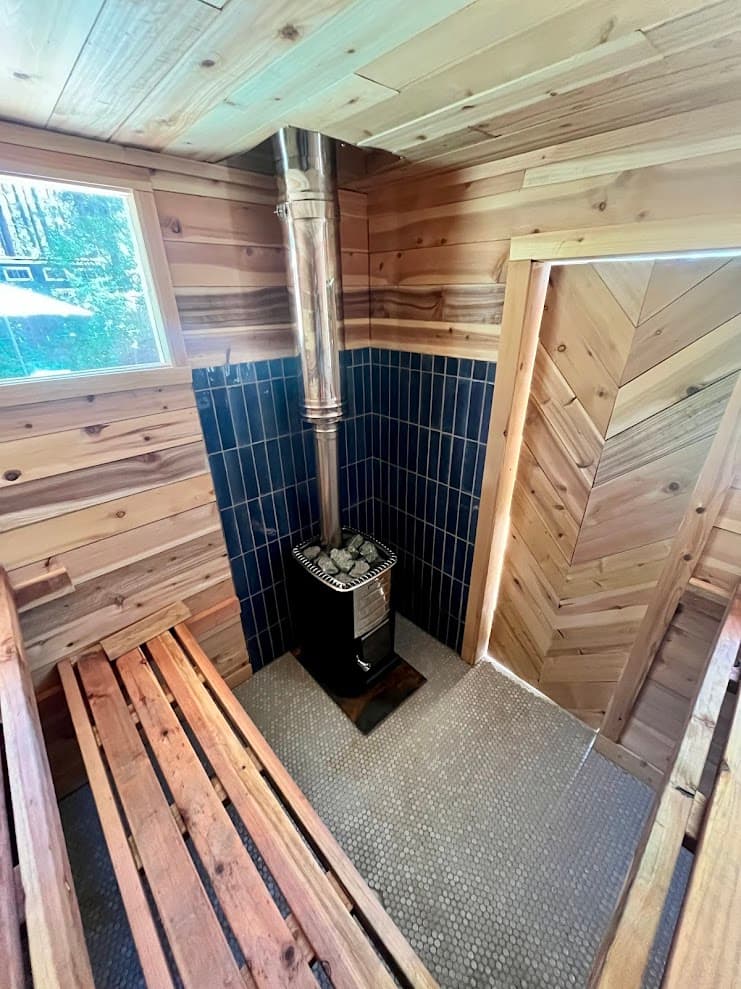
Sauna heater stones are more critical than they first appear. The wrong stones will crack, spall, and fail within months. The right stones, properly maintained, last years and create exceptional löyly.
This guide explains stone types, why certain rocks fail, proper placement, and maintenance practices that ensure your sauna performs reliably.
The Right Stones: Olivine Diabase and Peridotite Only
Only two types of rock are suitable for sauna heater stones: olivine diabase and peridotite. This is not negotiable. Any other stone will crack, shatter, or fail under the thermal cycling that sauna creates.
Olivine Diabase (Recommended)
Olivine diabase is the primary choice for sauna stones. It's a dark-colored volcanic rock composed of olivine and pyroxene minerals.
Properties:
- Color: Dark gray to black
- Density: High thermal density, excellent heat retention
- Durability: Withstands thousands of heat cycles (180-200°F swings) without cracking
- Thermal conductivity: Heats quickly and distributes heat evenly
- Availability: Widely available from sauna suppliers
Most commercial sauna suppliers ship pre-screened olivine diabase specifically selected for sauna use. This is the standard choice globally.
Peridotite (Alternative)
Peridotite is another suitable stone, less common than olivine diabase but equally durable. It's a coarse-grained igneous rock composed primarily of olivine.
Properties:
- Color: Green to olive tones (lighter than diabase)
- Thermal properties: Similar to olivine diabase
- Durability: Equally reliable over thermal cycles
- Availability: Less commonly available than olivine diabase
If olivine diabase is not available, peridotite is a viable alternative. Both rocks achieve the goal: reliable heat storage and soft löyly production.
Why River Rocks and Granite FAIL in Saunas
A common mistake: using river rocks, creek stones, or rocks collected from the landscape. These will absolutely fail. Here's why:
River Rocks and Creek Stones
River rocks are rounded, smooth, and often porous. The smoothness is from years of water erosion, and the composition is varied — sedimentary, metamorphic, and igneous rocks mixed together.
Why they fail:
- Porous composition: They contain air pockets and moisture. When heated rapidly, the moisture turns to steam and explodes the rock from the inside out — a phenomenon called spalling.
- Mixed mineral composition: Different minerals expand at different rates when heated. This creates stress and cracking along grain boundaries.
- Low thermal resistance: River rocks are not engineered for thermal cycling. They crack after dozens or hundreds of heat cycles.
- Safety hazard: Exploding rocks can shoot sharp fragments into the sauna space — dangerous to occupants.
River rocks may look attractive and be free, but they will fail catastrophically within weeks to months. This is not a cost-saving opportunity; it's a safety and reliability liability.
Granite
Granite is a popular building stone, but it's unsuitable for sauna heater applications.
Why granite fails:
- Quartz content: Granite contains quartz, which has a different thermal expansion rate than the feldspar and mica also present. This creates cracking.
- Thermal cycling stress: Granite is engineered for building exteriors (stable temperature), not the rapid 200°F+ swings sauna creates.
- Low porosity: While this is generally good, granite's specific mineral composition makes it brittle under rapid thermal stress.
- Visible failure: Granite begins to crack visibly within weeks of sauna use. The cracks are irreversible.
If you have granite countertops in your home, don't assume it's suitable for sauna. The context is completely different.
The Physics of Stone Failure
Sauna stones experience extreme thermal cycling. An electric or wood-burning heater raises stone temperature from ambient (50-70°F) to 180-200°F in 30-90 minutes. When you pour water on the stones, the surface drops 50-100°F instantly, while the interior remains hot. This creates uneven stress.
Only stones with:
- Uniform mineral composition (no mixed minerals expanding at different rates)
- High thermal conductivity (heat distributes quickly from surface to core, minimizing stress)
- Low porosity (no air pockets that cause internal steam explosions)
- High thermal fatigue resistance (engineered to withstand thousands of cycles)
...will survive sauna conditions reliably. Olivine diabase and peridotite meet all these criteria. River rocks, granite, and most other stones do not.
Stone Size, Shape, and Thermal Mass (Trumpkin Research)
Ideal Stone Size and Type
Stone size has a direct impact on thermal performance and löyly quality. Research from Trumpkin/localmile.org provides specific guidance:
- Optimal range: 5-15 cm (2-6 inches), most commonly 4-8 cm (1.5-3 inches)
- Too small (<1 inch): Heat unevenly, don't provide adequate thermal mass; steam quality suffers
- Too large (>6 inches): Difficult to pack densely, heat slower to core, higher crack risk, reduce surface area for steam generation
- Optimal (4-8 cm): Best balance of thermal mass, heat absorption speed, steam generation, and packability
Shape Matters for Steam Quality
Rough, irregular surfaces are preferred over smooth stones. Rough surfaces hold water longer and generate better steam quality.
Why surface roughness matters (Source: Trumpkin):
- Rough surfaces provide more area for water to absorb and convert to steam
- Water pools briefly in surface irregularities, extending the vaporization time (soft löyly instead of harsh steam)
- Smooth, polished stones shed water too quickly, creating harsh steam spikes
When sourcing stones, specifically request rough, naturally-textured olivine diabase or peridotite. Avoid polished or smooth stones.
Stone Mass Targets (Critical for Löyly)
This is the game-changer: The total mass of stones in your heater directly determines löyly quality. Most North American heaters fall far short of ideal standards.
Target stone mass by sauna volume (Source: Trumpkin/localmile.org):
- Minimum acceptable: 6 kg/m³ of sauna volume (~0.4 lbs per cubic foot)
- Better: 8 kg/m³
- Excellent/ideal: 10-12 kg/m³ (~0.6-0.75 lbs per cubic foot)
- Premium (smoke saunas): 15-90 kg/m³ (far more mass for slow, stable heat)
Example: An 8×8×8 sauna (512 cu ft) should have approximately:
- Minimum: 205 lbs of stone (6 kg/m³)
- Better: 273 lbs (8 kg/m³)
- Excellent: 307-410 lbs (10-12 kg/m³)
Most standard wall-mounted electric heaters hold only 50-100 lbs — achieving only 2-5 kg/m³. This is why many North American saunas have harsh, unsatisfying löyly compared to Finnish or European saunas.
Stone Placement and The Löyly Cavity (Trumpkin Design Principle)
The Löyly Cavity Concept
The löyly cavity is the heated zone in the sauna where bathers sit and experience the convective heat and steam. Proper stone placement creates and maintains this cavity. This is a critical design principle often missed in North American saunas.
Design principle: Benches must elevate bathers into the löyly cavity — the zone above the heater where convective heat has distributed evenly. Bathers sitting too low (below this zone) experience poor stratification, weak steam delivery, and the notorious "cold feet" problem.
The stone arrangement directly affects whether the löyly cavity exists and functions properly. Loose packing and proper depth ensure convective heat flows evenly to where bathers are positioned.
Loose Packing (Essential for Löyly)
Stones should be loosely packed, not tightly stacked. Loose packing allows hot air from the heater element to circulate around and between all stones, distributing heat evenly.
Arrangement guidance (Source: Trumpkin):
- Packing density: Drop stones in naturally; aim for small gaps throughout the pile, not a compacted mass
- Orientation: Flat side up, slightly tilted toward heater center
- Air circulation: Ensure convective heat flows freely from bottom to top through the entire stone bed
Depth Above Heating Elements (Critical)
Minimum 35cm (14 inches) of stone depth above the heating elements. This depth is critical for two reasons:
- Steam quality: Water converts fully to steam before reaching the heater casing. Shallower arrangements cause water to splash directly on hot steel, creating harsh, stale-smelling steam instead of soft löyly.
- Thermal performance: Adequate depth ensures all stones reach proper temperature; stones near the heating element are much hotter than those on the surface, which is normal and desired.
Height and Total Arrangement
- Typical height: Stones pile 12-18 inches (30-45 cm) above the heater element, depending on depth needed and heater design
- Containment: Stones sit on a grate or metal framework above the heating element, with smaller stones filling gaps to prevent shifting
- Grate design: The grate must allow steam to rise through; solid or blocked grates restrict convection and create dead zones
When Not to Use Rocks (Finnish Smoke Sauna)
In a traditional Finnish smoke sauna (savusauna), rocks are heated by the fire itself but not directly stacked on a heater element. Instead, they sit loose in the sauna space, heated by ambient air and flames. This is a different arrangement and works well in that context.
For modern electric or wood-burning saunas, the tight arrangement around the heater element is standard.
Stone Thermal Properties and Löyly Quality
The goal of sauna stones is to create thermal capacitance — the ability to absorb and retain heat, then slowly release it when water is poured.
How Stones Improve Löyly
- Without sufficient stones: Water poured on the heater element vaporizes instantly, creating a sharp, harsh steam and an abrupt temperature spike. The experience is uncomfortable — intense but not pleasant.
- With adequate stones: Water absorbs into the stone mass, vaporizing slowly and continuously. This creates a gentle, rolling steam (soft löyly) where the temperature remains stable and the humidity rises gradually.
More stones = softer, more luxurious löyly. This is why premium sauna heaters (like HUUM Hive) hold 200-300+ lbs of stones. The extra mass creates exceptional löyly quality.
Stone Loss During Use
Every time you pour water on stones, a small amount of material spalls off (tiny fragments break loose). Over months and years, the stone mass gradually decreases. This is normal and expected.
Annual inspection and replacement of lost stones keeps the thermal mass consistent and löyly quality high.
Annual Maintenance and Inspection
What to Inspect
Once a year (or more frequently in heavily used saunas), perform a visual inspection of the heater stones.
Signs of Failure:
- Visible cracks: Radial or branching cracks through a stone indicate stress and failure
- Spalling or chunks missing: Small pieces broken away from stone surfaces
- Discoloration or whitening: May indicate chemical breakdown or mineral separation
- Round, smooth pebbles (river rock): If you somehow have these, replace them immediately
Stone Replacement
Replace any stone showing signs of cracking or spalling. These stones will continue to deteriorate and may eventually explode (though rare, it's a safety concern).
How to replace:
- Allow the sauna to cool completely
- Remove failed stones from the heater
- Inspect remaining stones for hidden damage (look at all sides, not just what's visible from above)
- Add new olivine diabase stones to restore lost thermal mass
- Loosen-pack the new stones among existing ones, ensuring air circulation
- Run an empty sauna cycle (no water) to ensure new stones heat uniformly
Cost of replacement stones: $1-2 per pound. A typical sauna uses 100-150 lbs of stones, so full replacement costs $100-300.
Overall Loss Rate
With proper olivine diabase or peridotite stones, you might lose 5-10% of the stone mass per year in a frequently-used sauna (2+ sessions per week). In an infrequently-used sauna, loss is minimal.
This is normal. It means your stones are doing their job and creating löyly.
Sourcing Sauna Stones
Recommended Suppliers
Rather than sourcing stones locally, buy pre-screened sauna stones from sauna equipment suppliers. They are:
- Pre-tested for thermal durability
- Sized appropriately for sauna heaters (2-4 inches)
- Guaranteed to be olivine diabase or peridotite
- Often cheaper than trying to source locally and verify
Major sauna heater manufacturers (Harvia, HUUM, EOS, etc.) sell replacement stone kits. Cost: $2-4 per pound delivered.
What to Avoid
- Local river rocks or landscape stones: These will fail. Don't use them.
- Unverified online sources: If the vendor doesn't explicitly state the stone type (olivine diabase or peridotite) and thermal properties, skip them.
- "Sauna rocks" from general retailers: Some hardware or outdoor suppliers sell stones labeled "sauna rocks" that are not suitable. Always verify composition.
Stone Cost and Lifespan
Initial Cost
- 100 lbs (typical home sauna): $200-300 initial stones
- 150 lbs (larger sauna or premium setup): $300-450
- 300 lbs (luxury setup with HUUM Hive or similar): $600-900
Replacement and Maintenance
Budget $50-150 per year for stone replacement and maintenance in a regularly-used sauna. Over the 20-30 year lifespan of a sauna structure, this is minimal.
Lifespan
Properly selected olivine diabase or peridotite stones last indefinitely in a sauna. They don't wear out in the traditional sense; they gradually spall and decrease in mass over years. Replacement is a normal, manageable maintenance task.
Summary: Stone Selection and Maintenance
- Use only olivine diabase or peridotite. No exceptions.
- Never use river rocks, granite, or landscape stones. They will fail catastrophically.
- Select 2-4 inch stones, irregular shape, loosely packed. This arrangement provides optimal heat distribution and soft löyly.
- Inspect annually for cracks, spalling, or visible failure. Replace any failed stones.
- Budget for gradual stone replacement. This is normal maintenance, not a sign of failure.
- More stones = better löyly. If your sauna's löyly feels harsh or inconsistent, adding more thermal mass (more stones) improves the experience.
Ready to Build Your Sauna?
Get the stones right, and you'll enjoy reliable, exceptional löyly for decades.
Start the Design Process