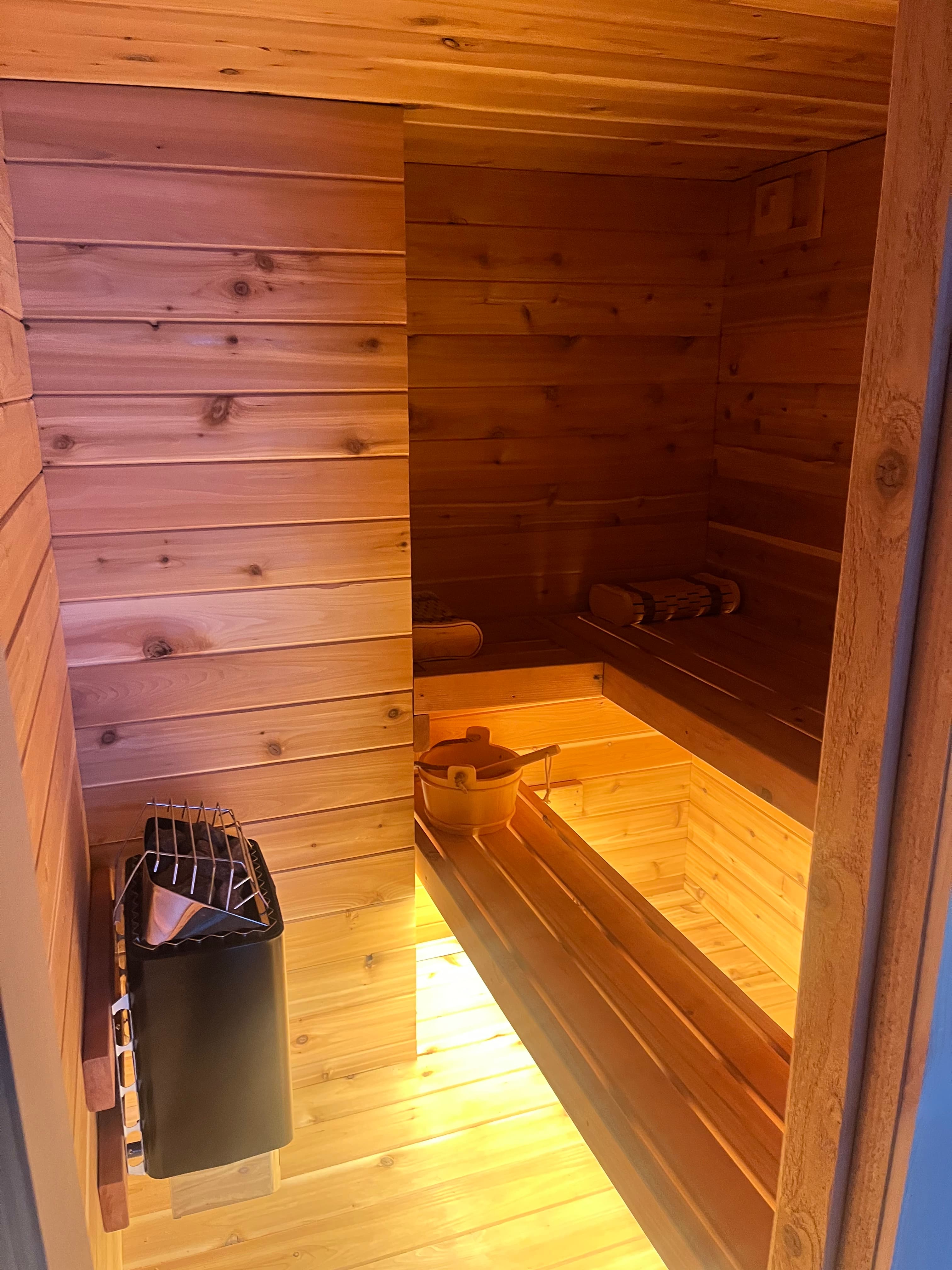
The heater is the heart of your sauna. It determines how quickly the space heats, how well temperature is controlled, how the sauna feels, and ultimately how much you'll enjoy using it. Choosing the right heater requires understanding the three main categories: electric, wood-burning, and gas — and knowing how each one performs in your specific situation.
This guide walks through the options, brands, sizing, and the tradeoffs you need to understand. We'll focus on what actually matters for home saunas, because most of the hype in the market is marketing, not engineering.
Not all sauna heaters are created equal, and price generally correlates with stone capacity, build quality, and controls. Here's how the market breaks down:
At this range you get reliable heaters from established brands — not no-name imports. The Harvia KIP series ($700–$900) is our go-to budget recommendation. Built-in controls, 6–9 kW options, 50–60 lbs of stone capacity. It heats a 6×8 sauna in 25–35 minutes and produces decent löyly. The Finlandia FLB series ($800–$1,000) is another solid option with a 10-year warranty.
What you give up: Stone capacity is limited (50–80 lbs vs 150+ lbs in premium units), which means shorter steam bursts and faster temperature drops after throwing water. Controls are basic — no WiFi, no app. But for a home sauna used 3–5 times per week, these do the job well.
This is the sweet spot for most home builders. The Harvia Cilindro ($1,400–$1,800) holds 120+ lbs of stones in a floor-standing cylindrical design — dramatically better löyly than wall-mounted budget heaters. The HUUM HIVE Mini ($1,500–$2,000) is a design-forward option that looks stunning and holds 100+ lbs of stones.
At this tier you also get WiFi-capable controllers. The Harvia Xenio WiFi controller ($300–$500 add-on) lets you preheat your sauna from your phone. Saunum's Climate Equalizer ($1,800–$2,500) is unique — it's a secondary system that redistributes heat to eliminate the cold-feet/hot-head stratification problem.
Our recommendation: If budget allows, spend here. The jump from 60 lbs of stones to 120+ lbs transforms the sauna experience. Löyly lasts longer, temperatures recover faster, and the whole room feels more even.
Premium heaters are about stone mass, build quality, and the löyly experience. The HUUM DROP ($2,500–$3,500) holds 150+ lbs of stones in a sculptural teardrop design — it produces some of the best löyly available from an electric heater. The EOS S-Line ($3,000+) is the commercial gold standard, and the EOS Invisio ($3,500+) hides completely under the bench for a clean, stones-only visual.
For wood-burning enthusiasts, the Lamppa BluFlame ($3,000+) is the finest wood stove available — a gasification design that burns clean, heats fast, and produces exceptional steam quality.
Who should spend here: People who sauna daily, want the best possible löyly, or are building a commercial/rental sauna where experience quality drives repeat business. For an Airbnb sauna or a dedicated sauna room in a custom home, the premium is justified.
Electric heaters (Select Saunas | Amazon) dominate the North American sauna market — roughly 80–90% of home sauna installations use electric. They're the simplest to install, require no chimney or venting, and offer precise temperature control.
Sizes range from 1.7kW (small home units) to 72kW (commercial). The baseline sizing rule: calculate 1kW of heating capacity per 45 cubic feet of sauna interior. So a 6×8 foot sauna with 8-foot ceiling (384 cubic feet) needs roughly 8.5kW.
Important note: Most residential electric heaters in the 6–9kW range require a dedicated 240V circuit with 40–50A capacity. This means running new electrical service if you don't already have it, and hiring a licensed electrician. Installation cost: $1,500–$3,000.
An electric sauna heater is a wall-mounted box containing three to four heating elements powered by 240V (or 208V in commercial settings). Inside the box, typically 40–50 lbs of rocks sit on a grate above the elements. When you turn on the heater, the elements warm the rocks. The hot air rises into the sauna chamber. When you throw water on the rocks (called "throwing löyly"), the water vaporizes and creates the characteristic sauna humidity and steam.
Control ranges from basic on/off switches to programmable digital controllers with temperature and timer displays. Wi-Fi-enabled heaters let you preheat your sauna from your phone.
The rocks in your heater are not decorative — they're the thermal flywheel of your sauna. Rock mass directly determines löyly quality, heat consistency, and comfort. This is the single most overlooked factor in North American sauna selection.
Rocks store heat and release it slowly, which creates soft, even löyly release. More rocks = softer, more luxurious, more evenly-distributed steam.
Important distinction (Source: Trumpkin): Only stones touching the heater's heat exchange surface matter for thermal transfer. Decorative stones on the outside contribute less to löyly quality than interior stones that directly contact hot air. When comparing heaters, ask specifically about functional stone mass, not total stone count.
Use only olivine diabase or peridotite — these are stable at sauna temperatures and resist cracking. Never use river rocks, granite, or landscape stones; they can explode from thermal stress.
Optimal stone size: 4–8 cm (1.5–3 inches), rough/irregular surface preferred. Loose packing (not compacted) allows convective heat to distribute evenly.
Minimum depth: 35 cm (14 inches) of stone above heating elements. This ensures water converts to steam before reaching the heater casing, creating soft löyly instead of harsh steam.
Trusted by homeowners across Tahoe and beyond
Beyond standard electric heaters, there are a few specialized variants worth knowing about:
Wood-burning sauna heaters are traditional and deliver a different kind of thermal experience. The heat signature is denser and more dynamic — you get sharp temperature swings and more humidity per throw. Many sauna users prefer it for the ritual and the thermal sensation.
Requirements are more complex than electric:
Rock capacity is significantly larger than electric heaters — typically 100–300+ lbs, depending on stove size. This larger mass creates the characteristic wood-fired thermal experience: slower heat-up (45–90 minutes vs. 20–30 for electric) but more sustained and even heat once up to temperature.
Wood-fired stoves are best for outdoor/freestanding saunas in rural settings where chimney installation is practical and code compliance is manageable.
Gas heaters (propane or natural gas) heat very quickly and maintain temperature well. They're excellent for commercial saunas, public facilities, and large rooms (600+ cubic feet) where speed and consistency matter.
For home saunas, gas is less common because:
Gas makes sense if you already have gas service and want a large sauna (600+ cu ft) with fast heat recovery.
Infrared heaters are not sauna heaters. Infrared cabins operate at 120–150°F (compared to traditional sauna 170–200°F+), produce no steam, have no rocks, and create no löyly. They're a different product category entirely — like comparing a sauna to a tanning bed.
If you want a true sauna experience, don't choose infrared. If you're looking for a different kind of heat therapy with lower temperatures, infrared might be what you want — but that's not a sauna.
The sauna heater market is dominated by a few major manufacturers, plus specialty European and American brands. Here are the players:
Correctly sizing your heater is critical. Too small, and the sauna won't reach temperature. Too large, and it overshoots.
Baseline calculation: 1kW per 45 cubic feet of interior space, assuming R-13 to R-21 wall insulation and R-30+ ceiling insulation.
If your sauna is poorly insulated (R-5 or less), add 30–50% capacity. If it's super-insulated (R-30+ walls), you can reduce by 20%.
Examples:
If your sauna is 208V (commercial), expect roughly 25% power reduction compared to 240V. Adjust sizing accordingly.
When evaluating a heater, check these boxes:
Good news if you're buying in 2025+: Until July 2025, UL 875 (sauna heater safety standard) imposed restrictions that don't apply in Europe or elsewhere. This limited North American heater selection and raised prices significantly.
Old UL 875 restrictions (may be phasing out):
2025 Update: UL has adopted IEC (European) standards, which should improve heater selection, lower costs, and enable better performance. Watch for changes throughout 2025–2026 as new heaters enter the market.
Choose electric if: You want simplicity, no chimney, precise temperature control, minimal maintenance, and fastest heat-up time. Best for indoor or urban saunas.
Choose wood-burning if: You want the traditional experience, live in a rural setting with chimney installation possible, don't mind longer heat-up times, and enjoy the ritual of wood fire. Best for outdoor, freestanding saunas where permits and clearances are manageable.
For most home owners in mountain communities, electric is the practical choice. Wood-burning is beautiful but complex to install and maintain.
Do not attempt to install the electrical circuit yourself unless you're a licensed electrician. A 240V circuit powering a 9kW heater is a legitimate fire hazard if miswired.
Hire a licensed electrician to:
Once the circuit is installed, heater assembly and rock loading are straightforward and can be DIY.
Olivine diabase and peridotite are stable at high sauna temperatures (200°F+) and don't crack or degrade. River rocks and granite have different mineral compositions and can fracture explosively when heated. Always use olivine diabase or peridotite.
You can try, but the sauna will take much longer to reach temperature (45–60 minutes vs. 20–30 minutes), and you may never reach optimal operating temperature (170–180°F). Undersizing creates a poor experience. Size correctly.
208V is common in commercial settings but delivers roughly 25% less power than 240V. If you're in a 208V building, you'll need a larger heater (in kW) to compensate. Ask the manufacturer for 208V-rated models.
Up to a point. Adding rocks increases thermal capacitance, which makes löyly softer and longer-lasting. But don't overload — it can reduce air circulation and cause uneven heating. Check your heater's maximum weight capacity; most wall-mounted units are safe with 60–80 lbs.
Electric heater elements can degrade over time (5–10 years depending on use). A $1,500–$2,500 element replacement is possible, or you can replace the entire heater for $2,000–$4,000+. Quality heaters can last 15+ years with normal use.
12 decisions that determine how well your sauna performs — insulation, bench height, heater sizing, ventilation, and more.
Have questions about your project? Send us a message or schedule a free 15-minute intro call.
Schedule a free 15-minute intro call or send us a message about your project.
We'll learn about your space, goals, and timeline — and recommend the right next step for your project.