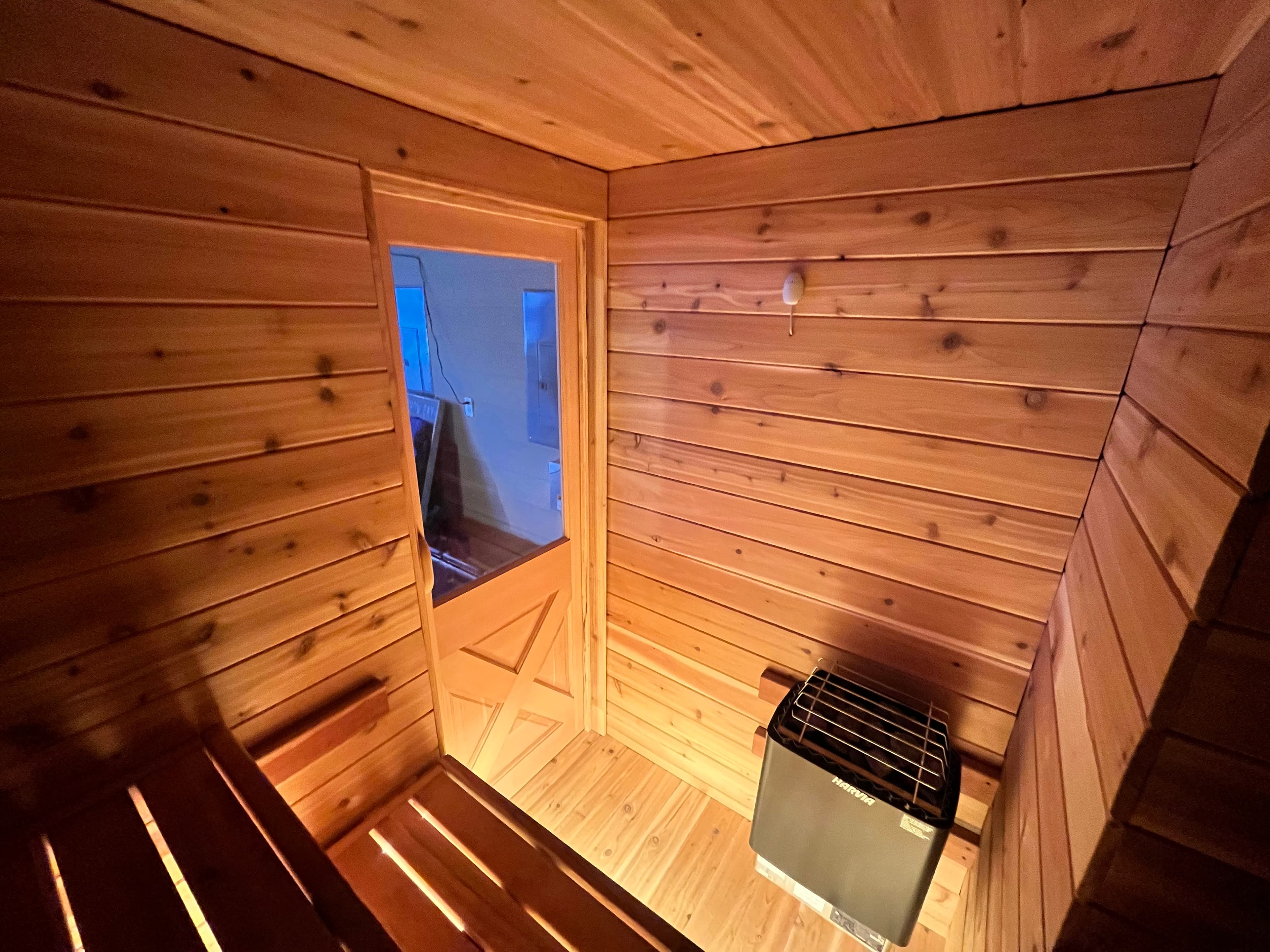
The heater is the most critical component of your sauna. It determines how fast you reach temperature, how even the heat is, and the quality of your löyly. I've specified heaters on dozens of custom sauna builds — from compact home saunas to commercial installations — and the brand you choose matters less than whether the heater matches your sauna size, electrical capacity, and how you actually use your sauna.
This guide ranks the leading electric sauna heater brands, covering specs, pricing, what each brand does well, and where they fall short. If you're planning a new build, our custom sauna design service includes heater specification and sizing matched to your exact space, and we can connect local clients with sauna builders to execute it.
| Brand | Top Model | kW Range | Rock Capacity | Price (6 kW) | Best For |
|---|---|---|---|---|---|
| Harvia | KIP Pro | 4–11 kW | 50–100 lbs | $800–$1,200 | Best overall value |
| HUUM | Drop / Hive | 4.5–18 kW | 80–300+ lbs | $1,200–$1,600 | Best löyly quality |
| EOS | Invisio / U | 3.6–30+ kW | 30–100 lbs | $900–$1,300 | Compact spaces / commercial |
| Saunum | Kyrö | 6–16 kW | 80–120 lbs | $1,100–$1,500 | Even heat / cold climates |
| Amerec | AK Series | 3.5–9 kW | 60–120 lbs | $700–$1,000 | Best budget option |
| Scandia | Stainless | 4.5–9 kW | 80–120 lbs | $1,000–$1,400 | Durability / coastal areas |
| Finlandia | Finn | 4.5–9 kW | 80–120 lbs | $900–$1,200 | Traditional Finnish style |
| Tylo | Various | 4–12 kW | 60–100 lbs | $1,500–$2,200 | Luxury / design-focused |
Harvia is the largest sauna heater manufacturer globally and the brand I specify most often. Their heaters are reliable, widely compatible, and produce excellent löyly. Parts are easy to source, which matters when you need a replacement element 8 years from now.
HUUM produces high-end heaters with emphasis on design and massive rock capacity. The Hive holds 300+ lbs of stones — more than any other residential heater. That stone mass creates the softest, most luxurious löyly available. If you care about the sauna experience above all else, this is the brand.
EOS manufactures the widest range of electric heaters, from a compact under-bench model to massive commercial units. The Invisio is unique — it tucks under a bench, freeing up wall space in small saunas.
Saunum's "Climate Equalizer" technology actively circulates air to prevent temperature stratification — the common problem where it's 200°F at ceiling height and 130°F at your feet. This matters most in larger saunas, tall saunas, or cold-climate builds where dead zones are common.
Trusted by homeowners across Tahoe and beyond
Amerec is US-based with Finnish roots. Their heaters are competent performers at the lowest price point in the market. If you're building on a budget or outfitting a commercial facility where you need multiple units, Amerec delivers solid performance without the premium markup.
Scandia builds heaters with premium stainless steel construction. They last longer than most competitors, which is why they offer a 10-year warranty — the best in the industry. If you're in a coastal area where salt air corrodes standard steel, or you simply want a heater you won't replace for 20 years, Scandia is worth the premium.
The oldest sauna company in the USA (founded 1936). Finlandia specializes in traditional Finnish sauna culture. Their heaters are designed to replicate the authentic Finnish löyly experience — no smart controls, no WiFi, just a well-built heater that does what a sauna heater should do.
Tylo produces the most aesthetically refined heaters on the market. Carbon fiber element coating, cool-touch exterior, and premium materials throughout. These are the heaters you see in high-end spas and luxury home saunas where budget isn't the primary constraint.
Rock capacity is the single most important factor for löyly quality. The stones absorb heat, produce steam when you throw water, and provide thermal mass that smooths temperature swings. More stone mass = softer, more even, more enjoyable löyly.
Most North American wall-mounted heaters only hold 50–100 lbs of stone, which achieves about 2–5 kg per cubic meter of sauna volume. That's functional but produces thinner, harsher steam. Based on Trumpkin research, here are the targets:
If you're limited to a wall-mounted heater with lower rock capacity, slightly oversizing the kW compensates somewhat for reduced stone mass.
Plan for roughly 1 kW per 50 cubic feet of sauna volume. A standard 6×8×7 home sauna (336 cu ft) needs a 6–9 kW heater. Cold climates, poor insulation, or exterior walls increase the requirement. Most residential saunas fall in the 6–9 kW range.
Three tiers of control: built-in mechanical knobs (simplest, $0 extra), external digital panel ($100–$300), and WiFi/smart controls ($200–$500). The Harvia Xenio WiFi and HUUM Cloud are the two most common smart systems. Smart controls let you preheat your sauna from your phone — convenient, not essential.
Smaller heaters (3.6–4.5 kW) run on a 240V/30A circuit. Standard residential heaters (6–9 kW) need 240V/40–50A. Larger heaters (10+ kW) may require 60A or more. Check your electrical panel capacity before choosing a heater. Upgrading electrical service adds $1,500–$3,000+ to a project — budget for this.
Until mid-2025, the UL 875 safety standard imposed restrictions that don't exist in Europe or Finland — limiting heater variety and driving up costs in North America:
Good news: As of July 2025, UL has largely adopted IEC (European) standards. This means higher temperature allowances, better sensor placement, and improved ventilation requirements. Expect more heater options and better pricing as manufacturers bring European models to the US market through 2026–2027.
The heater itself is only part of the cost. Here's what a complete heater installation actually runs:
| Component | Budget Build | Mid-Range | Premium |
|---|---|---|---|
| Heater unit | $700–$1,000 | $1,000–$1,600 | $1,500–$2,200+ |
| Sauna stones | $50–$100 | $100–$200 | $150–$300 |
| Controller/panel | Built-in ($0) | Digital ($150–$300) | WiFi ($300–$500) |
| Electrical (licensed) | $1,500–$2,000 | $2,000–$3,000 | $2,500–$4,000 |
| Total installed | $2,250–$3,100 | $3,250–$5,100 | $4,450–$7,000+ |
Electrical is often the biggest surprise cost. If your panel is full or far from the sauna location, expect the higher end of these ranges. Always get an electrician's quote before committing to a heater.
Undersizing the heater. Choosing a heater that's too small for your sauna volume is the most common mistake. The sauna takes forever to heat up, never quite reaches proper temperature, and the löyly feels weak. When in doubt, size up — a 9 kW heater in a space that only needs 6 kW heats faster and produces better steam.
Ignoring electrical capacity. People choose their dream heater and then discover they need a $3,000 panel upgrade to power it. Check your available amperage before you buy.
Choosing on price alone. A $700 heater and a $1,200 heater both make your sauna hot. The difference is in löyly quality, build longevity, control options, and replacement part availability. Over a 15-year heater life, the price difference is negligible.
Overlooking rock capacity. kW gets all the attention, but rock capacity determines how your sauna actually feels. A high-kW heater with minimal stone mass produces harsh, thin steam. Prioritize stone mass over raw power.
Skipping the controller. A bare-bones built-in timer works, but an external controller with proper temperature sensing gives you much better control over your sauna experience. The $150–$300 upgrade is worth it.
Best overall value: Harvia KIP. It's the industry standard for good reason. Reliable, affordable, widely compatible, and produces excellent löyly. For a 6×8 sauna, the KIP 8 kW is the default recommendation.
Best löyly quality: HUUM Hive. If you prioritize the sauna experience above cost, the Hive's 300+ lb rock capacity creates the softest, most luxurious steam available. The design is also beautiful. Worth the premium if this is your daily-use sauna.
Best budget option: Amerec AK. Solid performance without premium pricing. Good for budget-conscious builders or commercial applications where you need multiple units.
Best for cold climates: Saunum Kyrö. If you're building in a cold region (Tahoe, high elevation, northern states), the Climate Equalizer ensures even heat distribution in spaces that would otherwise have significant temperature stratification.
Best for longevity: Scandia Stainless. The 10-year warranty and full stainless construction mean this heater will likely outlast your sauna building. Coastal or humid-climate builders should seriously consider it.
Best for tight spaces: EOS Invisio. The only under-bench heater on the market. If your sauna is small enough that a wall-mounted heater eats into your usable space, the Invisio solves that problem.
Plan for roughly 1 kW per 50 cubic feet of sauna volume. A standard 6×8×7 home sauna (336 cu ft) needs a 6–9 kW heater. Cold climates, poor insulation, or exterior walls may require sizing up by 1–2 kW. Our heater sizing guide walks through the calculation.
Heaters range from $700 (Amerec AK) to $2,200+ (Tylo premium). Most residential 6–9 kW heaters cost $800–$1,600. The bigger cost surprise is electrical — budget $1,500–$3,000 for a licensed electrician to run a dedicated 240V circuit.
A quality heater lasts 12–18 years with normal residential use. Premium stainless steel models can last 20+ years. Heating elements are the most common replacement part ($100–$300). Stone replacement every 3–5 years depending on use intensity.
Yes — nearly all residential sauna heaters above 3 kW require 240V service. The amperage requirement depends on heater size: 30A for 3.6–4.5 kW, 40–50A for 6–9 kW, 60A+ for 10+ kW. Always hire a licensed electrician for this work.
Rock capacity. More stone mass creates softer, more even löyly. A heater with high kW but low rock capacity heats fast but produces harsh, thin steam. Aim for at least 6 kg of stone per cubic meter of sauna volume — 8–12 kg/m³ is excellent.
You can mount the heater unit and load the stones yourself. But the electrical connection must be done by a licensed electrician. Sauna heaters require dedicated circuits with proper gauge wiring, and in some jurisdictions, GFCI protection and inspection. DIY electrical work on a 240V circuit is dangerous and may void your warranty and homeowner's insurance.
12 decisions that determine how well your sauna performs — insulation, bench height, heater sizing, ventilation, and more.
Have questions about your project? Send us a message or schedule a free 15-minute intro call.
Schedule a free 15-minute intro call or send us a message about your project.
We'll learn about your space, goals, and timeline — and recommend the right next step for your project.