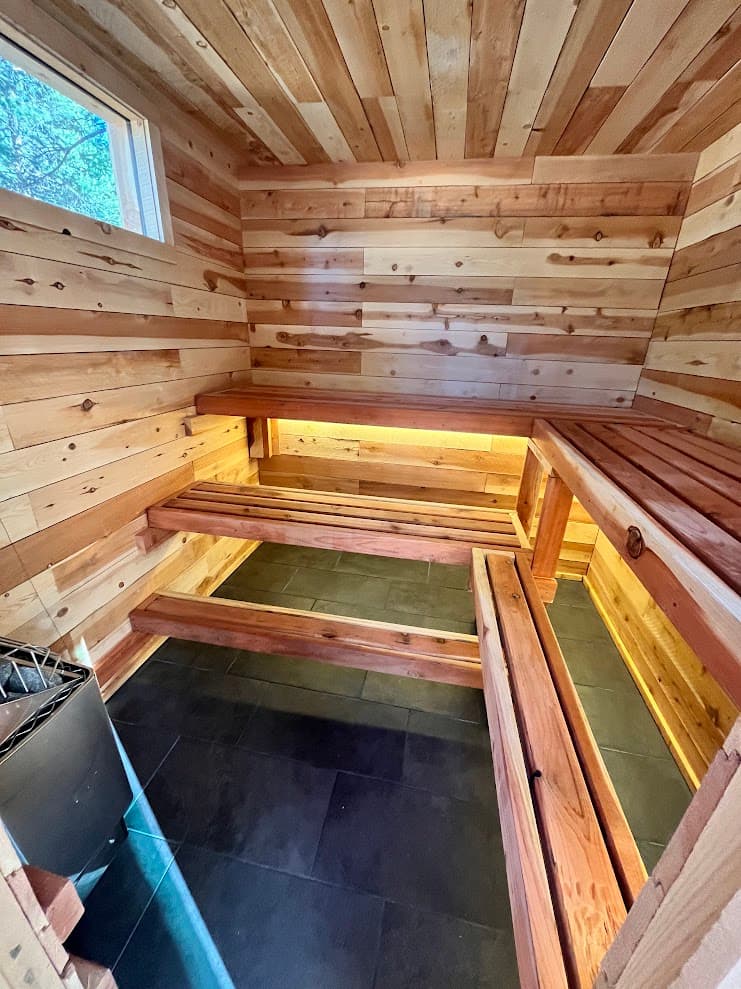
Choosing the right heater size is critical. Too small and your sauna will never reach comfortable temperature — you'll wait forever and use more energy. Too large and you waste money on an oversized system that cycles on and off inefficiently. Sizing is straightforward if you understand the formula and adjustment factors.
For a well-insulated sauna room with wood interior (walls and ceiling), the rule of thumb is:
1 kW of heating capacity per 45 cubic feet of room volume.
This is the starting point. From here, you adjust up or down based on insulation quality, climate, exposure, and room configuration.
Use this table to find your heater size based on typical sauna dimensions:
| Room Size | Occupancy | Cubic Feet | Baseline kW | Recommended Range |
|---|---|---|---|---|
| 4×4×7 | 1–2 person | 112 | 2.5 | 2–4 kW |
| 5×6×7 | 2–3 person | 210 | 4.7 | 4–6 kW |
| 6×8×7 | 3–4 person | 336 | 7.5 | 6–9 kW |
| 8×10×7 | 4–6 person | 560 | 12.4 | 10–15 kW |
| 10×12×7 | 6–8 person | 840 | 18.7 | 15–20 kW |
| 12×14×8 | 8–10 person | 1,344 | 29.9 | 25–35 kW |
Trusted by homeowners across Tahoe and beyond
Step 1: Measure your room dimensions
Measure the interior length, width, and height in feet. Don't include bench depth — measure the actual heated volume.
Step 2: Calculate cubic feet
Multiply length × width × height. Example: 8 feet long × 8 feet wide × 7.5 feet high = 480 cubic feet.
Step 3: Apply the baseline formula
Divide cubic feet by 45. Example: 480 ÷ 45 = 10.7 kW baseline.
Step 4: Apply adjustment factors (see below)
Increase or decrease the baseline based on insulation, climate, and other factors.
The baseline formula assumes a well-insulated room with R-11 walls and good sealing. If your conditions are different, adjust accordingly.
You're building an outdoor sauna 6 feet × 8 feet × 7.5 feet high. It's in the Lake Tahoe area, fully exposed to the elements, with R-13 insulation in the walls.
You'd choose a 12 kW electric heater (e.g., Harvia KIP on Amazon | HUUM Drop on Amazon) or a wood-burning stove with adequate rock mass to deliver equivalent heat.
The heater size you choose determines the electrical circuit you need.
A licensed electrician will verify your home's main panel capacity and determine the circuit requirements based on the specific heater model you choose.
Rock mass affects both heat quality and heater sizing strategy. More stones = softer löyly, better thermal stability, and longer heat consistency.
Source: Trumpkin/localmile.org provides specific guidance on ideal stone mass:
If you want excellent löyly quality but are limited by heater options in North America, slightly oversizing the heater (5–10%) compensates for reduced rock mass and slower heat-up time with dense thermal mass.
Example: Your sizing calculation shows 9 kW needed. If you choose a heater with large rock capacity (200+ lbs), increase to 10 kW to ensure the rocks heat thoroughly. If you choose a standard 50 lb heater, the baseline 9 kW is adequate.
Correctly sized electric heaters: 30–60 minutes to reach 170–180°F depending on insulation and starting temperature.
Correctly sized wood-burning stoves: 1–2 hours due to larger rock mass and slower heat transfer through the rocks.
An undersized heater will take much longer to heat and may never reach desired temperature. An oversized heater will overshoot temperature quickly, then cycle inefficiently.
In mountain climates like Tahoe or Truckee, or for outdoor saunas with high exposure, don't be conservative. A slightly oversized heater ensures reliable performance in winter conditions and won't waste significant energy — it just reaches temperature faster and cycles less frequently.
12 decisions that determine how well your sauna performs — insulation, bench height, heater sizing, ventilation, and more.
Have questions about your project? Send us a message or schedule a free 15-minute intro call.
Schedule a free 15-minute intro call or send us a message about your project.
We'll learn about your space, goals, and timeline — and recommend the right next step for your project.