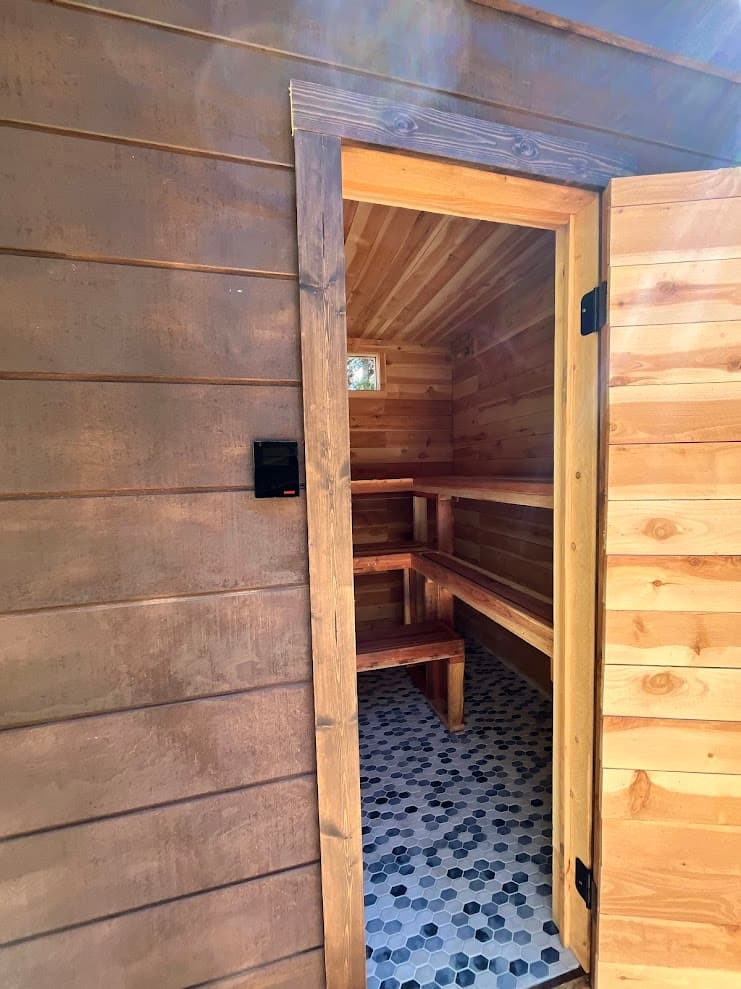
The total cost of a home sauna depends on three factors: whether you build it yourself or hire professionals, the sauna type and size, and the finish level. A budget DIY indoor sauna can cost as little as $3,000–$4,000 in materials. A custom outdoor sauna with premium finishes can exceed $50,000. Most homeowners invest $8,000–$20,000 for a quality sauna they'll use for decades.
This guide breaks down every cost component, from framing and materials to electrician fees and permitting, so you can plan accurately for your project. If you want a precise, build-ready budget, our custom sauna design packages include a full materials and cost specification for your exact space.
If you're comfortable with basic construction and electrical planning, a DIY sauna is the most cost-effective path. You'll purchase materials, hire a licensed electrician for the 240V circuit and heater installation, and handle the framing, insulation, cedar interior, and finishing yourself.
Total DIY materials: $4,000–$8,000. This assumes you're doing framing, insulation, interior finish, and bench construction yourself.
If you hire a professional sauna builder or contractor, labor costs multiply the materials expense. The builder assumes risk, coordinates permits, handles electrical integration, and guarantees quality. Professional builds range widely depending on sauna size, location (indoor vs outdoor), and finish level.
Labor typically adds 100–150% to materials cost, depending on site conditions, accessibility, and complexity. A builder's overhead, insurance, and guarantees justify this markup.
Trusted by homeowners across Tahoe and beyond
Sauna kits offer a middle ground between DIY from scratch and custom builds. A kit includes pre-cut framing components, pre-built benches, insulation, cedar paneling, and sometimes the heater — all ready to assemble. This reduces construction time and simplifies design decisions.
Advantage: Kits eliminate design uncertainty. Disadvantage: Less customization, shipping costs can be high, and assembly still requires careful work. Cheaper kits sometimes cut corners on cedar quality or heater specs.
Low upfront cost, but infrared saunas are a different product category. They lack the steam (löyly), the ritual, and the research backing of traditional saunas. We recommend traditional saunas for the full sauna experience.
A traditional sauna requires more investment but delivers a lifetime of use and proven health benefits backed by decades of Finnish research.
The sauna heater (stove) is one of the largest single expenses in any sauna build. Heater costs vary by type, power (kW), and brand.
Key brands: Harvia (Finland), HUUM (Estonia), EOS (Germany), Saunum (Finland). All are reliable; the difference is in features and durability.
Wood-burning is only practical for outdoor saunas. For modern, low-maintenance sauna use, electric heaters are the standard choice.
Every sauna requires a dedicated 240V electrical circuit from your main panel to the heater. This is not optional and should never be skipped.
Always use a licensed electrician for this work. They'll pull permits, follow code, and ensure safety. DIY electrical work can void insurance and create fire hazards.
Most jurisdictions require permits for sauna builds, especially outdoor structures and electrical work. Costs vary by location but typically include:
Total permitting range: $250–$1,000. In mountain regions like Tahoe, permits are often required due to snow load, electrical, and building code compliance. Don't skip permitting — it protects you, ensures code compliance, and can be required by insurance.
Once your sauna is built, ongoing electricity costs are modest. A typical sauna session uses:
This is minimal compared to the upfront investment. A $10,000 sauna pays for itself in wellness and lifestyle value, not energy savings.
| Type | Materials | Installed Cost |
|---|---|---|
| DIY indoor (6×8) | $4,000–$6,000 | $4,000–$6,000 |
| Professional indoor | — | $8,000–$14,000 |
| DIY outdoor (8×8) | $4,000–$8,000 | $4,000–$8,000 |
| Professional outdoor (standard) | — | $8,000–$20,000 |
| Premium custom outdoor | — | $20,000–$50,000+ |
Most sauna materials come from standard suppliers. You don't need exotic sources.
Several variables can push your sauna costs up or down:
DIY is cheaper upfront ($4,000–$8,000 materials) vs professional ($8,000–$20,000+). But DIY requires skill, time, and mistakes can be costly. If you're inexperienced, professional build avoids costly errors and guarantees quality.
Some contractors offer financing. Home equity lines of credit (HELOC), personal loans, or credit cards can also finance a build. A $10,000 sauna on a personal loan at 7% over 5 years costs ~$200/month.
A basic infrared unit (~$1,000) is cheapest, but it's not a traditional sauna. For a real sauna, DIY indoor conversion in a garage ($4,000–$6,000 materials) is the most cost-effective path.
Yes. Mountain regions like Tahoe require stronger roofs (snow load), deeper foundations (frost line), and stricter building codes. Expect 10–20% higher costs in cold climates. Urban areas with higher labor costs also increase professional build prices.
A well-built sauna can increase appeal, but it doesn't typically appraise at 1:1 value. Expect 50–70% return on resale. Build it for your own enjoyment, not as an investment.
12 decisions that determine how well your sauna performs — insulation, bench height, heater sizing, ventilation, and more.
Have questions about your project? Send us a message or schedule a free 15-minute intro call.
Schedule a free 15-minute intro call or send us a message about your project.
We'll learn about your space, goals, and timeline — and recommend the right next step for your project.