Garage Sauna Plans — Converting a Garage the Right Way
A garage is one of the most practical places to put a sauna, and good garage sauna plans take advantage of what's already there instead of fighting it. You've usually got a concrete slab — no foundation to pour. There's often a 240V panel within a short run. The structure is already framed and roofed. What's left is the part that actually makes or breaks a sauna: building a proper insulated, sealed hot room inside that space, with the vapor barrier, ventilation, and bench layout that a garage conversion specifically demands. Get those right and a corner of your garage becomes a sauna that heats to 180-200°F in under an hour. Get them wrong and you've trapped moisture inside your garage walls.
Here's what a garage conversion needs to get right, and the compact build our plans are based on.
Why a Garage Is a Good Place for a Sauna
The appeal is mostly about what you skip. No foundation work, because the slab is already there. No exterior framing or roofing, because the garage envelope exists. The 240V circuit your electric heater needs is often a short pull from an existing subpanel. And you're building indoors, out of the weather, which makes it a comfortable winter project.
A garage also gives you a buffer space — you walk in from the house or the yard, into the garage, then into the sauna. That's a natural cooling-down and changing area you don't have to build.
The catch is ceiling height. Before you commit to a garage conversion, confirm the space can give you a 7.5-8 foot interior sauna ceiling after you frame down for a flat ceiling and add the floor buildup. Most garages handle it, but a low garage ceiling is the one thing that can rule the project out, so measure first.
What Garage Sauna Plans Need to Get Right
A garage conversion has two failure modes that outdoor builds don't, and good garage sauna plans address both head-on.
Vapor barrier — protecting the garage structure
A sauna throws a lot of moisture: water on the stones, sweat, breath. In a freestanding outdoor build that moisture has somewhere to go. Inside a garage, if it gets into the surrounding wall cavities it causes rot and mold in your home's structure. The fix is a continuous aluminum foil vapor barrier on the warm side of the insulation, seams overlapped six inches and sealed with aluminum tape, extended to floor and ceiling with every penetration sealed. This is the single most important detail in a garage conversion, and it's exactly where DIY builds without real plans cut corners.
Ventilation in a tight indoor space
A garage sauna is a sealed box inside another box, so airflow matters even more. Fresh air comes in high near the heater, stale CO2-rich air exhausts low on the opposite wall, and a closeable drying vent up high lets the room dry out after a session. In a tight indoor conversion, a small mechanical exhaust fan is often the right call to actively pull moisture out and keep it from lingering in the garage. Our sauna ventilation guide covers why the intake goes high, above the heater.
The 240V circuit
An electric sauna heater needs a dedicated 240V circuit, and that's a licensed-electrician job — no exceptions. A garage often makes this the easy part since the panel is right there, but the circuit still has to be sized to the heater. Our heater sizing guide shows how output maps to room size.
Trusted by homeowners across Tahoe and beyond
The 6.5x6.5 Garage Build
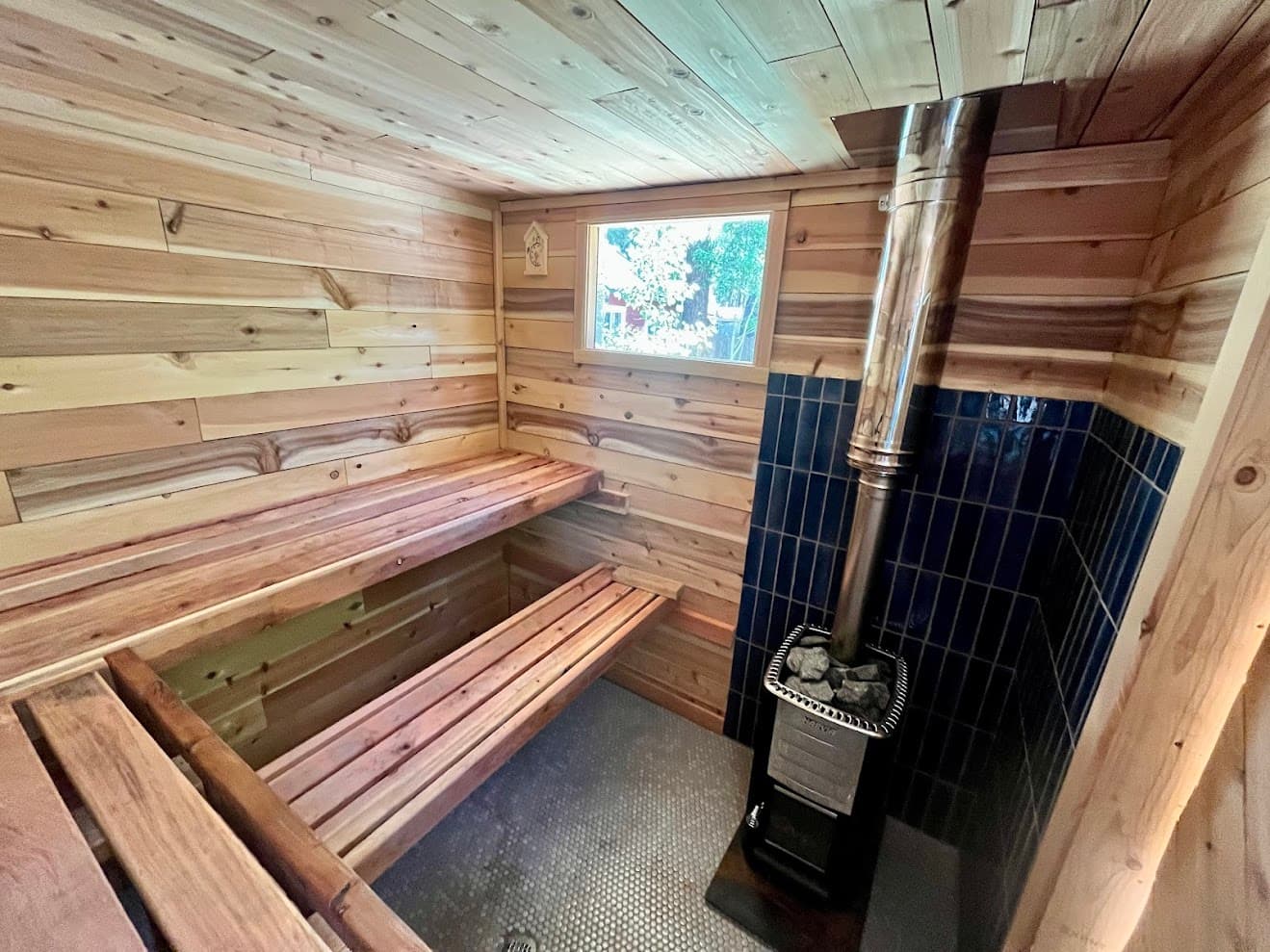
The build our plans are based on is a 6.5x6.5 sauna inside a Reno garage — a compact 2-3 person room that heats fast. It runs a Harvia KIP 8kW heater with WiFi control, a continuous vapor barrier to protect the garage structure, balanced ventilation, two-tier parallel benches, a cedar interior, and a flat ceiling. Materials came in around $3,000-4,000, and it reaches 180-200°F within an hour. You can see the finished conversion in our garage sauna case study.
The benches follow the same rule as any good sauna: the upper bench top sits 40-48 inches below the ceiling so your feet land at or above the heater stones, which is what keeps the heat even from head to toe instead of leaving you with cold feet.
Frequently Asked Questions
How much does it cost to convert a garage into a sauna?
Materials for a compact 6.5x6.5 garage conversion run about $3,000-4,000, plus the electrical for the 240V circuit. Because the slab, walls, and roof already exist, a garage conversion is usually cheaper than a freestanding outdoor build. Price your exact build with our free materials calculator.
Do I need to insulate a garage sauna?
Yes — fully. Even though it's indoors, the sauna needs to reach and hold 180-200°F, and the surrounding garage is unheated. Insulate the walls and ceiling and install a continuous vapor barrier on the warm side. Skipping the vapor barrier is how moisture gets into your garage structure and causes rot.
Can I build a sauna in an attached garage?
Yes, and it's common. The main things to confirm are ceiling height (you need 7.5-8 feet of interior sauna ceiling) and that you can run a dedicated 240V circuit. An attached garage also gives you easy access from the house.
How big should a garage sauna be?
A 6.5x6.5 room fits 2-3 people and heats quickly, which makes it a good fit for a garage corner. If you have more room and want to seat more people, the same principles scale up — see our 8x8 sauna plans for a larger build.
Get Started on Your Garage Sauna
A dedicated garage conversion plan is on the way — you can get notified when it launches and we'll email you the moment it's ready. In the meantime, the two things that make a garage conversion succeed are available now: The Sauna Building Guide walks through vapor barrier, ventilation, and every other phase in detail ($19), and the free materials calculator prices your exact room. If you'd rather have us design the conversion for your specific garage, that's what a design consultation is for.