Redwood Outdoors Cabin Sauna Review: Graded Against Real Sauna Standards
Redwood Outdoors built its name on backyard wellness gear, and their 4-person Cabin is one of the more popular outdoor cabin kits you'll see. It starts around $7,299 with a Harvia heater included, and it gets two things right that a lot of outdoor kits get wrong: a slope roof that actually sheds snow, and a real choice of quality heaters. What a buyer is really weighing is whether the rest of the build holds up — the bench size, the wall thickness, and the ventilation. We grade every product against the same engineering standards we use on custom builds, and we cross-referenced Redwood's current listing against independent hands-on reviews to keep the numbers here honest.
Overview
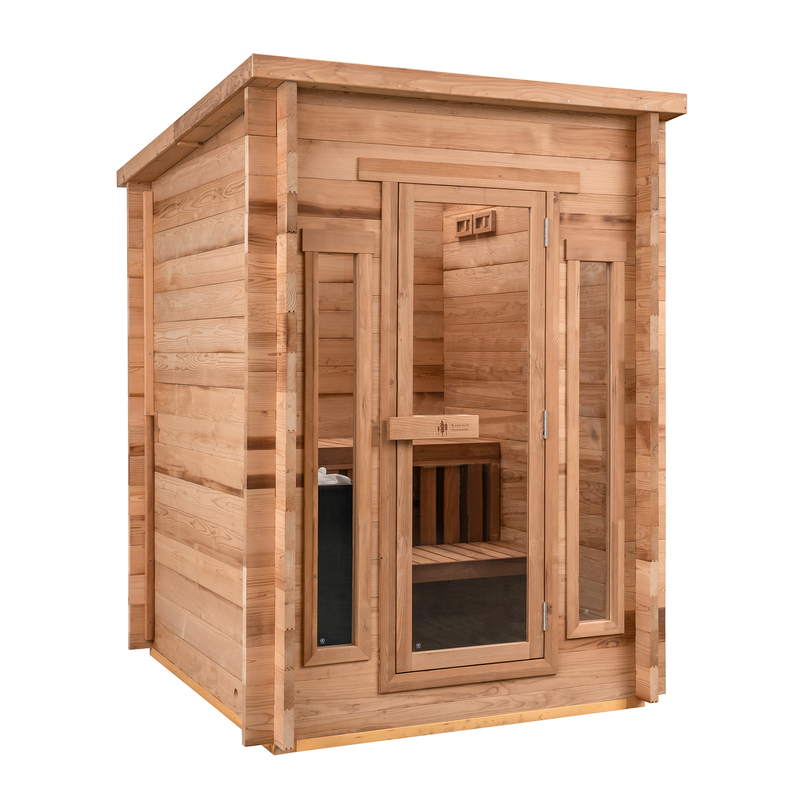
The Redwood Outdoors Cabin (4-person) is a compact Scandinavian-style outdoor cabin, built from hemlock with a single-slope roof, two tiers of benching, a full glass front door, and a Harvia electric heater as standard. It assembles from interlocking lumber in roughly six to eight hours with two people and runs on a dedicated 240-volt circuit. The footprint is about 79 by 79 inches — call it 6.5 by 6.5 feet.
The price is $7,299 with the standard heater, with upgrade paths to larger Harvia electric units or a wood-burning stove.
What the Redwood Cabin Does Well
The Slope Roof
The single-slope roof is a real advantage, and it's the first thing worth pointing out. Snow and rain shed off it instead of piling up and pooling the way they do on the flat-roof outdoor kits. If you're anywhere it snows, that matters — a flat roof loads up and traps meltwater, and over time that's what kills an outdoor structure. Redwood got this right where a lot of competitors didn't.
Bench Depth
The top bench is 23 5/8 inches deep. We typically recommend at least 24 inches so you can sit comfortably or lie all the way down without hanging off the edge, and Redwood is right on that mark. A proper deep top bench is one of the things that separates a sauna you actually relax in from one you just sit upright in, and this one has it.
Heater Options
Redwood ships this with a Harvia heater — a top-tier, UL-listed Finnish brand — and lets you choose. The standard is a Harvia KIP around 6 kW, with paths up to the Spirit, Virta, and larger 8–9 kW units, or a wood-burning stove. That flexibility is genuinely useful: you can size the heater to how cold your climate is and how fast you want it hot, or go wood-fired if that's your thing. Getting a name-brand heater in the box, with options, is real value when a lot of cabins make you buy the heater separately for $1,000 to $2,000.
Trusted by homeowners across Tahoe and beyond
Where It Falls Short
Capacity — the 55-Inch Top Bench
Redwood rates this for four people. The top bench is 55 inches long. Split that four ways and you get about 14 inches of seat per person, which isn't enough — nobody's comfortable at 14 inches, and you can't lie down at all. Realistically this is a three-person sauna. At three, you've got roughly 18 inches each, which works. The air volume backs this up too: a 6.5-by-6.5-foot room is around 230 to 245 cubic feet, and healthy air quality wants about 105 cubic feet per person, so four people puts you well under half of that. Call it three, and plan around three.
The Full Glass Door in Snow Country
The full glass front door looks great, but it's a weak point if you're somewhere with real snow accumulation. Snow drifting or sliding against a full glass door can pack it shut, and in a hard freeze you're dealing with ice around the frame — at worst, a risk to the glass itself. It's the flip side of that good slope roof: the roof sheds snow well, but the door is where snow and ice can still get you. In a mild climate it's a non-issue; in deep-snow country, think about how the door is oriented and sheltered.
Thin Walls and Low Efficiency
Redwood doesn't publish a wall thickness or an insulation R-value, and from what we can see the walls look like 2 to 3 inches at most. That's not much. Our standard is a framed wall with R-13 to R-21 of insulation and a vapor barrier, and a 2-to-3-inch wall isn't getting you there. The practical cost is efficiency: thin walls bleed heat, so the heater runs longer and harder to reach and hold temperature, and that shows up on your electric bill every session — especially in cold weather. Before you buy, ask Redwood directly for the wall thickness and insulation spec, and weigh it against your climate.
Passive Ventilation Only, and No Drain
Credit where it's due — the Cabin has two passive vents, which is more than the single token vent a lot of kits ship with. But passive vents alone don't move enough air to keep the air quality good. We've measured it: passive airflow doesn't meaningfully control the CO2 that builds up once you've got two or three people breathing in a small room, and there's no mechanical fan here to do the job. Redwood publishes very little about the ventilation beyond the vents themselves. The good news is this is the cheapest problem to fix — a proper mechanical downdraft setup is about $100 to $200 in parts (an inline duct fan, flex duct, and two wall caps), and our Sauna Ventilation Kit bundles it if you'd rather not source the parts.
There's also no floor drain. It's not a dealbreaker, but water, sweat, and splashed löyly water need somewhere to go, and a drain makes cleaning easier over the years.
Specs vs. Design Standards
| Spec | Redwood Cabin (4-Person) | Design Standard | Assessment |
|---|---|---|---|
| Roof | Single-slope | Sheds snow / water | Good |
| Top Bench Depth | 23 5/8" | 24" recommended | Good — deep enough to lie down |
| Top Bench Length | 55" | ~18–24" per person | Fits ~3, not 4 |
| Capacity | ~3 realistic (rated 4) | 105 cu ft/person | Overstated |
| Heater | Harvia KIP ~6 kW std (6–9 kW or wood) | Quality UL-listed brand | Excellent + flexible |
| Wall Thickness | ~2–3" (not published) | Framed, R-13 to R-21 | Thin — low efficiency |
| Insulation | Not published | R-13 to R-21 | Low / unclear |
| Ventilation | Two passive vents, no fan | Mechanical downdraft | Passive only |
| Door | Full glass | Manage snow load | Risk in heavy snow |
| Wood | Hemlock (older units: Thermowood) | Cedar or thermowood | Acceptable |
| Drain | None | Recommended | Not included |
| Warranty | 1 year | 5+ years typical | Short |
| Electrical | 240V | Standard | Correct |
| Temperature | Reaches ~190°F | 170–200°F operating | Passes |
| Price | $7,299 (heater included) | — | Competitive |
The Bottom Line
The Redwood Cabin gets the roof and the heater right. The slope roof sheds snow instead of trapping it, the top bench is deep enough to actually lie down on, and a name-brand Harvia with real options — up to a wood-burning stove — is a strong package at $7,299 with the heater included.
The compromises are size, walls, and air. The 55-inch top bench makes this a three-person sauna, not the four it's rated for. The walls look thin at 2 to 3 inches, so efficiency suffers and running costs climb in cold weather. The full glass door is a weak point in heavy snow. And ventilation is passive-only, though at least there are two vents and the mechanical fix is cheap.
Who it's for: two or three people in a mild-to-moderate climate who want a slope-roof cabin with a quality heater, and who'll add proper mechanical ventilation. If you're in deep-snow country, weigh the glass door and the thin walls carefully, and ask Redwood for the wall spec before you buy. And whatever you land on — any sauna is better than no sauna. The important thing is that you're using one.
Also read: Dundalk Luna Sauna Review and SISU Crew Cabin Sauna Review.
Frequently Asked Questions
How many people does the Redwood Outdoors Cabin actually fit?
Redwood rates it for four, but the top bench is only 55 inches long — about 14 inches per person at four, which is too tight to sit comfortably or lie down. Realistically it's a three-person sauna, where each person gets a more reasonable ~18 inches. The interior air volume points to the same conclusion.
Is the Redwood Cabin good for snowy climates?
Partly. The single-slope roof sheds snow and water well, which is a real plus over flat-roof kits. But the full glass door is a weak point where snow drifts or piles — it can pack shut or ice up — and the thin walls mean higher running costs in cold weather. In a mild climate it's a good outdoor cabin; in deep-snow country, plan for how the door is sheltered.
What heater comes with the Redwood Outdoors Cabin?
A Harvia electric heater — the Harvia KIP around 6 kW is standard, with upgrades to the Spirit, Virta, larger 8–9 kW units, or a wood-burning stove. Harvia is a top-tier, UL-listed Finnish brand, and the choice of options is one of this sauna's real strengths. (That's an affiliate link — if you buy through it I may earn a small commission at no extra cost to you.)
Does the Redwood Cabin have good ventilation?
It has two passive vents, which is more than many kits include, but there's no mechanical fan. Passive airflow alone doesn't do much to control the CO2 that builds up with a few people inside. Adding a mechanical downdraft setup costs about $100 to $200 and noticeably improves the air.
Does the Redwood Outdoors Cabin have a floor drain?
No. A drain isn't essential, but it makes cleaning easier over the years, so it's worth noting if hygiene and upkeep matter to you.
Want to know what actually makes a sauna perform — before you buy a kit? Our Sauna Building Guide walks you through the engineering that matters: bench heights, heater sizing, ventilation, and insulation, so you can judge any sauna with confidence. You can also see how the Redwood Cabin stacks up against other kits in our honest sauna reviews, or if you'd rather have a sauna designed around your exact space, our design consultations can help.