Sauna Ventilation Kit
Stay in longer, think clearer, and feel the heat even out — with a complete intake-and-exhaust system for the sauna you already have. The fan unit arrives mostly assembled — a few simple connections, then drill two holes, mount it, and plug it in. If yours feels stuffy after a couple rounds, this is the fix — nothing to spec or source, and no guesswork.
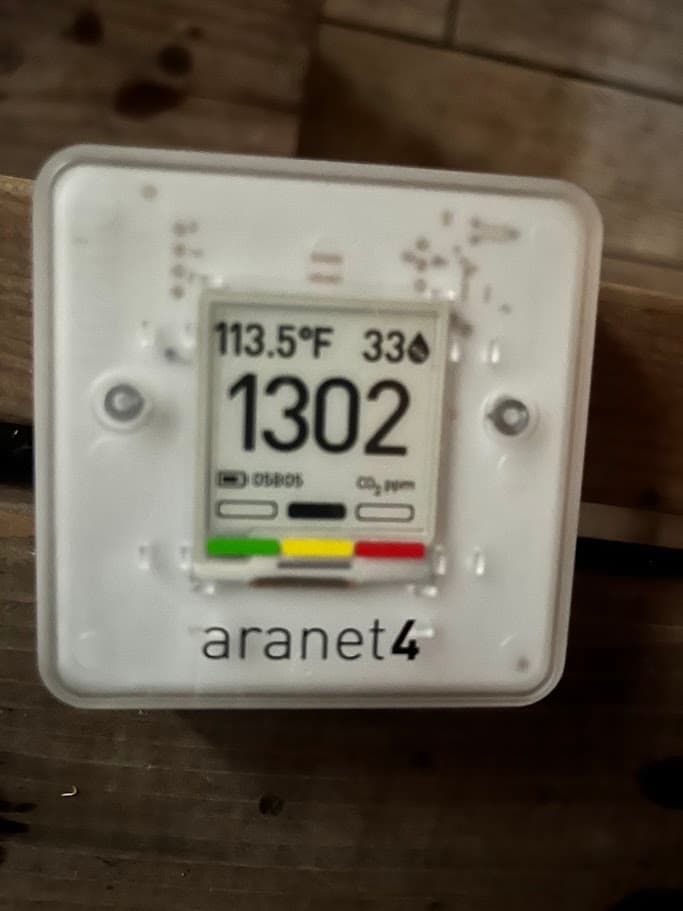
Measured in a real sauna: a monitor read 1,302 ppm of CO2 on passive vents — into the red — and dropped below 700 ppm once the exhaust was running.
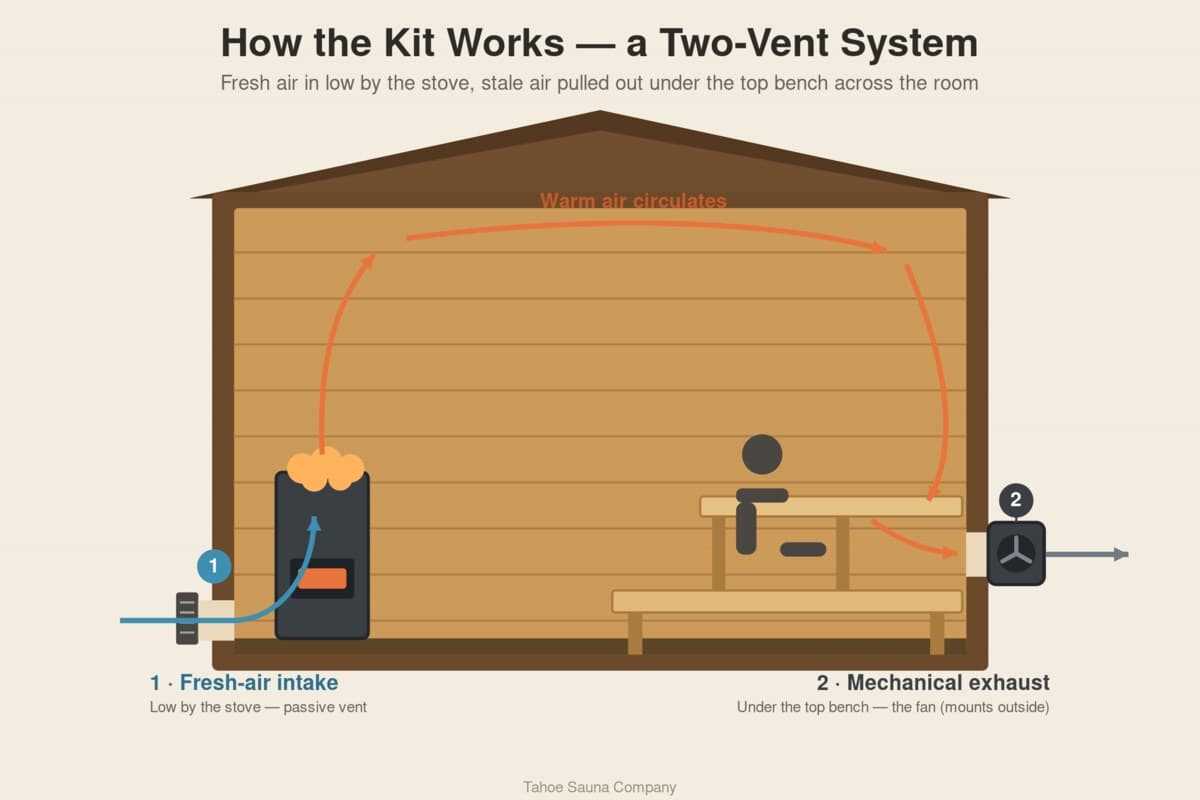
How the two-vent system works — fresh-air intake just above and beside the stove, powered exhaust below the foot bench.
Most saunas — kits and custom builds alike — rely on passive vents: two holes and the hope that air moves on its own. It usually doesn't, not enough. So CO2 builds up, the air goes stale, and the heat stacks near the ceiling while your feet stay cold. A small mechanical fan fixes all of it. It pulls the stale air out and draws fresh, heated air down to where you're sitting. The difference is immediate — you can stay in longer, your head stays clearer, and the whole room feels more even.
Watch on our YouTube channel — subscribe for more builds →
We put a CO2 monitor in a real sauna. On passive vents alone, it climbs past 1,300 ppm — into the meter's red zone — after a few rounds. That heavy, foggy-headed feeling is the CO2, and clearing it is exactly what the mechanical exhaust does.
Arrives Mostly Assembled — Just a Few Connections
We build it for you — in small batches, assembled and tuned by hand. The fan, ducting, and fittings come about 90% built and sealed into one unit — sized and matched for a sauna — packed with the hole saw and a written install guide. It's a complete system: a fresh-air intake and a powered exhaust, the way a sauna should breathe. No figuring out which fan, no five separate orders, no sourcing parts. You make a few simple connections, drill two holes, mount the unit, and plug it in. You bring the drill.
Stuffy by the second round. A heavy, foggy head. Heat stacked at the ceiling while your feet stay cold — so you cut the session short.
Clear air at round five. A steady loop of fresh, warmed air across the bench — even heat, a clearer head, and you stay in as long as you like.
The Ventilation Kit
In stock and ready to ship now, with free U.S. shipping — most orders go out within about a week. Two options: the kit on its own, or the kit bundled with an Aranet4 air quality monitor so you can watch your sauna's CO2 drop the moment the fan comes on. The Aranet4 runs about $200 on its own, so the bundle adds it for $165. Pick one below.
Ventilation Kit — from $395, free shipping
A complete intake + exhaust system, mostly assembled. A few connections, drill two holes, and mount it.
- A complete intake + exhaust system — both vents
- Arrives mostly assembled — just a few simple connections
- Quiet 4" inline fan with a 10-speed controller
- Insulated ducting + clamps, a 90° elbow, and a coupler
- Aluminum foil tape to seal the joints
- The hole saw to drill both holes — included
- Step-by-step install guide, written by us
- Plug-and-play or hardwire — your call
Introductory price. Built in small batches — order below to claim one from the current run, and you'll enter your shipping address at checkout.
Secure checkout via Stripe · shipping collected at checkout
Visa · Mastercard · Amex · Apple Pay · Google Pay
Hesitant or not sure it fits your sauna? We usually reply the same day — you're talking to the people who build and tune these.
Add an Aranet4 Air Quality Monitor for Your Sauna
Searching for an air quality monitor for your sauna? This is the one we use. You can bundle the ventilation kit with an Aranet4 CO2 monitor for $560 — the same gold-standard air quality monitor you see reading 1,302 ppm in our test above, before the exhaust fan kicks in. It's the tool that turns “the sauna feels stuffy” into a number you can actually watch.
The Aranet4 is a portable indoor air quality monitor built around a research-grade NDIR carbon-dioxide sensor. On its always-on e-ink screen it shows CO2, temperature, relative humidity, and atmospheric pressure, with a traffic-light indicator and a Bluetooth app that logs the full history. It needs no wiring and no hub — it runs for years on two AA batteries, so you just set it on a bench and read it. In a sauna it does two jobs at once: it doubles as a löyly gauge for heat and humidity, and — the reason it's here — it measures the CO2 that makes a poorly ventilated sauna feel heavy and foggy-headed.
That's exactly why it pairs with this kit. Set the Aranet4 on the top bench and you can watch the whole story play out: on passive vents alone the CO2 climbs past 1,300 ppm into the red after a few rounds, then you flip on the mechanical exhaust and watch it fall back toward fresh outdoor air (around 400 ppm). You stop guessing whether your ventilation is working and start seeing it. It's the difference between hoping the air is better and knowing it.
To add one, choose “Ventilation Kit + Aranet4 Air Quality Monitor — $560” in the buy box above. Prefer just the kit? Leave it on the $395 option — you can always add a monitor later.
The Fan Mounts Outside — Keep It Covered
The mechanical fan sits on the outside of your sauna, which keeps it completely clear of the heat inside — right where you want an electric fan. The trade-off is that it's out in the weather, and an electric fan shouldn't sit exposed to rain, snow, and sun. The kit doesn't include an exterior cover, so you protect it yourself — and we highly recommend you do. We build hand-built wood covers that enclose the fan and the exterior ducting in one piece, stainable or paintable to match your sauna. They're available on request — just ask when we reach out and we'll make one to fit.


A hand-built wood cover — available on request — that weatherproofs the exterior fan and ducting, stainable or paintable to match your sauna.
Want the cover to come with your kit? Send us a message and we'll build a hand-built wood cover to fit and ship it alongside your kit for an additional fee. Prefer a budget option? See the FAQ for an easy DIY cover.
How It Works
The kit is a two-vent system, and where each vent goes is the whole game. The intake is a passive vent on the heater wall, just above the stove — about 12 inches above the top of the stove and 12 inches to the right of it, beside the heater rather than directly over it. Fresh air comes in there and gets grabbed by the heater's rising convection plume, so it's warmed and mixed into the hot air instead of sinking cold across the floor or pooling at your feet. The mechanical exhaust goes on the opposite wall, below the foot bench. The fan pulls that mixed air down through the bench zone and out at the lowest point in the room.
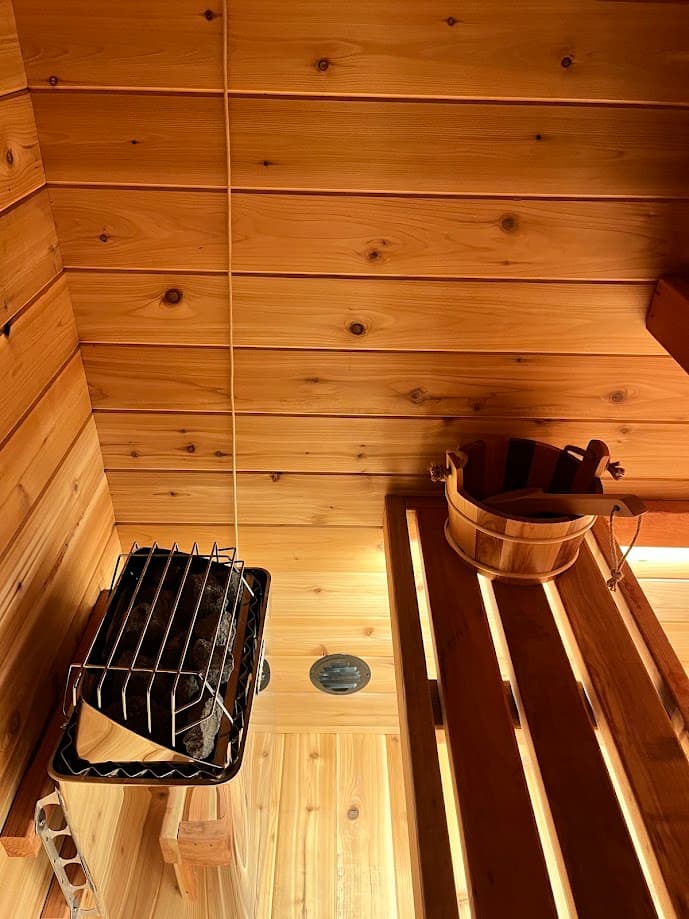
The passive intake in one of our saunas — on the heater wall beside the stove. We now place it about 12 inches above the top of the stove and 12 inches to the side, so fresh air rides the heater's plume instead of the floor.
That under-the-foot-bench placement is the point. Pulling the exhaust from below the foot bench means the fresh, heated air gets dragged down through the zone where you actually sit and breathe — constantly exchanging the air around you, clearing CO2 and the stale, heavy feeling — and the CO2-heavy air leaves at the lowest point instead of you just bleeding off the hottest air at the ceiling. Fresh air in above the stove, used air out below the foot bench on the far wall, in a steady loop across the whole room.
The fan itself mounts on the outside of the sauna, so it stays completely clear of the heat — exactly where you want an electric fan for it to last. The included guide tells you where both vents go for your sauna, and install is about an hour with nothing but a drill.
The exhaust runs on a mechanical fan with a 10-speed adjustable controller, so you set exactly how much air moves through the room — turn it up to clear the air quickly, or ease it back for a gentler, quieter exchange. You're always in control of the airflow.
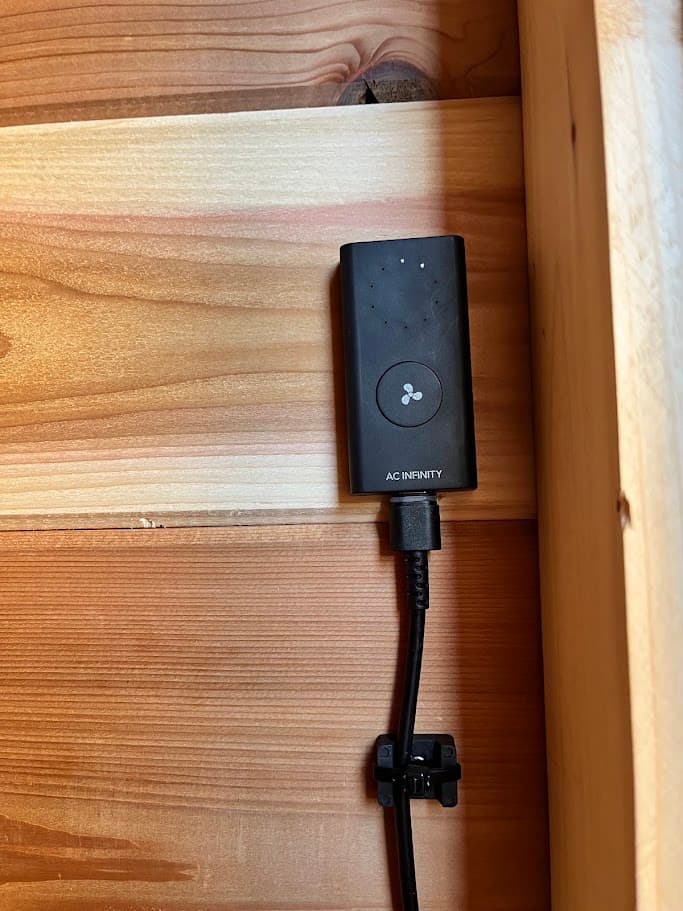
The included 10-speed controller — dial the airflow up or down to suit your session.
Cutting a vent opening with the included hole saw — a drill is the only tool you supply.
Why It's the Tahoe Sauna Company Kit
We design and build saunas for a living. This kit is that experience, boxed up:
- Sized and matched for a sauna. The right fan and airflow for the room — not a random duct fan you hope is big enough.
- A real install guide. Exact placement written by people who build saunas. Placement is the whole game — it's the difference between a vent that actually helps and one that does nothing.
- Weatherproof wood covers on request. A hand-built housing that protects the exterior fan — available on request, and you won't find it on any marketplace.
- We stand behind it. Questions before or after, you're talking to a sauna company — not a marketplace seller.
What You Actually Feel
- Lower CO2. The thing that makes you feel heavy and foggy-headed. Clear it out and you think straight.
- Fresher air. No more stale, used-up feeling after the second or third round.
- Even heat. Less of the hot-head, cold-feet stratification that makes a sauna feel off.
- Longer sessions. Better air means you can comfortably stay in longer and get more out of it.
The honest trade-off: cutting vents costs you a little efficiency, so the sauna works marginally harder to hold temperature. It's a small price for much better air, and the fan only runs when you want it to.
Works With Any Sauna
Barrel sauna, prefab kit, cabin sauna, indoor or outdoor, electric or wood-fired — it doesn't matter. It's a standard 4-inch system and two openings through the wall, so there's nothing brand-specific about it. If you already have a sauna, this works on it.
Common Questions
Yes — any sauna, any brand, electric or wood-fired. It's a standard 4-inch system and two openings through the wall — intake and exhaust.
No. Plug it into an extension cord and use it the same day, or hardwire it for a clean finish if you prefer.
Almost — it arrives about 90% assembled as one unit, with just a few simple connections to make. Make those, drill two holes, mount the unit, and plug it in.
Yes. It's electric, so it shouldn't sit exposed to the weather, and we highly recommend a cover. We build hand-built wood covers that weatherproof the exterior fan and ducting — available on request.
Not at all. If you'd rather source your own on a budget, a simple plastic resin deck box — the kind sold for patio storage — makes a great, weather-resistant housing. The soft resin drills easily with a hole saw for the intake and exhaust. We like the Suncast 22-gallon resin deck box, at Home Depot, Lowe's, or Amazon. Set it over the fan and ducting, drill your two openings, and you have a tidy, weatherproof housing for very little.
About an hour. It comes mostly assembled, so you make a few connections, drill two holes with the included saw, mount the unit, and plug it in.
You can — but sourced one piece at a time (fan, controller, insulated ducting, elbow, coupler, hole saw, foil tape), the parts alone typically run close to the kit's price across five or six orders, before you've solved sizing or placement. The kit is everything matched and sized in one box, with a written install guide and a sauna company behind it.
Yes. Bundle the kit with an Aranet4 CO2 / air quality monitor for $560 — pick that option in the buy box. It reads CO2, temperature, and humidity in real time, so you can watch your ventilation working. Just the kit is $395.
Built and backed by a working sauna company.
We design and build saunas for a living, and we assemble and tune every kit ourselves before it ships. Have a question about your sauna before you order? Reach out — you're talking to people who install these, not a marketplace seller.
See the custom saunas we've designed and built on our Our Work page — the same hands behind this kit.
Every kit is built, tuned, and tested by hand before it ships. If anything arrives wrong or damaged, email us and we'll make it right — and if your air isn't measurably better, send it back within 30 days for a refund.
Get Your Kit
The kit is in stock and ready to ship at the introductory price. Buy below and enter your shipping address at checkout — shipping is free, and most orders go out within about a week.
Secure checkout via Stripe · shipping collected at checkout
Visa · Mastercard · Amex · Apple Pay · Google Pay
Hesitant or not sure it fits your sauna? We usually reply the same day — you're talking to the people who build and tune these.
More on Sauna Ventilation
Want the reasoning behind the design? These go deeper: sauna ventilation design, mechanical vs. natural ventilation, and the most common ventilation mistakes. Start with the full ventilation guide, or see sauna air quality & CO2 and our real-sauna CO2 study. Got a specific setup? We cover barrel saunas, infrared saunas, and why a sauna feels stuffy. Fixing up an older sauna in general? See Sauna Doctor for maintenance and renovation — cleaning, wood care, rocks, heater problems, and bigger benches.
Building a Sauna From Scratch?
If you're still in the design phase, we'll get the ventilation right from the start — along with the heater, benches, and everything else. We offer full custom designs with 3D models, materials lists, and construction instructions.
Learn About Custom Design →