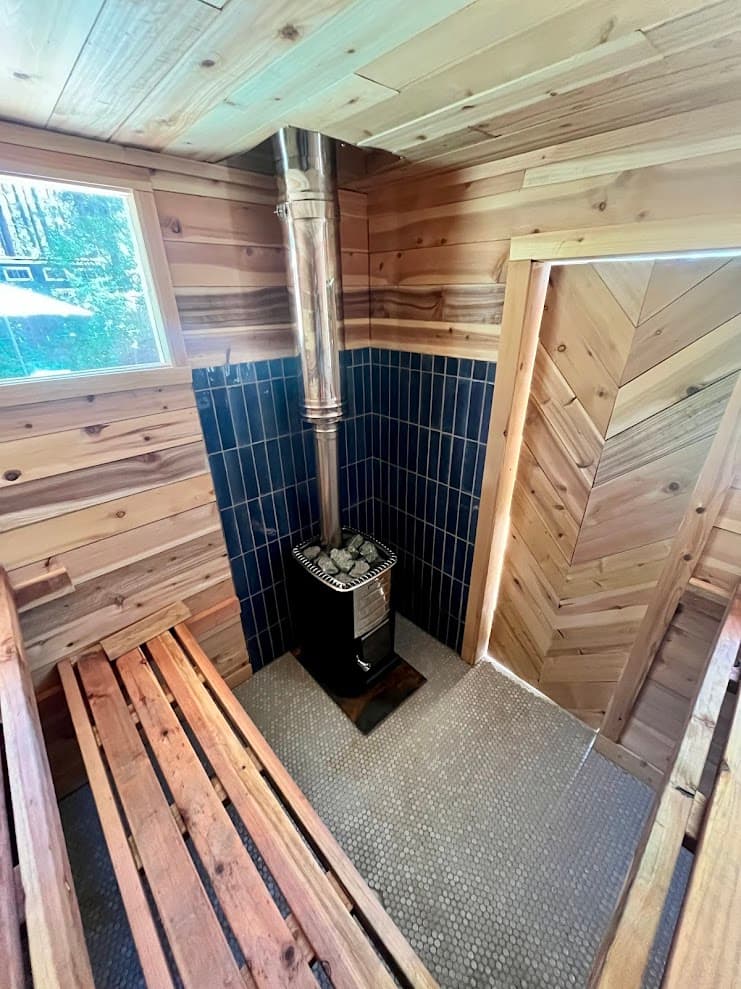
Sauna Materials List — Everything You Need to Build a Sauna
A complete sauna materials list is the difference between one or two organized trips to the lumberyard and ten frustrating ones. Most people underestimate how many distinct systems go into a sauna — it's not just cedar and a heater. You're building a framed, insulated, vapor-sealed structure with its own electrical, ventilation, and finish work, and each of those needs the right materials in the right spec. Below is the full list by category, what to look for in each, and the real cost ranges, so you can plan the build and budget before you buy anything.
What's on a Complete Sauna Materials List
A sauna breaks down into eight material groups. Miss one and the build stalls.
Framing
Standard 2x4 studs at 16 inches on center, a double top plate, and plywood or OSB sheathing for an outdoor build. For a conversion inside a garage or shed, you're framing the interior sauna walls and a flat ceiling below the existing roof. Budget roughly $200-500 for framing on a small-to-mid build.
Insulation
This drives how fast the sauna heats and how long it holds temperature. Mineral wool is our pick for its fire and moisture resistance; fiberglass batts work on a budget. Target R-13 to R-21 in the walls and R-30 to R-38 in the ceiling, since heat rises and the ceiling needs more. Figure $150-400 including the vapor barrier.
Vapor barrier
Non-adhesive aluminum foil sheeting on the warm, interior side of the insulation, seams overlapped six inches and sealed with aluminum tape. This is cheap material that prevents expensive damage — without it, moisture gets into the wall cavities and rots the structure. Don't substitute plastic poly sheeting; use the foil.
Interior wood
Western red cedar tongue-and-groove is the standard — naturally moisture and decay resistant, and it looks and smells the part ($4-8/sq ft). Hemlock ($3-6) and aspen ($2.50-5) are good lower-cost options. A small-to-mid interior runs $500-2,500 in wood, often the most expensive single line item. Avoid pine (it weeps sap) and anything pressure-treated.
Heater and stones
An electric heater sized to your room — roughly 1 kW per 45 cubic feet of a well-insulated wood-lined space, so 6 kW for a small build and 8 kW for an 8x8. Budget $1,000-3,000. Use only olivine diabase or peridotite stones; never river rock or granite, which crack and shatter under heat cycling. Our heater sizing guide maps output to room size.
Benches
Built entirely from 2x4 redwood or cedar, laid as horizontal slats with about half an inch of spacing for drainage and airflow. Upper benches are 24 inches deep, lower benches 16. Figure $200-600. Bench height is the spec that matters most — see our bench height guide.
Door, windows, and ventilation
A solid wood slab door, 24 inches wide to limit heat loss, opening outward, with high-temp stainless or brass hinges ($300-800). Tempered, double-pane windows if you want a view ($200-600 each), kept modest since glass loses heat. And the ventilation kit — duct, grilles with closeable dampers, exterior caps, and a small inline fan for mechanical exhaust.
Electrical and finish
A dedicated 240V circuit, GFCI protection, and high-temp IP65 under-bench LED lighting on a 2700-3000K warm color. Electrical materials run about $150, plus $500-2,000 for a licensed electrician to install the circuit — which is required, not optional.
How Much Do Sauna Materials Cost
For a typical small-to-mid build, the full materials list lands around $4,000-8,000, with interior cedar and the heater as the two biggest line items. A compact 6.5x6.5 garage conversion can come in at $3,000-4,000 since the structure already exists; a quality 8x8 outdoor build runs $5,000-6,000 in materials. A professional build, with labor, runs $8,000-20,000.
The single best way to get your number isn't a generic table — it's pricing your actual room. Our free sauna materials calculator takes your dimensions, heater type, and options and gives you a detailed line-item list with real prices, adjusted for your region, that you can take straight to the store.
Trusted by homeowners across Tahoe and beyond
Frequently Asked Questions
What materials do I need to build a sauna?
Eight groups: framing lumber, insulation, an aluminum vapor barrier, interior cedar (or hemlock/aspen), an electric heater and proper stones, 2x4s for benches, a door and ventilation components, and electrical for a 240V circuit plus lighting. A complete plan set or the materials calculator itemizes the quantities for your specific build.
How much do sauna materials cost?
About $4,000-8,000 for a typical DIY build, with interior wood and the heater being the largest line items. Garage conversions can run $3,000-4,000 because the structure exists; larger custom outdoor builds run higher. Electrical installation by a licensed electrician adds $500-2,000.
What's the most expensive part of a sauna build?
Usually the interior cedar ($500-2,500) and the heater ($1,000-3,000). You can trim the wood cost with hemlock or shiplapped cedar fence pickets, but don't cut corners on the heater, the insulation, or the vapor barrier — those determine whether the sauna performs and lasts.
Where do I buy sauna materials?
About 99% comes from big-box stores and lumberyards — framing, insulation, vapor barrier, and interior wood. The heater, stones, and specialty hardware come from sauna suppliers or online. Local mills often beat big-box pricing on wood, especially in bulk.
Get an Exact Materials List for Your Build
This list covers what goes into every sauna, but quantities and cost come down to your specific dimensions and choices. Run the free sauna materials calculator to get a detailed, line-item list with real prices for your exact room. And if you want the full reasoning behind each material choice — why this insulation, why this vapor barrier, why this heater size — The Sauna Building Guide walks through every phase of the build for $19.