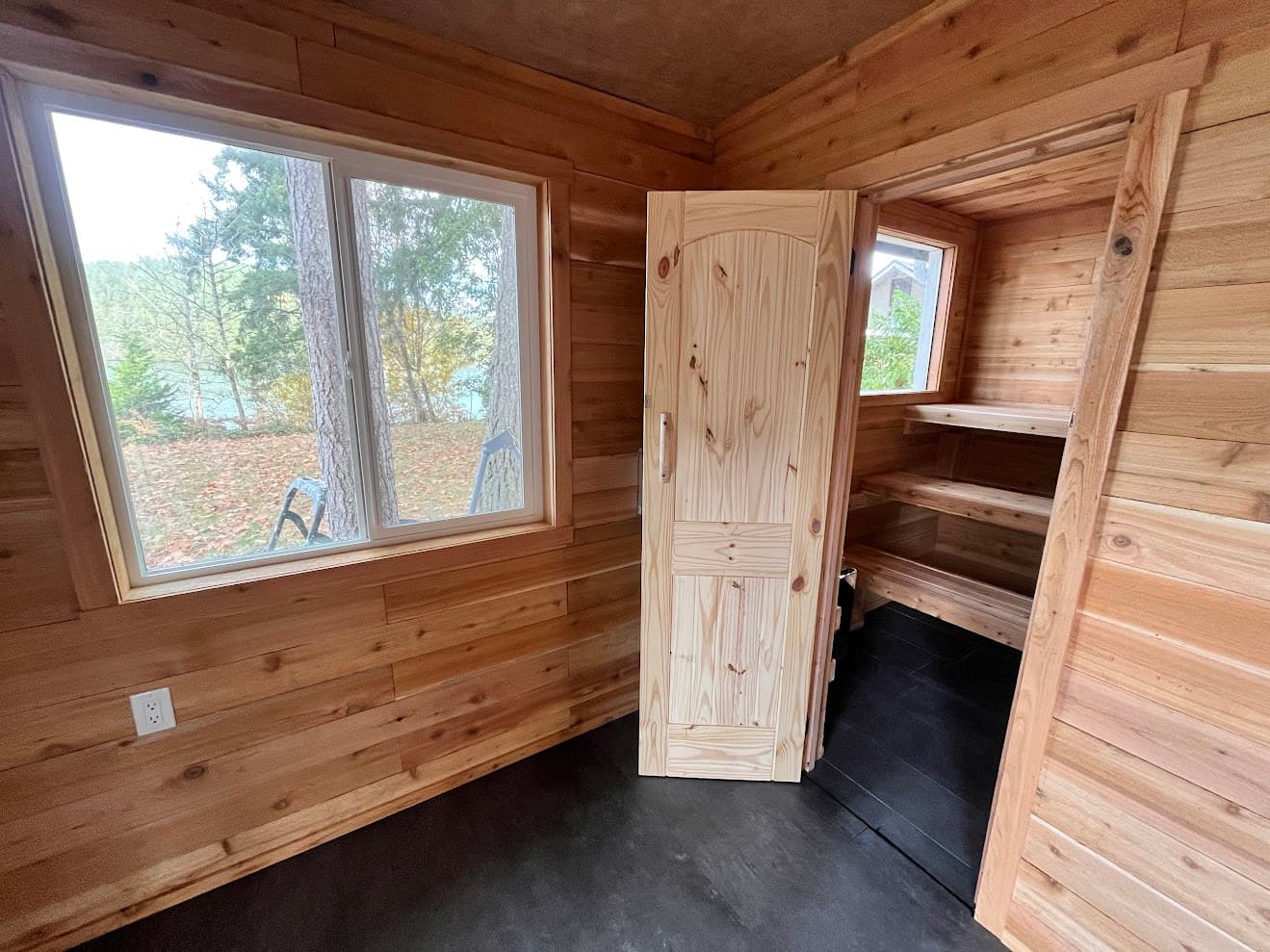
Benches are where you spend your entire sauna session. Getting the dimensions right is critical for comfort, safety, and thermal performance. I've designed benches for dozens of saunas, and the single most common mistake I see is benches at the wrong height relative to the heater — which creates the "cold feet" problem that ruins otherwise well-built saunas.
This guide provides exact dimensions, material cut lists, and step-by-step construction details for every common sauna size. If you're building your own sauna, bookmark this page — you'll reference it multiple times during the build.
Before we get into specific dimensions, there's one principle that overrides everything else: your feet must sit 4–8 inches ABOVE the top of the heater stones.
This zone above the stones is called the löyly cavity — it's where convective heat from the heater rises and distributes evenly. When you sit below this zone, your upper body is warm but your feet are cold. When you sit within or above it, the heat wraps around you uniformly. This is the difference between a sauna that feels mediocre and one that feels incredible.
How to calculate your bench height: Measure the distance from your floor to the top of your heater stones. Add 4–8 inches. That's your minimum upper bench surface height. For most floor-standing heaters, the stone tops are about 20–26 inches above the floor, so the upper bench needs to be at least 28–34 inches high. Wall-mounted heaters vary — always measure your specific unit.
The ceiling constraint: You also need 40–48 inches of headroom above the upper bench surface (so you can sit upright without hitting the ceiling). In a standard 7.5-foot (90-inch) ceiling sauna, that means your upper bench can be no higher than about 42–50 inches. With an 8-foot (96-inch) ceiling, you get a bit more range.
These two constraints — above the stones AND below the ceiling — define your bench height. Everything else follows from this.
The vertical distance between tiers should be 14–18 inches — enough to step up comfortably and sit on the lower bench without your knees hitting the upper bench.
Bench wood has different requirements than wall wood. You're sitting directly on it, often with bare skin, so the wood needs to not feel painfully hot, not splinter, and resist moisture without chemical treatment.
Trusted by homeowners across Tahoe and beyond
The tightest layout that still works as a real sauna. Single-tier only — there isn't room for two tiers in a 4-foot space.
Cut list (cedar 2×4s): 6 boards at 48" for bench surface (with 3/8" gaps = ~24" deep), 2 support brackets cut from 2×6, and 2 wall cleats at 48".
The most common small sauna size. Fits in a garage corner or closet conversion. Two-tier layout works here.
Cut list (cedar 2×4s): Upper bench: 6 boards at 72". Lower bench: 4 boards at 48". Support brackets: 4 from 2×6 (upper), 2 from 2×6 (lower). Wall cleats: 2 at 72", 1 at 48".
The most popular size for family saunas. Room for a full two-tier layout with an L-shape or U-shape option.
Cut list (cedar 2×4s): Upper: 6 boards at 96". Lower: 4 boards at 96". L-section upper: 6 boards at 72" (if building L-shape). Brackets: 5 from 2×6 (upper), 4 from 2×6 (lower). Wall cleats: as needed per bench length.
Room for a full three-tier or U-shaped layout. This is where bench design gets more interesting — you can have dedicated lying-down sections, separate sitting areas, and a real temperature gradient.
In saunas 6×8 and larger, L-shaped or U-shaped bench layouts maximize seating capacity and give you options — sitting upright in one section, lying down in another.
L-shaped: The bench wraps around one corner. In a 6×8 sauna, you might run 6 feet along the back wall and 4 feet along the side wall. This seats 3–4 people on the upper tier. The corner joint is the tricky part — you need a 45-degree miter on the surface boards and a corner support bracket underneath.
U-shaped: The bench wraps three walls, leaving the heater wall open. Best for saunas 8×8 and larger. Seats 6–8 people. The two corner joints each need the same miter and bracket treatment.
Corner construction tip: Use a heavy-duty L-bracket (stainless steel, minimum 3/16" thick) at each corner, bolted into studs on both walls. The corner is the highest-stress point because it carries weight from two directions. I typically use a 4×4 cedar post at the corner as additional support, running from floor to bench underside.
This is something most DIY guides skip, but it matters a lot for long-term maintenance: build your bench sections to be removable.
Removable benches let you clean the floor beneath them (sweat, water, and skin cells accumulate and can grow mold), inspect the wood for moisture damage, and replace individual boards without rebuilding everything.
How to make benches removable:
The support brackets/cleats stay permanently wall-mounted. Only the bench surface frames are removable.
Here's the actual build sequence for a standard two-tier bench system. This assumes your sauna walls and ceiling are already framed and finished.
Step 1: Mark your heights. Using a level and tape measure, mark the upper bench height and lower bench height on all walls where benches will be installed. Double-check against your heater stone height (feet must be 4–8" above stones). Use a laser level if you have one — bench surfaces that aren't perfectly level are immediately noticeable.
Step 2: Install wall cleats. Cut cedar 2×4s to bench length. Screw into wall studs at bench height using 3" stainless steel screws (minimum 2 screws per stud). These cleats carry all the weight, so don't skip studs.
Step 3: Build bench frames. Construct rectangular frames from cedar 2×4s — two long rails connected by cross-pieces every 16–20 inches. The frame depth matches your desired bench depth (24" for upper, 16" for lower). Test-fit each frame on its cleats before adding surface boards.
Step 4: Add support brackets. For benches wider than 4 feet, add angle brackets or vertical supports every 24–32 inches. The bracket connects from the wall cleat to the front edge of the bench frame. Without brackets, a 6-foot bench will sag under body weight.
Step 5: Attach surface boards. Lay 2×4 surface boards across the frame, perpendicular to the wall (front-to-back). Space boards 3/8–1/2 inch apart. Secure each board to the frame with two stainless steel screws per cross-piece. Critical: countersink all screw heads at least 1/4" below the surface — exposed metal gets painfully hot at sauna temperatures. Or use the hidden fastener method (screws driven up from below through the frame into the boards).
Step 6: Sand everything. Sand all surfaces and edges with 120-grit followed by 180-grit. Round over all edges and corners. Any sharp edge or rough spot will be uncomfortable on bare skin. Pay special attention to the front edge of the bench — that's where your legs rest.
Step 7: Install backrests (optional). Mount backrest boards on the wall behind the upper bench, angled 10–15 degrees off vertical (about 75–80 degrees from horizontal). Use 3–4 cedar boards with 1/2" gaps, supported by angled brackets at each stud.
Every piece of metal in your sauna needs to be stainless steel or properly coated. Regular steel rusts within months in sauna humidity. Galvanized hardware is acceptable for structural brackets behind walls but not for anything exposed to the sauna interior.
Budget tip: Stainless steel hardware costs 3–4× more than regular steel. It's worth it. One rusted bracket that fails while someone is sitting on the bench is a safety issue and a rebuild.
Backrests make a huge difference in comfort, especially for longer sessions. I install them on almost every sauna I design.
Keep backrest designs simple. Complex profiles with grooves and channels trap water and promote rot. Flat or gently curved boards with gaps between them dry faster and last longer.
Always space bench surface boards 3/8 to 1/2 inch apart. This serves multiple purposes: water and sweat drain through rather than pooling, air circulates around the wood for faster drying between sessions, and the boards can expand and contract with humidity changes without warping.
Leave 1–2 inches of clearance between the bench edge and adjacent walls. This gap allows air to flow behind and beneath the bench, which is critical for preventing mold in the bench-to-wall junction (the most common place for moisture damage in saunas).
Board orientation: Surface boards should run front-to-back (perpendicular to the wall). This allows water to drain toward the front of the bench and drip onto the floor rather than pooling against the wall.
These are the problems I see most often when reviewing DIY sauna builds:
Sauna benches require minimal maintenance if they're built correctly, but "minimal" doesn't mean "none."
Do not apply any finish or sealant to bench surfaces. No oil, no varnish, no stain. Bare wood breathes — finishes trap moisture and off-gas in heat. The only exception is paraffin-based sauna bench oil (like Supi Laudesuoja), which some people use to reduce staining from body oils. It's optional and mostly cosmetic.
The upper bench should be 40–48 inches below the ceiling, with the surface at least 4–8 inches ABOVE the heater stone tops. For most saunas with a standard heater, this means 36–42 inches above the floor. The exact height depends on your heater — always measure from the stone tops, not just from the floor.
16 inches minimum for sitting only, 24 inches for comfortable reclining (the most common upper bench depth), and 28–36 inches for full lying down. 24 inches works for both sitting and reclining without taking up too much interior space.
Cedar (western red or Alaskan yellow) is the most popular — naturally rot-resistant, pleasant smell, doesn't get painfully hot. Aspen is the best budget alternative at about half the cost. Thermally modified wood is the premium option with the best durability. Never use pine, spruce, or pressure-treated wood for bench surfaces.
Space boards 3/8 to 1/2 inch apart. This allows drainage, promotes airflow, and prevents mold. Also leave 1–2 inches between the bench and adjacent walls for air circulation.
Removable is strongly recommended. It makes cleaning the floor much easier, lets you inspect for moisture damage, and allows replacing individual boards. Use wall-mounted cleats with pin-and-socket or gravity-lock systems rather than permanent fasteners.
12 decisions that determine how well your sauna performs — insulation, bench height, heater sizing, ventilation, and more.
Have questions about your project? Send us a message or schedule a free 15-minute intro call.
Schedule a free 15-minute intro call or send us a message about your project.
We'll learn about your space, goals, and timeline — and recommend the right next step for your project.