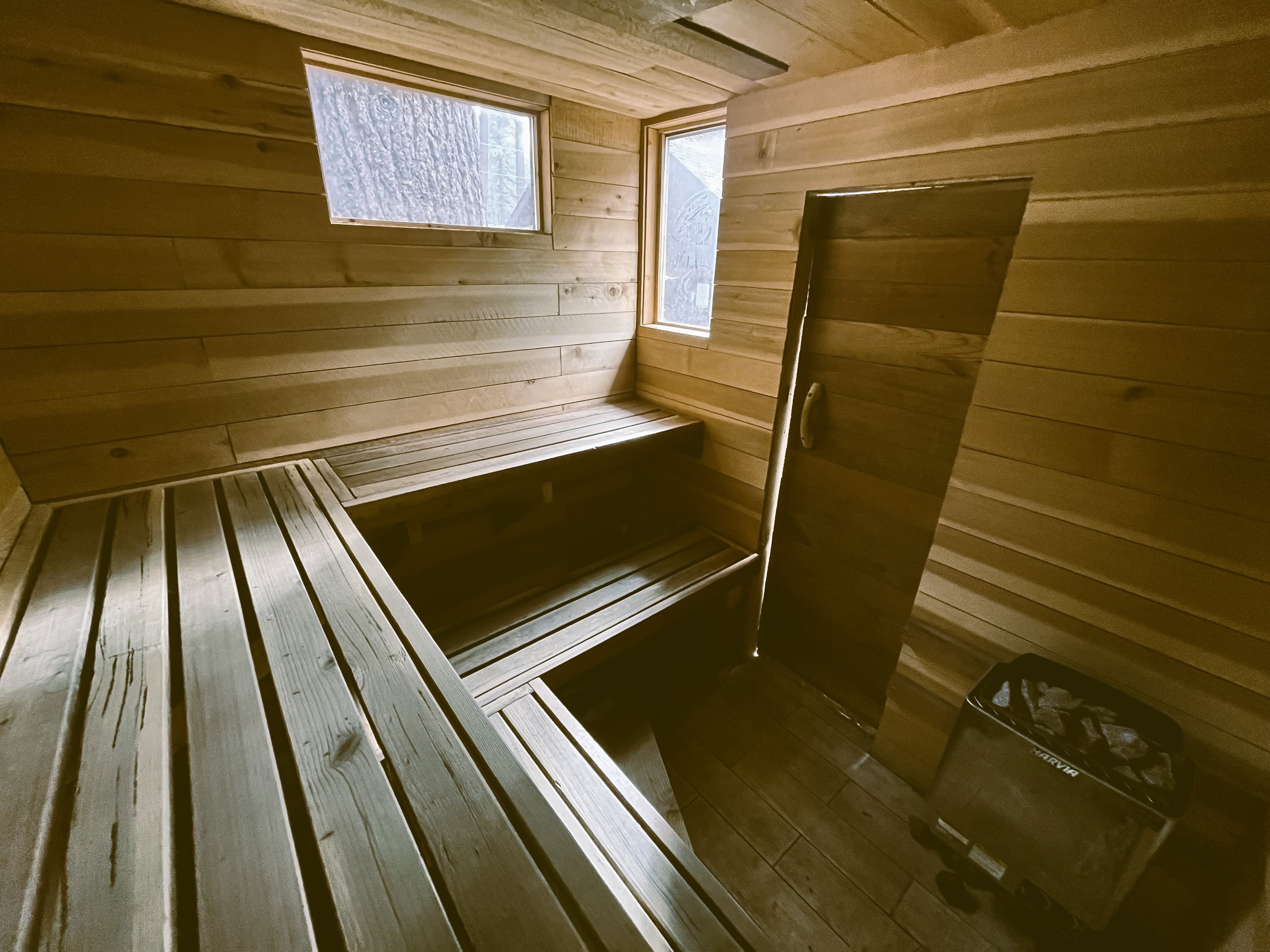
Garages are ideal for sauna conversion: good ceiling height, concrete floor, electrical panel usually nearby, and the space is already enclosed. Unlike basement saunas, garages have better air quality and simpler ventilation. Unlike outdoor builds, you avoid foundation work and weather exposure.
A typical garage sauna costs $3,000–$4,000 in materials for a 6.5×6.5-foot room that fits 2–3 people comfortably. You build an interior frame, insulate, add cedar paneling, benches, and heater. The garage walls become part of your sauna envelope.
Watch on our YouTube channel — subscribe for more builds →
Ceiling height: Most garages are 8–9 feet tall. You can frame a sauna room at 7–7.5 feet and still have headroom above to route ductwork or utilities.
Concrete floor: Ideal for a sauna. It's level, it drains, and tile adheres directly. No frost concerns, no wooden rot.
Electrical panel: Usually in or near the garage, cutting the cost of running a 240V circuit.
Existing walls and roof: The garage envelope provides protection. You're not building an outdoor structure from scratch.
Accessibility: Stepping directly from your house into a sauna is convenient. No outdoor exposure in winter.
You don't need the entire garage. A 6.5×6.5-foot corner or end section works great for 2–3 people. A 6×8 room fits 3–4 comfortably. Frame this room inside the garage using 2×4 studs.
Location matters: Choose a corner or end of the garage, not the middle. This simplifies ventilation (you have an exterior wall for exhaust ducts) and keeps the sauna isolated from the main garage work zone.
Height: Frame your sauna room to a finished ceiling height of 7–7.5 feet. In cold climates (Tahoe, mountain areas), a lower ceiling (6.5–7 feet) actually reduces heat-up time. The space heats faster with a smaller volume, and the experience is still excellent.
Trusted by homeowners across Tahoe and beyond
Build walls using 2×4 studs, 16 inches on center. Lay a sole plate (bottom plate) directly on the concrete floor. Attach the sole plate with concrete fasteners (powder-actuated nails or adhesive). Install top plates and king studs in the normal way.
Framing the ceiling: For a low-ceiling sauna (6.5–7 feet), build a flat ceiling frame at your target height using 2×6 joists spanning between the walls. This creates a horizontal surface to attach insulation and vapor barrier.
Door opening: Frame a rough opening for a 24-inch-wide sauna door, typically on the wall facing the garage interior. Standard sauna doors are 78–80 inches tall.
Fasteners: Use corrosion-resistant fasteners throughout. Concrete screws are best for anchoring to the slab.
Insulation values are critical. The sauna room is a box within a box — you're creating a thermal envelope.
Walls: R-13 minimum (R-15 or R-19 preferred in cold climates). Mineral wool batts fit between 2×4 studs. Install them with the kraft paper side facing outward (toward the garage), creating a loose vapor barrier on the exterior. Do not use the kraft paper as your primary vapor barrier.
Ceiling: R-30 minimum (R-38 ideal in snow-load climates). This is where most heat loss occurs. Use mineral wool batts in the frame you created above.
Vapor barrier: Install 6-mil polyethylene sheeting or heavy-duty aluminum foil sheeting on the interior face of the framing — the warm side. Overlap all seams by 6 inches and tape with aluminum foil tape. Seal around electrical penetrations with acoustical sealant. Sauna Vapor Barrier | Radiant Barrier Roll
The vapor barrier prevents warm, humid air from the sauna from infiltrating the wall assembly. Without it, condensation accumulates and the framing rots.
Over the vapor barrier, attach 1×2 or 1×3 furring strips vertically (or horizontally, depending on your preference). These create a small air gap between the vapor barrier and the cedar paneling.
Cedar paneling: Install Western Red Cedar tongue-and-groove boards horizontally, male edge (tongue) facing downward. Cedar resists rot, insulates moderately, and creates the traditional sauna aesthetic. Avoid softwoods like pine or spruce — they absorb moisture and deteriorate quickly.
Space the cedar boards 1/8 inch apart to accommodate wood movement from humidity changes. Do not force them tight — wood swells when humid and shrinks when dry.
A garage sauna needs fresh air and a path for humid air to exit. Trumpkin's research shows that proper ventilation is critical for steam quality, CO₂ levels, and thermal stratification. The standard North American ventilation design fails—fresh air entering LOW—so we recommend Trumpkin's mechanical downdraft approach.
Best practice (Trumpkin design): Fresh air intake 3–3.5" diameter positioned near or ABOVE the top of the heater — about 12" above the stove and 12" to the side of it, on the heater wall. This lets the heater's rising plume grab the fresh air and mix it into the hot air instead of letting it sink across the floor. Mechanical exhaust blower (100–125 CFM for a 4-person sauna) on the opposite wall below the foot bench. This pulls the mixed air down through the bench zone and removes CO₂-rich air at the lowest point without dumping the steam.
Intake: Near or above the top of the heater, about 12 inches up and 12 inches to the side of the stove, on the heater wall. Install a 3–3.5 inch vent with an adjustable cover and a backflow damper to prevent outside air coming back in.
Exhaust: Opposite wall, BELOW the foot bench (the lower bench). Install an inline duct blower (Fantech preferred, 4-6 inch ductwork, 100–125 CFM for a 4-person sauna). Run flexible ductwork to the exterior. Terminate with a louvered cap and damper.
Drying vent: Optional. A third vent high on the wall (6–10 inches below ceiling) on the exhaust wall, opened 1–2 hours after use to remove residual moisture.
Why this works: Fresh air entering above the heater gets grabbed by the rising heat, warmed, and distributed evenly. The fan under the foot bench pulls that air down through where you sit and breathe and takes the stale air out at the lowest point. This design reduces stratification (head-to-feet temperature difference) by 4–15°C, maintains CO₂ below 700 ppm, and improves steam quality dramatically. Use an Aranet4 air quality monitor to validate your CO₂ levels during sessions.
The concrete garage floor is your base. Clean it, check it for level, and assess any cracks. Minor cracks are acceptable; major ones (wider than 1/4 inch) suggest settling — have an engineer evaluate.
Tile installation: Install tile board (cement backerboard) over the concrete, then tile over that. Tile is durable, easy to clean, and drains quickly. A gentle slope (1/8 inch per foot) toward a small floor drain is ideal if you want water management, but not required.
Drain: Optional. If you add one, it simplifies cleanup after sauna sessions. If not, simply squeegee water toward the garage entrance.
Two tiers of benches provide comfortable seating and two thermal zones. Build benches from 2×4 or 2×6 cedar or redwood lumber. Trumpkin's research shows that bench positioning is critical for thermal comfort—benches positioned too low create the classic "cold feet" problem.
Upper bench: 40–48 inches below the ceiling. Position your feet 10–20cm (4–8 inches) ABOVE the heater's stone tops. This places you in the löyly cavity where convective heat is evenly distributed and steam delivery is optimal. At this height, bathers' heads are in the hottest zone, and feet are in the efficient heat zone.
Lower bench: 16–20 inches below the upper bench. Creates a step and a cooler zone for those who prefer less heat.
Support benches with vertical cedar posts anchored to floor studs or embedded in wall framing. Use stainless steel fasteners — regular steel rusts in the sauna environment. Slats should be spaced 1/2 inch apart for drainage and air circulation.
For a 6.5-foot-tall sauna, you might lower the upper bench to 38–40 inches to maintain comfortable head clearance above the benches, but still ensure feet are 4–8 inches above the heater stone tops.
All electrical work must be done by a licensed electrician. Do not DIY this.
Dedicated 240V circuit: Most residential electric heaters (6–9 kW) require 40–50A at 240V. Wire it as a dedicated circuit from the main panel (or a subpanel if the garage is far from the main panel).
Control unit location: Mount the heater control outside the sauna on the adjacent garage wall. The heater itself sits on a heat-resistant pad inside the sauna room, usually in a corner opposite the door.
Wire routing: All wires passing through the vapor barrier must be sealed with acoustical sealant to prevent humidity from infiltrating the insulation.
Permits and inspection: Electrical work will need a permit and inspection. Budget $100–$200 for the permit, plus $500–$1,500 for electrician labor (depending on distance from the main panel).
Install a sauna door (typically 24 inches wide × 78–80 inches tall) opening outward into the garage. Outward-opening doors are critical for safety.
Material: Solid wood or tempered glass. Solid wood is more common and less expensive.
Hardware: Stainless steel hinges and handle. Install a small vent gap (1/4 inch) at the bottom of the door frame to allow air circulation.
Calculate the sauna room volume: length × width × height in feet. For a 6.5×6.5×7-foot room, that's about 300 cubic feet.
Rule of thumb: 1 kW per 50 cubic feet of space. This 300-cubic-foot room needs a 6 kW heater. In cold garages (unheated in winter), add 20% buffer: 7–7.5 kW is safer.
Popular brands: Harvia, HUUM, EOS, Saunum. All are reliable. Budget $1,200–$2,500 for a quality 6–9 kW heater.
We designed a 6.5×6.5-foot garage sauna in Truckee, California. The project included:
The sauna reaches 180–200°F in 45 minutes. It maintains temperature well for 60-minute sessions. The lower ceiling in this space keeps heat-up time shorter than a tall sauna and the room feels intimate and cozy.
If your garage ceiling is only 8 feet, a 6.5-foot sauna ceiling is ideal. The benefits:
Do not fight low ceilings — work with them. A compact sauna is actually preferable to many builders.
Yes. A 5×6 or 6×6 room fits comfortably in a single-car garage and leaves room for tools and storage. It seats 1–2 people comfortably.
Cold ambient temperatures mean your heater works harder to reach sauna temperature. Insulation becomes more critical. Use R-15+ in walls, R-38+ in ceiling, and size the heater with a 20% cold-climate buffer.
Yes, if your garage is ventilated. But venting exhaust outside is preferable — it removes humid air completely rather than circulating it into the garage. If venting to outside, you'll need flexible ductwork and louvered exterior terminations.
DIY: 4–6 weeks working weekends. With a contractor: 2–3 weeks continuous. Time depends on skill level and available labor.
In most jurisdictions, yes — at minimum for electrical work. Some areas also require a building permit for interior structures. Check with your local building department. Electrical work will definitely need a permit and inspection.
Tile over cement board is ideal. It's durable, easy to clean, drains quickly, and lasts decades. A gentle slope toward a floor drain is nice but not required.
Yes. A 6.5×6.5 room is a good starting point. You can always frame a larger room in the future if your needs change.
12 decisions that determine how well your sauna performs — insulation, bench height, heater sizing, ventilation, and more.
Have questions about your project? Send us a message or schedule a free 15-minute intro call.
Schedule a free 15-minute intro call or send us a message about your project.
We'll learn about your space, goals, and timeline — and recommend the right next step for your project.