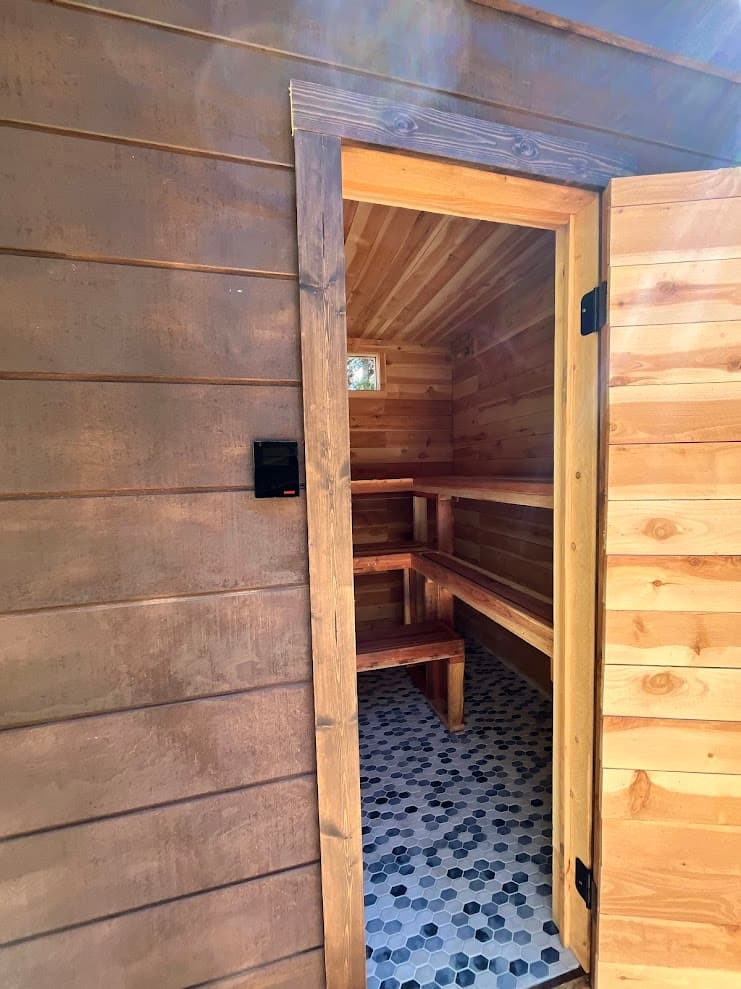
A garage is one of the most practical spaces to convert into a sauna. The footprint is already there, the roof is overhead, and you usually have access to a dedicated electrical circuit. But garage saunas have specific challenges that standard construction guides don't cover — cold concrete floors, uninsulated walls, and moisture that has nowhere to go unless you design for it.
This guide covers the decisions that matter most. Our role at Tahoe Sauna Company is design and planning. Construction is handled by a licensed contractor you hire directly.
Most garage sauna builds are self-contained rooms built inside the garage rather than using the garage walls directly. This approach lets you insulate properly and keeps the moisture entirely contained within the sauna envelope.
For most households, a 6×8 or 6×10 interior gives enough room for an upper bench and a lower step bench — comfortable for 2–4 people. Ceiling height should land between 7 and 7.5 feet; higher ceilings take longer to heat and require a larger heater.
Heater sizing is based on cubic feet: multiply length × width × height. If your space has glass, add roughly 1 kW per square foot of glass area. For cold climates like Tahoe and Truckee, add a 20% buffer on top of the manufacturer's rated capacity — cold ambient temperatures in an unheated garage mean the heater works harder to reach temperature.
Concrete pulls heat out of the sauna continuously. If you frame directly on an uninsulated concrete slab, you will struggle to maintain temperature and your energy bill will reflect it. The fix is a sleeper floor: pressure-treated 2×4s laid flat on the concrete, rigid foam insulation between them, and a plywood subfloor on top. This lifts the assembly off the slab and eliminates the cold thermal bridge.
Walls need R-19 minimum in 2×6 framing. Ceiling gets R-38. In an unheated Tahoe garage where ambient temperature can drop below 10°F, this insulation level is the floor, not the target.
Trusted by homeowners across Tahoe and beyond
The vapor barrier is the most commonly installed wrong. It goes on the interior face of the framing — between the insulation and the cedar paneling — not on the exterior face. Seams should overlap 8 inches and be taped with aluminum foil tape. Every electrical box, every penetration, needs to be sealed with acoustical sealant. Sauna Vapor Barrier | Radiant Barrier Roll
If the vapor barrier goes on the wrong side, you trap moisture inside the wall assembly. That moisture condenses on cold framing, stays wet, and eventually rots the structure. The fix is expensive — you have to open the wall.
A sauna without proper ventilation feels stale and uneven. The correct configuration uses two dampered vents: one intake and one exhaust. The intake goes low on the heater wall — about 6 to 10 inches above the finished floor — and draws fresh air in near the heat source. The exhaust goes high on the opposite wall, 6 to 10 inches below the ceiling, and lets spent air out. Both should be adjustable galvanized dampers with exterior louvered covers.
In a garage, these vents penetrate the interior sauna wall and exhaust into the garage itself, not outside. This is acceptable as long as the garage is ventilated. If you want the exhaust to terminate outside, plan the duct routing before framing begins.
Most residential electric sauna heaters in the 6–9 kW range require a 240V/40A dedicated circuit with GFCI protection at the panel. The control unit mounts outside the sauna on the adjacent wall. Wire must be rated for the heat environment and routed through the vapor barrier with proper sealing.
This work requires a licensed electrician and will need an inspection in most jurisdictions. Budget for the permit.
In most jurisdictions, yes — at minimum for the electrical work. Some areas also require a building permit for the interior structure. Check with your local building department early. We note permit requirements in our design packages.
A 6×8 or 6×10 interior room is a comfortable fit in most two-car garages and still leaves room to work around the sauna. Smaller spaces like a 5×6 work for one or two people.
Yes — but insulation specifications matter more than in a conditioned space. Use R-19 in the walls, R-38 in the ceiling, and insulate the floor off the concrete slab. Size the heater with a cold-climate buffer.
We focus on design and technical planning. We produce the drawings and specifications your licensed contractor uses to build. We can also help you find a qualified builder in the Lake Tahoe and Truckee area.
12 decisions that determine how well your sauna performs — insulation, bench height, heater sizing, ventilation, and more.
Have questions about your project? Send us a message or schedule a free 15-minute intro call.
Schedule a free 15-minute intro call or send us a message about your project.
We'll learn about your space, goals, and timeline — and recommend the right next step for your project.