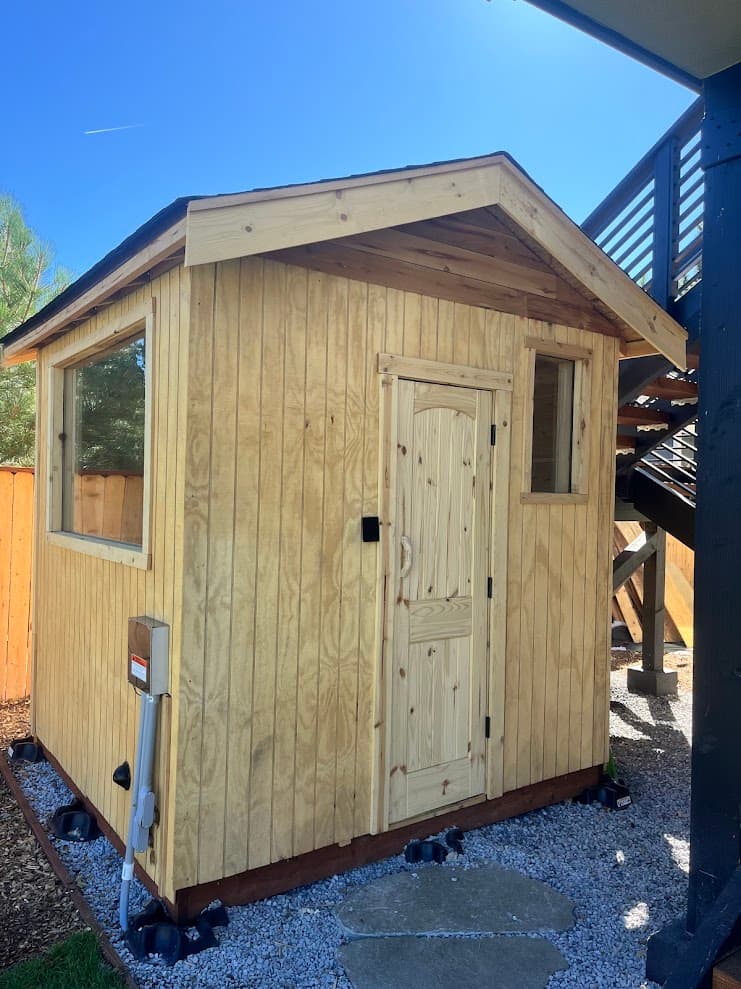
One of the first questions we hear from sauna owners is: should it go inside or outside? Both deliver an excellent sauna experience when designed well. The right choice comes down to your available space, total budget, climate, and how you want to use the sauna.
In mountain regions like Lake Tahoe and Truckee, the decision carries extra weight. Cold, snow, and elevation create design demands that flat-land sauna guides don't address. This guide breaks down both paths honestly — the real costs, the design challenges, and the trade-offs — so you can decide with clear expectations.
An outdoor sauna is a freestanding building on your property — built on a foundation, deck, or gravel pad. This dedicated structure gives you advantages you can't get inside your home.
Our recommended size for outdoor saunas is 8×8 feet interior. This fits 4–6 people comfortably on the top bench, with room for a small changing area in front.
The trade-off is cost and complexity. An outdoor sauna requires a foundation, framing, roofing, exterior cladding — everything a small building needs — plus the interior sauna finish.
Trusted by homeowners across Tahoe and beyond
Lake Tahoe, Truckee, and similar mountain communities experience snow, sub-freezing temperatures, and high elevation. Outdoor saunas here require specific design choices that generic guides miss.
Your roof must be engineered or overbuilt for local snow load requirements. At Tahoe elevations, this typically means a 3:12 pitch minimum and engineered rafters. A flat roof or 2:12 pitch will accumulate snow, adding weight and creating interior leaks. A steep pitched roof (4:12 or higher) sheds snow naturally and reduces maintenance.
If your outdoor sauna includes a shower or water lines, they must be heat-taped or drained after use in winter. Prefab saunas with exterior decorative showers can develop freeze damage if not designed for cold climates. Plan for drainage or winterization from the start.
In an unheated outdoor structure at elevation, add 20% to the manufacturer's recommended heater capacity. A standard 8kW heater might need to be 9.6kW to overcome the cold ambient temperature and reach 180–200°F reliably in winter. The sauna needs to fight the outside cold to maintain temperature.
Frost-prone soil (which describes most of the Sierra) requires foundations below the frost line — typically 24–36 inches at Tahoe elevations. Floating deck foundations with adjustable footings are common and easier to adjust if settling occurs. Concrete piers are more permanent but require deeper holes.
An indoor sauna converts existing space — a garage, basement, spare room, bathroom, or even a shed. The building envelope is already there, which cuts the total cost significantly and simplifies weather during construction.
The design challenges for indoor saunas are different from outdoor, but they're not more expensive — just different. Vapor control and ventilation are the critical engineering points.
Inside a sauna, you're creating heat and moisture. That moisture needs to stay inside the sauna envelope and not migrate into adjacent walls. This requires a continuous vapor barrier on the interior face of all framing — typically 6-mil polyethylene, with all seams taped and all penetrations sealed (electrical outlets, light fixtures, vents). If this is done incorrectly, moisture seeps into the wall assembly, insulation, and framing, causing invisible rot and expensive repairs years later. A properly detailed vapor barrier prevents this entirely.
You need both an intake and an exhaust path. Fresh air enters on the heater wall near or above the top of the heater, and a small fan pulls it out below the foot bench on the opposite wall to the outside. This can be as simple as a 4-inch duct through one wall (garage or basement), or it can be more complex if you need to route ductwork through an attic or basement to reach an exterior wall in a finished space.
Garages are the most common location for indoor saunas. They have good ceiling height (usually 8–9 feet in 2-car garages), concrete floors, and are semi-detached from living spaces, making moisture concerns easier to manage.
Example build: One of our 6.5×6.5 garage saunas cost the clients $3,000–$4,000 in materials. The garage was open-framed and unfinished, so site prep was minimal. We built a cedar interior, installed rigid foam insulation (R-13), a vapor barrier, and a Harvia KIP 8kW electric heater. The sauna reaches 180–200°F in about 1 hour. Total installed cost was around $12,000 (including electrical work and labor). The owners use it 3–4 times a week in winter.
Garage saunas work especially well if you can reserve a bay for the sauna. A double garage with a sauna in one bay still leaves parking space in the other.
Basements offer good humidity containment — the concrete and below-grade structure naturally shed moisture. The challenge is ceiling height. Many basements have 7-foot ceilings, which is workable but tight. Basement saunas also require careful drainage planning if there's any history of water in the space.
Cost range: Materials $4,000–$7,000; installed $10,000–$18,000. The higher labor cost reflects drainage details and the coordination needed to route ventilation through the main structure.
If you have a master bath or spare bathroom with room, a small sauna (4×5 feet) is feasible. This is the most compact option and works well for couples or solo users. You get the convenience of showering immediately before or after.
Cost range: $2,000–$3,500 materials; $8,000–$12,000 installed.
A detached shed or studio is technically outdoor (no house attachment), but it's more straightforward than a full sauna building. If you have a 10×12 shed, you can partition 8×8 for the sauna. This is a budget-friendly middle ground.
| Type | Materials | Installed Cost |
|---|---|---|
| Garage conversion (6.5×6.5) | $3,000–$4,000 | $8,000–$14,000 |
| Basement conversion | $4,000–$7,000 | $10,000–$18,000 |
| Outdoor 8×8 (DIY materials) | $4,000–$8,000 | $4,000–$8,000 |
| Outdoor 8×8 (professional) | — | $8,000–$20,000+ |
| Outdoor luxury (custom finish) | — | $20,000–$55,000+ |
Key insight: DIY-friendly indoor conversions and DIY outdoor builds can be similarly priced ($4,000–$8,000 in materials). The difference appears when you factor in labor: indoor conversions have simpler labor (fewer structural decisions), while outdoor builds require foundation and roofing work that's more specialized.
Ask yourself these questions to clarify the right choice:
If you have the space and budget for a dedicated outdoor sauna, build it. An 8×8 outdoor structure delivers the best overall sauna experience — the design freedom, the cooling ritual, the potential for wood-burning, the landscape presence. Total cost: $4,000–$20,000 in materials depending on DIY vs. professional and finish level.
If space or budget is constrained, an indoor garage conversion is your best path forward. It costs less ($3,000–$4,000 materials), requires no foundation or roofing, and delivers a sauna that reaches full temperature quickly. You sacrifice the outdoor cooling experience, but you gain year-round accessibility and a much lower barrier to entry.
The worst outcome is delaying the decision indefinitely. A well-built sauna — indoors or out — is worth having sooner rather than later. Start with what you have (your space and budget), execute it well, and enjoy it for years.
Whether you choose indoor or outdoor, the interior finish matters most — this is where you spend time. Cedar walls, proper heating, good ventilation, and a comfortable bench design all affect how much you'll use the sauna. Indoor saunas often neglect ventilation or cut corners on vapor barriers, leading to problems. Outdoor saunas often underbuild the interior, leaving you with a cold, uncomfortable space.
Our design packages address all of this: we detail the vapor barrier, size the heater correctly, design the bench for real use, and ensure ventilation works. Whether you DIY or hire a professional, the right design makes the difference between a sauna you use weekly and one that sits unused.
In terms of materials, they're similar ($4,000–$8,000 DIY). The difference emerges in labor: outdoor saunas need roofing, foundation, and exterior work that require more specialized skills. A professional outdoor build costs more ($8,000–$20,000+) than a professional indoor conversion ($8,000–$14,000) for the same size.
Technically yes, but not recommended. Basements, garages, bathrooms, and sheds are better because moisture control is simpler, ventilation routing is easier, and you're not risking your main living space if something goes wrong. If you must use a finished room, expect higher humidity management costs and ongoing maintenance.
Yes. An unheated outdoor structure in sub-freezing mountain temperatures requires a larger heater and more insulation. Add 20% to the standard heater capacity, use R-21+ walls and R-30+ ceiling insulation, and plan for a steeper roof pitch to shed snow. These investments ensure reliable performance in winter.
Only if the vapor barrier is installed poorly or penetrations aren't sealed. A properly built indoor sauna keeps all moisture inside the sauna envelope. We detail vapor control in every design to prevent invisible damage to framing and insulation.
For indoor garages and small spaces, 6–8kW is standard. For larger or cold outdoor builds, 9–12kW. Harvia and Sauna House are reliable brands. We recommend based on your specific size and climate in the design phase.
Wood-burning is only practical outdoors. It requires a chimney, foundation design to handle masonry weight, regular maintenance, and chimney inspection. It's beautiful and traditional, but adds $2,000–$4,000+ to the build and requires ongoing effort. Electric heating is simpler and just as effective for modern builds.
12 decisions that determine how well your sauna performs — insulation, bench height, heater sizing, ventilation, and more.
Have questions about your project? Send us a message or schedule a free 15-minute intro call.
Schedule a free 15-minute intro call or send us a message about your project.
We'll learn about your space, goals, and timeline — and recommend the right next step for your project.