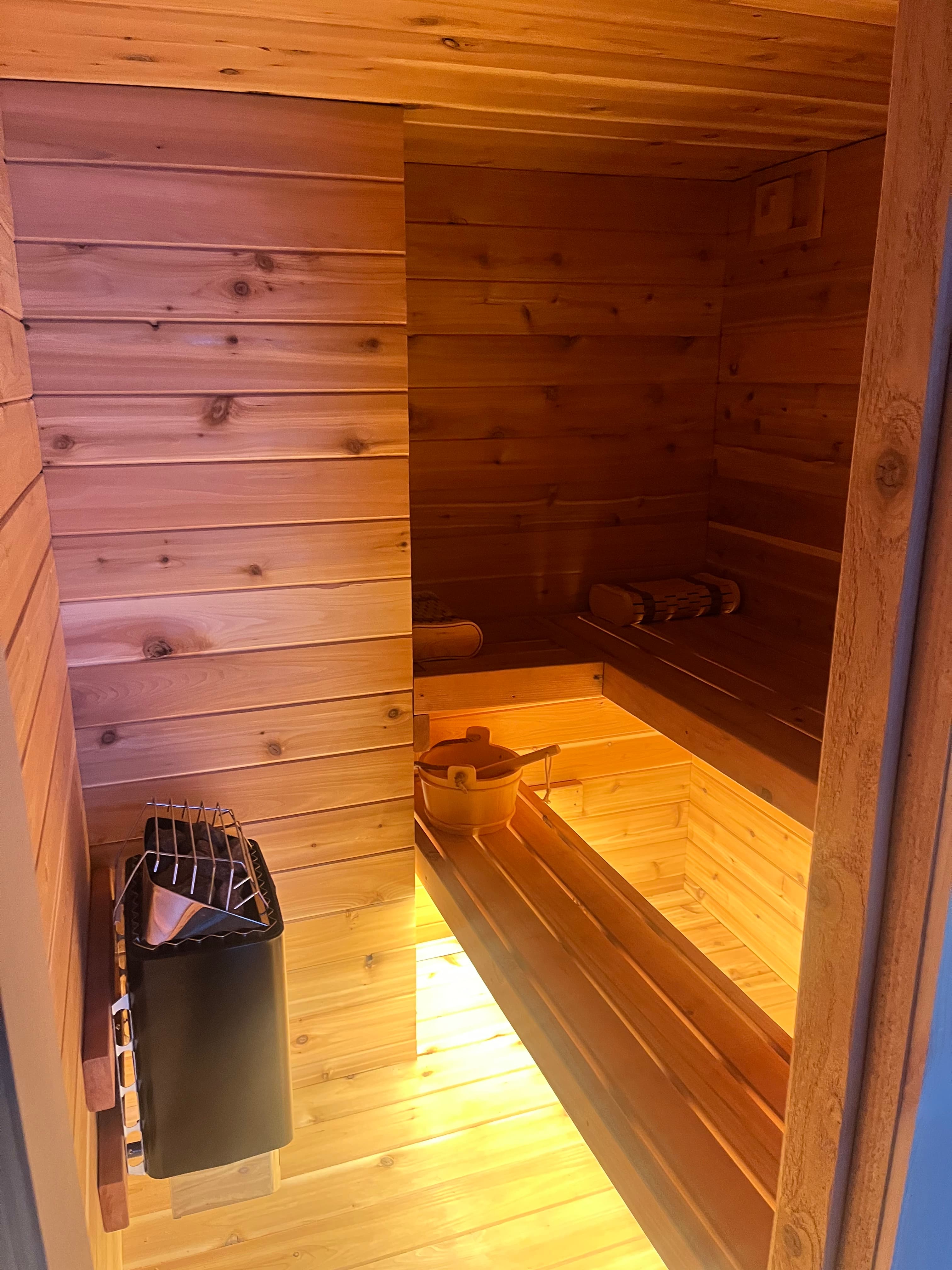
Basements are a popular indoor sauna location. The existing enclosure provides insulation from weather, access from inside the house is convenient, and temperature stays stable. However, basements are inherently damp — moisture control becomes your primary concern. With proper planning, a basement sauna is entirely feasible and provides a luxurious spa-like experience.
A typical basement sauna costs $3,000–$7,000 total for a 6×8 or 6.5×8-foot room, including materials and electrical. The main challenges are confirming ceiling height, routing ventilation to the exterior, and managing moisture. All are solvable with standard construction techniques.
For a detailed cost breakdown of all renovation types, see our sauna renovation cost guide.
The first and most important step: measure your basement ceiling. This single measurement determines feasibility.
Minimum: 7 feet from finished floor to framing above. Many finished basements have drop ceilings at 6.5–7 feet — confirm what's below the drywall. If the structural ceiling is lower, you may still be able to build a sauna, but it will feel tight.
Ideal: 7.5+ feet. This gives comfortable head room on the upper bench and feels spacious.
Account for finished thickness: If you're building a sauna room within the basement, remember that insulation, vapor barrier, and cedar paneling add 6–8 inches. If you frame a sauna room against a basement wall, the interior ceiling will be lower than the raw basement ceiling.
If your basement ceiling is 6.5–7 feet, you can still build a sauna. Lower ceilings have advantages: faster heat-up, lower operating costs, cozier feel. Just confirm you're comfortable with the scale before investing in materials.
Before you order a single board, assess your basement's moisture situation. Basements are naturally damp. If your basement already has moisture problems — efflorescence, soft spots, or visible water intrusion — fix those first.
Moisture signs to watch for:
If your basement has these issues, a sauna will make them worse. The sauna adds humidity, which the existing moisture problems can't handle. Repair your moisture issues first — better foundation drainage, sump pumps, dehumidifiers — before building the sauna.
For a normally dry basement: You can proceed. The sauna room will have its own moisture envelope, isolated from the rest of the basement.
Trusted by homeowners across Tahoe and beyond
A basement sauna must vent humid air to the exterior, not back into the basement. This is non-negotiable. Recirculating humid air into the basement defeats the purpose of moisture control. Trumpkin's research identifies improper ventilation as the #1 problem plaguing North American saunas.
Best practice (Trumpkin design): Mechanical downdraft ventilation—fresh air entering ABOVE the heater and exhaust blower removing CO₂-rich air BELOW the foot bench on the opposite wall. This design also improves thermal stratification and steam quality.
Exhaust routing: Run ductwork from the sauna room to the outside of the house. Options:
Use 4-inch flex ductwork or rigid duct. Insulate the ductwork if it runs through unheated space to prevent condensation inside the duct. Terminate outside with a louvered vent cap to prevent weather intrusion. Install a damper or butterfly valve to close off the vent when sauna isn't in use.
Intake: Fresh air supply 3–3.5" diameter on the heater wall, about 12" above the top of the heater and 12" to the right of it (beside the heater, not directly over it). The heater's rising plume grabs the fresh air and mixes it into the hot air so it's distributed evenly instead of sinking across the floor. Exhaust blower (100–125 CFM for a 4-person sauna) on the opposite wall below the foot bench pulls that mixed air down through the bench zone and takes the CO₂-rich air out at the lowest point without dumping the hot steam at the ceiling. Validate with an Aranet4 air quality monitor — CO₂ should stay below 700 ppm during a full session.
Frame the sauna room using 2×4 studs at 16 inches on center. Lay the sole plate (bottom plate) directly on the concrete floor. Attach with concrete fasteners (powder-actuated nails or construction adhesive).
Ceiling: If your basement has an existing drop ceiling or framing above at the desired height, you can use it. Otherwise, frame a flat ceiling using 2×6 joists at your target height (typically 7–7.5 feet). This creates a surface to attach insulation.
Door opening: Frame a rough opening for a 24-inch-wide sauna door. Standard sauna doors are 78–80 inches tall.
Moisture consideration: Avoid pressure-treated lumber if possible. Use regular framing lumber and rely on the vapor barrier for moisture protection. Pressure-treated wood is overkill and introduces chemicals you don't want in a sauna.
Basement floors are concrete and often slightly damp. Prepare it properly.
Moisture barrier: Install a 6-mil polyethylene moisture barrier directly on the concrete before tiling. This prevents capillary moisture from wicking up into the tile assembly.
Tile substrate: Install cement board over the polyethylene, then tile over that. Cement board resists moisture better than drywall and provides a solid base for tile adhesive.
Slope and drainage: A gentle slope (1/8 inch per foot) toward a floor drain is ideal. Many basements already have floor drains — route your sauna floor toward it. If not, simply squeegee water out after use.
Basement saunas require the same insulation specs as garage saunas, but with extra attention to the vapor barrier.
Walls: R-13 to R-19 mineral wool batts between the studs. Mineral wool is preferable to fiberglass in basements because it resists moisture absorption. Install it with the kraft paper side facing outward (toward the concrete basement wall).
Ceiling: R-30 to R-38 mineral wool. This is critical — you have living space (or at least conditioned space) above, and you want to insulate from it.
Vapor barrier: Install 6-mil polyethylene or heavy-duty aluminum foil sheeting on the interior face of the framing — the sauna-facing side. Overlap all seams by 6 inches and tape with aluminum foil tape. Seal around every electrical penetration, every vent opening, every pipe with acoustical sealant. Sauna Vapor Barrier | Radiant Barrier Roll
In a basement, the vapor barrier is your most critical line of defense. It prevents humid sauna air from infiltrating the wall assembly. Without it, moisture condenses inside the walls, and the structure deteriorates.
Over the vapor barrier, install 1×2 or 1×3 furring strips. These create a 1–1.5-inch air gap between the vapor barrier and the cedar paneling, allowing any residual moisture to circulate.
Cedar paneling: Install Western Red Cedar tongue-and-groove boards horizontally. Orient them with the male edge (tongue) facing downward. This directs any surface moisture downward rather than into the joints.
Cedar is essential for sauna interiors. It resists rot naturally, feels good to the touch, and creates the proper aesthetic. Never use softwoods like pine or spruce in a sauna.
Space boards 1/8 inch apart to allow for wood movement as humidity changes.
Install ductwork to carry humid air from the sauna to the exterior. Use 4-inch flexible or rigid duct. Insulate the duct if it runs through unheated space.
Exhaust vent: Mount inside the sauna room below the foot bench, on the wall opposite the heater, on a wall that you can duct to the exterior. Connect it to the inline fan so it pulls air down through the bench zone and out at the lowest point.
Intake vent: On the heater wall, about 12 inches above the top of the heater and 12 inches to the right of it. Passive, with an adjustable damper (galvanized or stainless steel). Can pull from the basement or from outside via a separate intake duct.
Drying vent: Optional. High on a wall (6–10 inches below ceiling) to open after use for drying.
All vents should have dampers to control airflow and prevent cold air intrusion when the sauna isn't in use.
Two-tier benches using 2×4 or 2×6 cedar lumber, mortised into wall studs for support. Bench height and positioning are critical per Trumpkin's research—benches that sit too low create cold feet and poor steam delivery.
Upper bench: 40–48 inches below the ceiling. Position your feet 10–20cm (4–8 inches) ABOVE the heater's stone tops. This places you in the löyly cavity—where convective heat is even and steam distributes properly. In a low-ceiling basement, you may lower this to 36–40 inches, but still maintain the 4–8 inch clearance above stone tops.
Lower bench: 16–20 inches below the upper bench.
Anchor with stainless steel fasteners (brass and stainless resist rust in humidity). Space slats 1/2 inch apart for drainage and air circulation. Test all joints for stability — benches bear body weight and must be rock solid.
Licensed electrician required. All electrical work in basements has additional moisture-related code requirements.
Dedicated 240V circuit: Most residential heaters (6–9 kW) need 40–50A at 240V. Wire must be rated for moisture environments (if code requires it).
GFCI protection: Likely required for any outlet in a basement sauna due to moisture.
Control unit: Mount outside the sauna room on the basement wall. All wires penetrating the vapor barrier must be sealed.
Permits and inspection: Electrical work will need a permit and inspection. Budget $100–$200 for permit, $500–$1,500 for electrician labor.
Install a sauna door (24" wide × 78–80" tall) opening outward into the basement room. Outward-opening doors are essential for safety.
Material: Solid wood or tempered glass.
Hardware: Stainless steel hinges and handle. Install a 1/4-inch vent gap at the bottom of the door frame for air circulation.
Calculate room volume: length × width × height in feet. For a 6×8 basement room at 7-foot height: 6 × 8 × 7 = 336 cubic feet.
Rule of thumb: 1 kW per 50 cubic feet. This room needs 6.7 kW, so an 8 kW heater is appropriate.
Note: Basements are temperature-stable (cooler than garages). The heater works efficiently without the cold-climate penalties you'd see in an unheated garage or outdoor space.
Popular brands: Harvia, HUUM, EOS, Saunum. Budget $1,200–$2,500.
If your basement ceiling is 6.5–7 feet, you can still build a sauna. The strategy:
A 6.5-foot sauna is still enjoyable. The lower ceiling doesn't ruin the experience — it just creates a different aesthetic.
Not necessarily. Normal basement dampness (the air is slightly humid) is fine. Moisture problems — seepage, efflorescence, soft concrete — must be fixed first. A well-built sauna with proper vapor barriers will handle normal basement humidity.
No. Venting into the basement circulates humid sauna air into the rest of the basement, which defeats the purpose of moisture control. Always vent to the exterior.
You can still build a sauna. Lower the upper bench to 36–38 inches, accept the cozier scale, and enjoy the faster heat-up time. The experience is excellent at this height.
If your basement runs slightly humid, a dehumidifier helps. But with proper ventilation to the exterior during sauna sessions, humidity shouldn't accumulate in the surrounding basement space.
Run 4-inch flexible ductwork from the sauna room to a basement window (simplest), up a wall cavity to above-grade, or to a rim joist. Terminate outside with a louvered vent cap. Work with your electrician and builder to plan the route before framing.
In most jurisdictions, yes — at minimum for electrical work. Some areas require a building permit for basement finishing projects. Check with your local building department.
Yes. Scale the room to your basement. A 6×10 or 8×8 room works as long as ceiling height allows. Just follow the same insulation, vapor barrier, and ventilation principles at larger scale.
12 decisions that determine how well your sauna performs — insulation, bench height, heater sizing, ventilation, and more.
Have questions about your project? Send us a message or schedule a free 15-minute intro call.
Schedule a free 15-minute intro call or send us a message about your project.
We'll learn about your space, goals, and timeline — and recommend the right next step for your project.