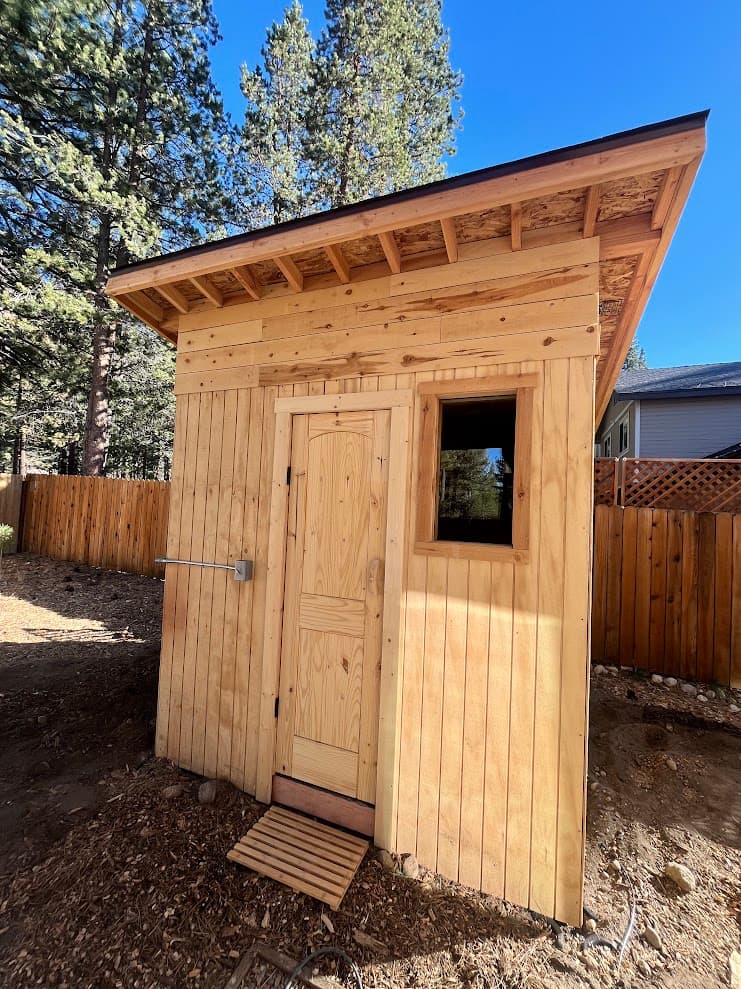
Converting an existing shed is one of the most popular and cost-effective ways to get a sauna. The structure already exists — you're adding insulation, vapor barrier, interior finish, heater, and ventilation. This approach can save thousands compared to building from scratch, and the shed provides a weather-tight envelope from day one.
A typical shed conversion runs $3,000–$5,000 in materials for a 6×8 or 8×10 space. The timeline is faster than an outdoor build because the roof and exterior walls are already there. Your main work is creating the interior climate envelope.
Before you order materials, confirm the shed can work. Check three things: ceiling height, structural integrity, and electrical access.
Ceiling height: Measure to the interior underside of the roof. You need a minimum of 7 feet, ideally 7.5 feet or more. If the shed has 6.5-foot ceilings, you can still build a sauna, but heat-up time increases and the space feels tighter.
Structural integrity: Inspect the walls, roof framing, and foundation. Look for rot, settling, or damage. The shed roof must support the interior weight of benches, people, and heater. Tap framing lumber with a hammer — solid wood should sound firm, not hollow. If you see soft spots, water damage, or cracked posts, have a structural engineer assess before proceeding.
Electrical access: Locate your main electrical panel and measure the distance to the shed. Most residential heaters (6–9 kW) require a dedicated 240V/40A circuit. If the panel is more than 100 feet away, you may need a subpanel, which adds cost and complexity.
Proper insulation keeps heat inside and eliminates cold spots. Shed conversions typically have minimal or no existing insulation. You'll insulate all walls and the ceiling.
Wall insulation: R-13 to R-21 minimum. For a 2×4 framed wall, R-13 fiberglass or mineral wool batts fit between the studs. For better performance, use R-15 or R-21 mineral wool (slightly thicker, better fire rating). In cold climates like Tahoe, aim for R-19.
Ceiling insulation: R-30 minimum. This is critical — heat rises, and an uninsulated ceiling will dump warmth directly outdoors. Use mineral wool batts or blown-in cellulose between the roof rafters. R-38 is ideal in snow-load climates.
Material choice: Mineral wool is preferred over fiberglass because it doesn't absorb moisture and maintains R-value when damp. In a humid environment like a sauna, this matters.
Trusted by homeowners across Tahoe and beyond
The vapor barrier is your defense against moisture damage. Install it on the warm side (interior face) of the framing, between the insulation and the cedar paneling.
Material: Heavy-duty aluminum foil sheeting (6-mil minimum). Staple it to the framing before installing interior panels. Sauna Vapor Barrier | Radiant Barrier Roll
Sealing: Overlap all seams by 6 inches minimum. Tape every seam with aluminum foil tape — ordinary duct tape will fail in the heat and humidity. Seal around every electrical penetration, every pipe, every vent opening with acoustical sealant before the interior panels go on.
Common mistake: Installing the vapor barrier on the exterior. This traps moisture inside the wall assembly, leading to condensation, rot, and structural failure. If you have any doubt, post photos and ask your electrician or a framing carpenter to confirm placement before taping.
Over the vapor barrier, install a 1/4- to 1/2-inch air gap using furring strips (thin wooden spacers). This gap allows any residual moisture to dry between uses.
Furring strips: 1×2 or 1×3 lumber, attached horizontally over the vapor barrier with stainless steel fasteners.
Interior finish: Western Red Cedar tongue-and-groove (T&G) paneling, installed horizontally with the male edge (tongue) facing downward. This directs any condensation down and out, not into the joints. Space panels 1/8 inch apart to allow for seasonal wood movement.
Cedar is the standard for sauna interiors. It resists rot, smells great, and feels good underfoot. Avoid spruce or pine — they absorb moisture and don't hold up well in the sauna environment.
A properly ventilated sauna stays fresh and warm. Most shed conversions use a three-hole system: intake, exhaust, and drying vent.
Intake: On the heater wall, near or above the top of the stove — about 12 inches above the top of the heater and 12 inches to the right of it. Fresh air entering there gets grabbed by the heater's rising plume and mixed into the hot air instead of sinking cold across the floor.
Exhaust: Opposite wall, below the foot bench, pulled by a small exhaust fan. The fan draws that mixed air down through the bench zone where you sit and breathe, and spent, CO2-heavy, moisture-laden air exits at the lowest point without dumping heat at the ceiling.
Drying vent: High on any wall, 6–10 inches below the ceiling. This vent is closed during sauna use but opened afterward to dry out the interior.
All three should have dampers (galvanized or stainless steel adjustable vents) with exterior louvered covers to prevent weather intrusion. Duct from the shed interior to the exterior, or simply punch through the shed wall and cover with a louvered vent cap.
Most sheds have concrete slabs or wood floors. Either can work.
Concrete floor: Clean and level. Install tile board (cement board) over the concrete, then tile over that. Tile is easy to clean and drains water quickly. Slope the floor gently (1/8 inch per foot) toward a small floor drain if you want water management. Without a drain, simply squeegee water out.
Wood floor: If the shed has wooden flooring, assess its condition. If it's solid and level, add a moisture barrier (6-mil polyethylene sheeting) and install tile board and tile on top. If the wood is soft or rotted, replace the subfloor section before tiling.
Benches are structural and need to be secure. Build two tiers using 2×4 cedar or redwood lumber, mortised into the wall studs.
Upper bench: 40–48 inches below the ceiling. At this height, bathers' heads are in the hottest zone.
Lower bench: 16–20 inches below the upper bench. This creates comfortable step access and two separate bathing zones (hot upper, cooler lower).
Support the benches with vertical posts anchored to the floor or embedded in the wall framing. All fasteners should be stainless steel or galvanized — regular steel rusts quickly in the sauna environment.
Electrical work must be done by a licensed electrician. Do not DIY this.
Circuit requirement: Dedicated 240V circuit from the main panel. For a 6–9 kW heater, this is typically a 40–50A breaker with 6–8 gauge wire (depends on distance and heater specs).
Penetration and sealing: All electrical wires passing through the vapor barrier must be sealed with acoustical sealant. The control unit mounts on the exterior wall near the sauna entrance. Wire routing should follow local electrical code.
Permits and inspection: This work will need an electrical permit and inspection. Budget $200–$500 for the permit, plus electrician labor ($500–$2,000 depending on distance and complexity).
Replace the shed's exterior door with a sauna door. Standard sauna doors are 24 inches wide by 78–80 inches tall, made of solid wood or tempered glass.
Door direction: Open outward. This is critical for safety — if someone inside feels unwell, they must be able to exit easily without the door swinging inward.
Hardware: Use stainless steel hinges and handles. Install a vent gap (1/4 inch) at the bottom of the door frame to allow air circulation and drainage.
Size the heater based on the shed's volume. Multiply length × width × height in feet.
Example: 6×8 shed, 7.5-foot ceiling = 6 × 8 × 7.5 = 360 cubic feet. A rule of thumb is 1 kW per 45–50 cubic feet, so this shed needs a 7–8 kW heater. In cold climates (Tahoe), add a 20% buffer for ambient cold, so 8.5–9.5 kW.
Popular residential heaters: Harvia (Finland), HUUM (Estonia), EOS (Germany). All are reliable in the 6–9 kW range. Budget $1,500–$2,500.
We designed and consulted on a 8×10 shed conversion near Olympia, Washington. The project included:
The sauna heats to 180–200°F in 45 minutes and maintains temperature for a 1-hour session. The existing shed structure saved the client $2,000–$3,000 compared to building an outdoor sauna from scratch.
Most can, if they meet minimum height (7 feet) and structural requirements. Assess the roof, walls, and floor first. If framing is rotted or the shed is settling, it will need repair before conversion.
DIY: 4–8 weeks working weekends. With a contractor: 3–4 weeks continuous work. The timeline depends on your skill level and available labor.
Wood floors can work. Add a moisture barrier and tile over the subfloor. If the wood is rotted or soft, replace that section first. The goal is a solid, level substrate for tile.
In most jurisdictions, yes — at minimum for electrical work. Some areas also require a building permit. Check with your local building department early. We note permit requirements in our design packages.
6.5-foot ceilings can work. The sauna will heat slightly faster and feel cozier, but it's still functional. Size the heater correctly and lower the upper bench slightly to maintain comfortable head clearance.
Fiberglass works but absorbs moisture and can settle over time in humid environments. Mineral wool resists moisture, maintains R-value, and has better fire performance. The cost difference is minimal — go with mineral wool.
12 decisions that determine how well your sauna performs — insulation, bench height, heater sizing, ventilation, and more.
Have questions about your project? Send us a message or schedule a free 15-minute intro call.
Schedule a free 15-minute intro call or send us a message about your project.
We'll learn about your space, goals, and timeline — and recommend the right next step for your project.