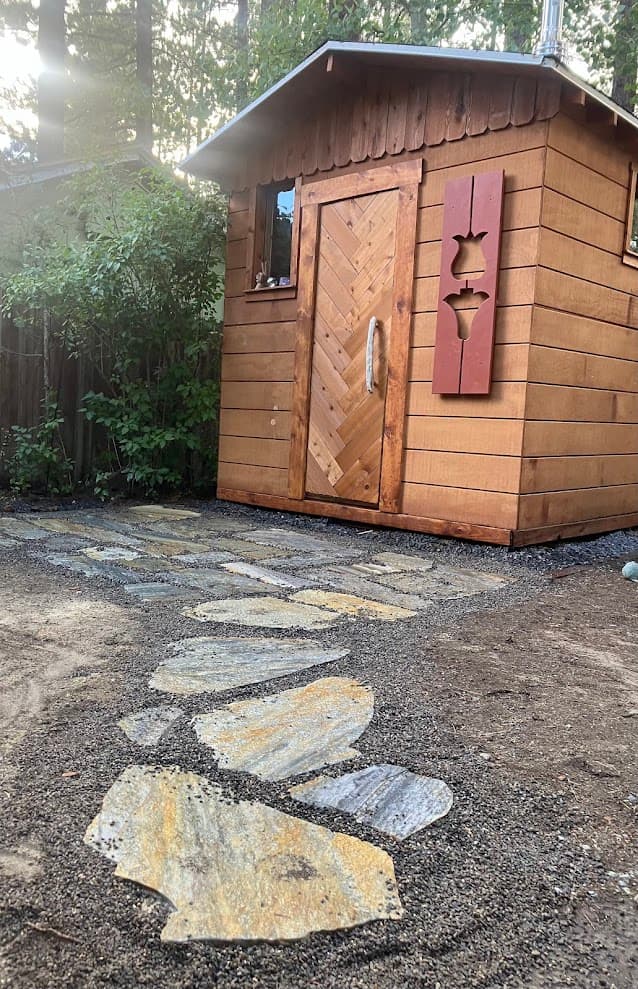
Size determines everything in a sauna: how many people fit, heater requirements, construction cost, and the overall thermal experience. Trumpkin's research recommends a minimum of 3 m³ (about 106 cubic feet) per person for proper thermal comfort and stratification control.
This guide walks through the standard size categories, explains why we recommend 8×8 for most home projects, and shows you the key dimensions that matter.
Sauna sizes fall into predictable categories. Each offers different advantages and tradeoffs in cost, space efficiency, and thermal experience.
A 4×4 or 4×6 sauna fits tight spaces: bathroom additions, compact deck corners, or rooms with limited floor space. These work best as interior saunas in homes where outdoor construction isn't an option. With a lower ceiling (6.5–7 feet interior), heat-up time is faster, and operating costs are minimal.
Reality: A 4×4 is genuinely tight for two people. A 4×6 is more comfortable for a couple or a parent and child. You'll have a single bench along one wall with minimal leg room.
The 6×6 or 6×8 is the most popular size for couples and small families. It's large enough for two-level bench design, which means different heat preferences can coexist. A 6×8 gives you room for an L-shaped bench layout with a 16–20-inch vertical separation between levels.
Sweet spot: 6×8 balances cost, practicality, and usability. You can fit 3–4 people comfortably on the upper bench, with room for guests on the lower level.
An 8×8 sauna is our recommended size for most home projects. Here's why: it uses standard 8-foot lumber with minimal waste, fits an L-shaped or U-shaped bench layout with 3 levels, accommodates 4–6 people on the upper bench, and leaves room for two adults to lay flat on that bench (the premium sauna experience).
At 480 cubic feet (7.5-foot ceiling), an 8×8 requires a 9–12 kW heater, which heats to 180°F in 30–45 minutes. It's efficient, scalable, and fits almost any residential property.
These are social or entertainment saunas, used for groups, guests, or commercial applications. A U-shaped bench wraps three walls, offering multiple seating and laying options. Heat management becomes critical: you need a larger heater (12+ kW) and proper airflow to maintain consistent temperature across the larger volume.
The 8×8 sauna is the Goldilocks size for residential builds. Here are the reasons:
Trusted by homeowners across Tahoe and beyond
Ceiling height matters more than many builders realize. It affects bench positioning, heat distribution, and the sauna experience itself.
This is optimal for residential saunas. It allows the upper bench to sit 40–48 inches below the ceiling, putting your head and shoulders in the 180–200°F zone — the ideal heat range. At this height, a pitched roof for an 8×8 sauna will have an exterior peak of 10–11 feet, which is acceptable in most residential zoning.
Works well for small saunas (4×4 or 4×6). The lower ceiling reduces heat-up time because you're heating less volume. For single-bench saunas, it's practical and cost-effective. For multi-level designs, it becomes cramped — the upper bench sits too high (48+ inches below ceiling), and the vertical separation between levels shrinks.
Gives you room for wider bench separation and a more spacious feel. But it increases heating volume and cost. The benefit is mainly aesthetic unless you're building a large social sauna where multiple people sit at different levels.
Remember: interior ceiling height + roof pitch = exterior peak height. A 7.5-foot interior ceiling with a typical 6:12 roof pitch on an 8×8 footprint gives you about a 10-foot exterior peak. Check local zoning height limits before finalizing.
Once you know your dimensions, calculate volume to determine heater size. The rule of thumb: 1 kW per 45 cubic feet.
Formula: Length × Width × Height (in feet) = cubic feet
Example calculations:
This calculation applies to electric heaters. Wood-fired stoves are sized by room volume but with different considerations (clearance, draft, flue sizing).
Your sauna size determines bench configuration, which affects comfort and usability.
Single straight bench along the long wall. Heater on the short wall. Door on the opposite short wall or long wall. No room for a second level — you're working with one bench height. This keeps costs low but limits the sauna experience.
L-shaped bench possible with shorter wings. Two-level bench layout fits if you accept tighter spacing between levels (14–16 inches). Heater in one corner. Volume is tight, so bench entry takes planning.
Full L-shaped bench with comfortable spacing. Upper bench along one 8-foot wall and one 6-foot wall. Lower bench below the upper on both walls. Three-level design is possible but tight. This is where multi-level benches really start to shine.
L-shaped or U-shaped bench wrapping two or three walls. Full three-level system: upper bench (the premium spot), middle bench, lower bench. Each level has adequate width and spacing. Two adults can lay on the upper bench. This is the sweet spot for thermal comfort and usability.
U-shaped benches wrapping three walls. Room for multiple sitting and lying positions. Heater placement is critical — it should be visible from all bench levels but placed safely to avoid direct radiant heat forcing you off benches.
Once you've chosen your sauna size, bench proportions are standardized:
Some designs add a backrest — boards at an angle behind the bench for leaning. If you include one, keep it low (12–18 inches tall) so it doesn't block heat flow from above.
Typical constraint: small space (4×4 or 4×6). Ceiling height: 6.5–7 feet. Single bench. Heater: 3–4 kW. Cost: DIY materials $3,000–$5,000, professional build $8,000–$12,000.
Target size: 6×8. Ceiling height: 7.5 feet. Two-level bench layout. Heater: 8 kW. Cost: DIY materials $4,000–$7,000, professional build $15,000–$22,000.
Target size: 8×8. Ceiling height: 7.5 feet. Three-level bench (L-shaped). Heater: 11 kW. Cost: DIY materials $5,500–$8,500, professional build $20,000–$30,000.
Size: 8×10 or larger. Ceiling height: 8 feet. U-shaped multi-level benches. Heater: 13+ kW. Cost: Professional build $30,000–$45,000+.
12 decisions that determine how well your sauna performs — insulation, bench height, heater sizing, ventilation, and more.
Have questions about your project? Send us a message or schedule a free 15-minute intro call.
Schedule a free 15-minute intro call or send us a message about your project.
We'll learn about your space, goals, and timeline — and recommend the right next step for your project.