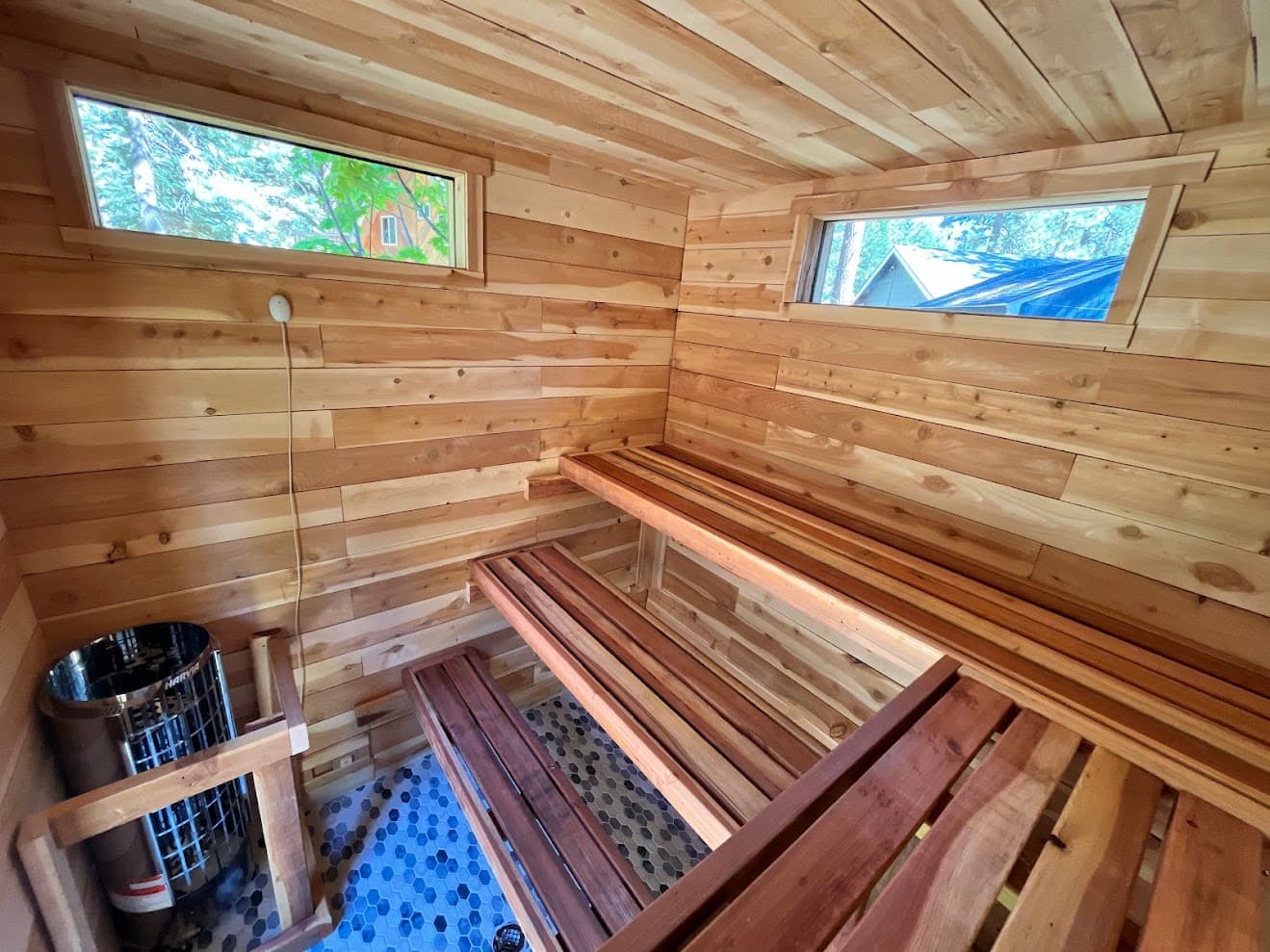
Insulation and vapor barrier design are the most critical elements of sauna construction. They determine how quickly your sauna reaches operating temperature, how stably it maintains that temperature, how efficiently it uses energy, and how long the structure lasts before moisture damage sets in.
Many sauna kits (especially barrel and prefab models) skip insulation entirely or use minimal vapor barriers. This is why kits consistently underperform — they never reach stable operating temperature, they bleed heat rapidly, and moisture problems appear within a few years.
This guide covers everything you need to know about sauna insulation: materials, R-values, vapor barrier details, installation sequencing, and common pitfalls to avoid.
Without proper insulation, heat escapes constantly through walls, ceiling, and floor. The result is a sauna that:
Conversely, a properly insulated sauna reaches 160–200°F within 45–60 minutes and maintains temperature with the heater cycling on and off periodically. This is the difference between a usable sauna and an expensive disappointment.
Several materials work well for sauna insulation. The best choice depends on your budget, local availability, and performance goals.
R-Value: R-13 to R-21 (depending on thickness and density)
Cost: $0.50–$1.00 per square foot. The most affordable option.
Properties: Lightweight, easy to install, widely available. Works well for sauna insulation when paired with a proper vapor barrier.
Installation: Lay batts between studs or ceiling joists. Friction-fit (they grip the framing without fasteners). No moisture resistance on its own — depends entirely on the vapor barrier for protection.
When to use: Budget builds where you have a solid vapor barrier design. This is the standard for most DIY custom saunas.
R-Value: R-15 to R-23 (slightly better than fiberglass per inch)
Cost: $0.75–$1.50 per square foot. 50% more than fiberglass, but worth it.
Properties: Fire-resistant, naturally moisture-resistant, excellent sound dampening. Does not support mold growth. Won't offgas at sauna temperatures.
Installation: Similar to fiberglass batts. Slightly denser, so friction-fit is more secure.
When to use: Our recommendation if budget allows. The superior moisture resistance and durability justify the extra cost. Mineral wool is the insulation of choice in European sauna design.
R-Value: R-5 to R-7 per inch. Very efficient, but requires more thickness for high R-values.
Cost: $1.50–$3.00 per square foot. Higher than batts.
Properties: Excellent moisture resistance and dimensional stability. Doesn't settle like batts. Strong compression resistance.
Caution: Some rigid foams (XPS, polyurethane) can offgas at high sauna temperatures. Use polyiso foam rated for high temperatures, or test first.
When to use: Exterior walls in very cold climates where R-value per inch is critical. Not typically used for interior sauna walls.
R-Value: R-6 to R-7 per inch. Excellent efficiency and air sealing.
Cost: $1.50–$2.50 per square foot. Professional application required.
Caution — NOT recommended for sauna interiors unless you have expert vapor barrier design: Spray foam creates an impermeable layer that can trap moisture inside the sauna cavity. Without a secondary vapor barrier on the interior face (which creates a confusing two-barrier system), moisture can become trapped and cause hidden rot. For saunas, a traditional batt + separate vapor barrier approach is clearer and safer.
When to use: Exterior applications where air sealing is the priority, or only if you have a detailed plan with a secondary interior vapor barrier.
Trusted by homeowners across Tahoe and beyond
R-value requirements depend on where the sauna is located and what's on the other side of the insulation.
Climate note: In Tahoe, Truckee, and other high-elevation cold climates, push toward the higher end of these ranges. R-25+ for walls and R-35+ for ceiling is ideal.
The vapor barrier is as important as insulation itself. Its job is to prevent warm, moist interior air from reaching the insulation where it can condense and cause rot or mold. Trumpkin's research emphasizes that a continuous, well-sealed aluminum vapor barrier on the hot/interior side is THE foundation of sauna durability.
Recommended: Non-adhesive aluminum foil-faced sheeting (often called "foil vapor barrier"). This is the standard for sauna construction and matches European best practices. Sauna Vapor Barrier | Radiant Barrier Roll
Why aluminum: Aluminum reflects radiant heat back into the sauna (reducing heater load) AND blocks moisture vapor from passing through. Two critical functions in one layer. Never substitute plastic or kraft paper.
Thickness: 2-mil to 3-mil aluminum face minimum. This is durable enough for typical sauna use and resists tearing during installation.
What NOT to use: Plastic sheeting (melts or offgasses in high heat and provides no radiant reflection), paper-faced vapor barriers (moisture-permeable and offgas), or spray foam without a secondary aluminum barrier (traps moisture inside).
Location — WARM SIDE (interior) of insulation: This is critical. The vapor barrier must face into the sauna, on top of the insulation, before the interior wood panels. Wrong placement (exterior side) traps moisture inside the insulation.
Installation sequence:
This is where most amateur sauna builds fail. Every seam and penetration must be sealed with aluminum tape. A single unsealed gap defeats the entire vapor barrier system and allows moisture to infiltrate the insulation where it condenses and causes hidden rot.
Allocate 15–20% of your insulation budget for tape and extra barrier material. It's cheap compared to the cost of replacing rotted framing later.
After the vapor barrier, install 1/4 to 1/2 inch furring strips (thin wood strips) running perpendicular to the framing. These create a small air space between the vapor barrier and the interior wood panels.
Purpose: If a tiny amount of moisture does penetrate the vapor barrier despite your best sealing, the air gap allows it to dry. Without this gap, moisture gets trapped and causes rot.
Installation:
Many sauna kits fail at insulation. Here's why, and how to avoid these pitfalls in your build.
Many kit walls are just T&G wood boards with empty cavities behind. No insulation, no vapor barrier. The wood itself IS the insulation (R-1 to R-2 per inch of thickness). This means:
If a barrier exists but is installed on the exterior (cold side), it traps moisture inside the insulation. The insulation gets wet, supports mold, and loses effectiveness. Structural damage follows.
Unsealed seams, gaps around penetrations, or corners where the barrier isn't properly sealed allow moisture vapor to sneak through. Even small gaps accumulate moisture over time.
Plastic sheeting melts or becomes brittle at sauna temperatures. Use aluminum foil sheeting instead.
Heat rises. The ceiling loses the most heat from any surface. Many builds skimp on ceiling insulation (R-15 or R-19) when they should be at R-30+. This is false economy.
Spray foam does air seal well, but it can trap moisture if there's no secondary interior vapor barrier. For saunas, stick with batts + aluminum barrier (clearer, safer system).
If you use rigid foam on the exterior and batts on the interior, make sure the vapor barrier is consistent and continuous. Gaps between different materials are common failure points.
Walls: Fiberglass R-15 batts + aluminum vapor barrier.
Ceiling: Fiberglass R-30 batts + aluminum vapor barrier. Ceiling is critical here.
Floor: Not typically insulated (concrete slab already in place). If over a crawlspace, add R-13 to R-19.
Cost: $1,000–$1,500 in insulation and vapor barrier for a typical 7×7 foot sauna.
Walls: Mineral wool R-19 or fiberglass R-21 batts + aluminum vapor barrier. Exterior walls in cold climates need better insulation.
Ceiling: Mineral wool R-30 or fiberglass R-38 batts + aluminum vapor barrier. Very important for outdoor structures.
Floor: Floating deck (no insulation necessary) or concrete slab. If over a crawlspace, R-13 minimum.
Cost: $2,000–$3,500 in insulation and vapor barrier.
Many kits have no real insulation. If upgrading a kit or building your own barrel:
Step 1: Frame walls and ceiling (2x4 studs, 2x6 ceiling joists, spaced 16" on center).
Step 2: Install wiring and any other penetrations before insulation.
Step 3: Install insulation batts (fiberglass or mineral wool) between studs and ceiling joists. Fill cavities completely.
Step 4: Unroll aluminum foil vapor barrier from floor to ceiling. Staple to studs every 12 inches. Overlap seams 6 inches, seal with aluminum tape. Seal all penetrations (wires, pipes, vents).
Step 5: Install 1/4–1/2 inch furring strips on top of vapor barrier, perpendicular to studs, 16" on center. Secure with brad nails.
Step 6: Install interior wood panels (T&G cedar or hemlock) horizontally on furring strips. Male edge (tongue) down, female edge (groove) up.
Step 7: Install benches, heater, and finish details.
In Tahoe, Truckee, and other mountain communities with deep freezes:
Before covering the vapor barrier with panels:
Take time here. This is where the quality of the build is determined.
A properly insulated sauna reaches 180–200°F in 45–60 minutes and maintains temperature with periodic heater cycling. An uninsulated kit might take 2–3 hours (or never) reach the same temperature and keeps the heater running continuously.
Operating cost difference: A well-insulated sauna might cost $50–$100/month to operate (electricity). A poorly insulated one costs $200+/month. Over 10 years, that's $18,000 vs $36,000. The $2,000 investment in proper insulation pays for itself in a few years.
12 decisions that determine how well your sauna performs — insulation, bench height, heater sizing, ventilation, and more.
Have questions about your project? Send us a message or schedule a free 15-minute intro call.
Schedule a free 15-minute intro call or send us a message about your project.
We'll learn about your space, goals, and timeline — and recommend the right next step for your project.