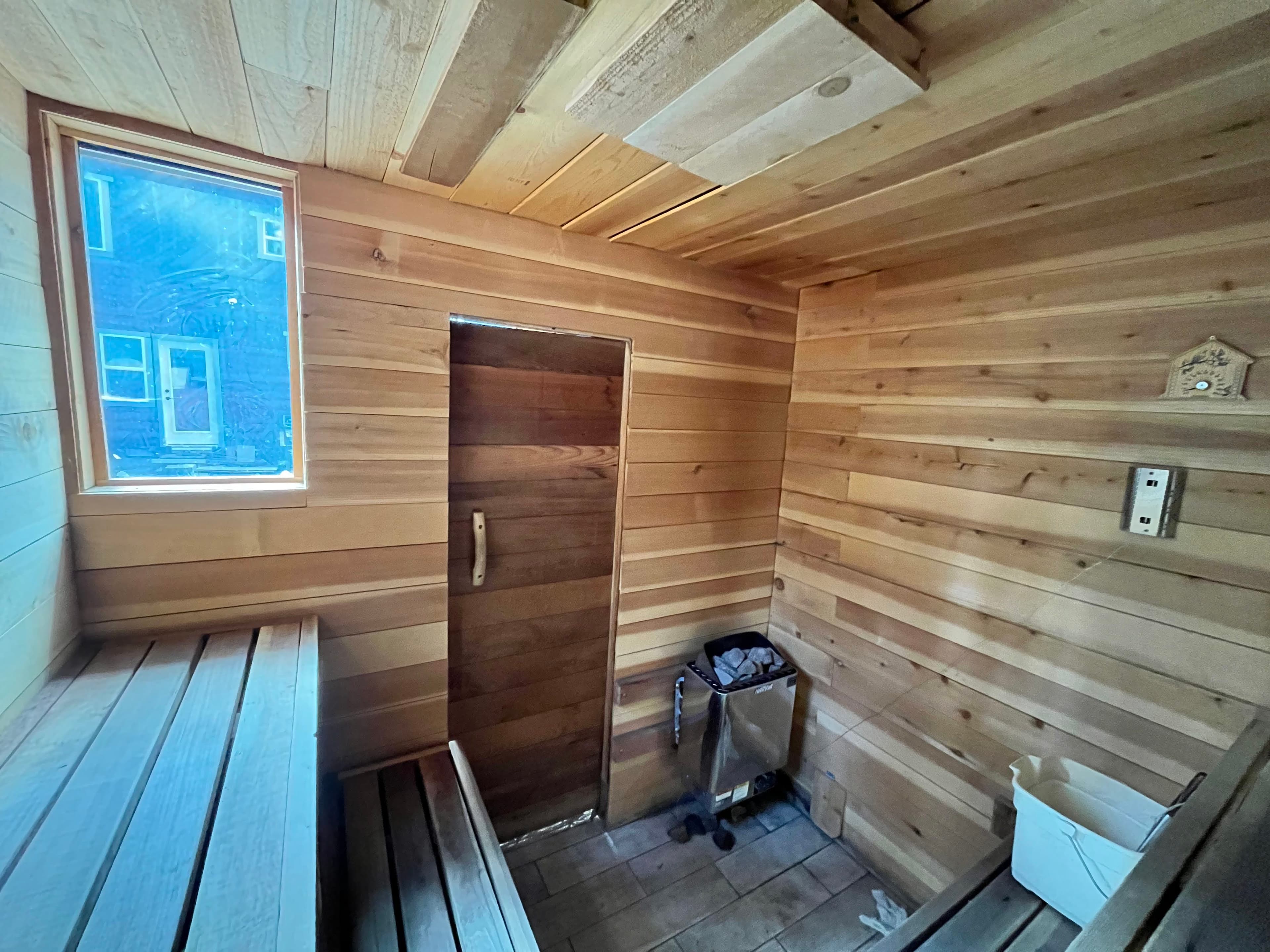
The choice between a sauna kit and a custom build comes down to one core tension: speed and convenience versus durability and long-term value. Kits are cheaper upfront and faster to deploy. Custom builds cost more initially but deliver a dramatically superior experience and often prove cheaper over the life of the sauna.
This isn't about opinion — it's about the math. Let's walk through what you're actually getting with each approach, and what the true cost of ownership looks like. If you decide a custom build is right, our custom sauna design service gives you build-ready plans without the contractor guesswork.
A sauna kit is a pre-manufactured structure delivered to your property on a pallet, ready for assembly. Most kits arrive with all major components — pre-cut panels, fasteners, and hardware — and need only assembly on-site.
Kits come in three primary styles:
Most kits use electric heaters (Harvia KIP on Amazon) (simpler installation than wood-burning stoves), and assembly typically takes 1–2 days with basic tools. Important caveat: kits still require a licensed electrician to run the 240V circuit if you're connecting to an electric heater.
Quality kits typically range from $3,000 to $10,000 depending on style and size. Here's the breakdown:
Total installed cost for a kit: roughly $5,500–$13,000 depending on options and labor. Seems reasonable. But there are hidden costs that emerge quickly.
Trusted by homeowners across Tahoe and beyond
Most sauna kits use simple construction: tongue-and-groove cedar boards serving dual duty as both structure and insulation. This is fast to assemble and cheap to manufacture, but it's fundamentally flawed for durability.
Contrast with Finnish/Norwegian kits: European manufacturers understand proper sauna design — bench height, volume per person, ventilation importance. North American/UK kits cut corners for price. They're often too small, have low benches, poor ventilation, and no changing/commons area.
Result: boards separate from heat cycling, gaps form, rain and snow intrude, insects find entry points, mold colonizes benches, users experience poor air quality and discomfort.
If you're considering a kit, use these red flags to identify poor design:
This is where the math breaks down for kit saunas. Within a few years, kits start requiring maintenance:
Realistic expectation: $1,500–$2,500 in repairs every 3–5 years. Over a 20-year period, these costs add up fast.
A custom build is a framed structure engineered and constructed specifically for your property. It's built like a small house: proper 2×4 studs, joists, rafters, engineered roof with snow load calculations, insulation, vapor barriers, and sealed penetrations.
Interior is fully customizable: bench heights, shelving, lighting, door placement. Exterior can be stained cedar, metal cladding, stone, or shingles. A two-level bench system can be designed so users choose their heat intensity — lower bench at 160°F, upper bench at 190°F.
Custom builds are constructed on-site (or delivered as pre-cut panels to be assembled on-site) and require a proper foundation: concrete slab, grade-level deck framing, or engineered footings.
Build time: 80–100 hours for experienced DIYers, 40–60 hours with a professional crew working part-time over a few weeks.
Here's where the real picture emerges:
| Criteria | Sauna Kit | Custom Build |
|---|---|---|
| Initial Cost | $5,500–$13,000 | $8,000–$20,000 (DIY to professional) |
| Temperature Consistency | Poor — single bench, uneven gradient | Excellent — multi-level benches, precise control |
| Insulation (R-value) | R-3 to R-5 (wood boards only) | R-13 to R-21 walls, R-30+ ceiling |
| Heat-Up Time | 30–50 minutes (variable) | 20–30 minutes (consistent) |
| Heating Cost/Year | $300–$600 more than custom | Baseline (efficient insulation) |
| Ventilation | Often absent or minimal | Proper intake/exhaust design |
| Maintenance (5-year interval) | $1,500–$2,500 repairs + caulking | $200–$500 staining/sealing only |
| Expected Lifespan | 8–12 years (active use) | 30+ years |
| Customization | Fixed — can't modify bench heights or interior | Fully customizable |
| Resale Value | Neutral (seen as aging equipment) | Positive (permanent home improvement) |
This is the calculation that matters:
Even a professionally built custom sauna is often $15,000–$20,000 cheaper over 20 years than a kit. A DIY custom build is a fraction of the cost.
Build a custom sauna. The overlap in upfront DIY cost with kit prices means you can get a dramatically better sauna for the same or slightly more money. Even hiring a professional builder, long-term value is superior.
A custom build lets you:
Kits make sense only if: you need deployment in days (not weeks), you have zero DIY interest, AND you accept replacement in 8–10 years.
For everyone else, a custom build is the investment that pays for itself. Better performance, longer durability (30+ years), lower operating costs, and complete design control. Custom sauna design is available remotely for clients anywhere in the U.S. — we deliver plans your contractor can build from. Learn more about our remote sauna design service.
Limited modifications are possible (adding insulation, modifying bench heights), but they're labor-intensive and often costly. By the time you retrofit a kit sauna, you're approaching the cost of a custom build with inferior results.
Assembly is straightforward, but electrical installation still requires a licensed electrician for the 240V circuit. A poorly installed electrical system is a fire hazard, regardless of how easy the rest of the kit is.
Many do not. Ventilation is often an add-on or overlooked entirely, which creates humidity and mold problems. Any sauna without intentional exhaust ventilation is unsafe to use regularly.
Hire a contractor. The cost is higher upfront, but you'll get a superior structure that lasts 30+ years instead of a kit you'll replace in 10 years. Over the life of the sauna, the professional build is cheaper.
Theoretically yes, but the reality is difficult. After a few heat cycles, boards warp and fasteners are stuck. Disassembly damages components, and reassembly elsewhere is rarely successful. Kits are meant to be permanent once installed.
12 decisions that determine how well your sauna performs — insulation, bench height, heater sizing, ventilation, and more.
Have questions about your project? Send us a message or schedule a free 15-minute intro call.
Schedule a free 15-minute intro call or send us a message about your project.
We'll learn about your space, goals, and timeline — and recommend the right next step for your project.