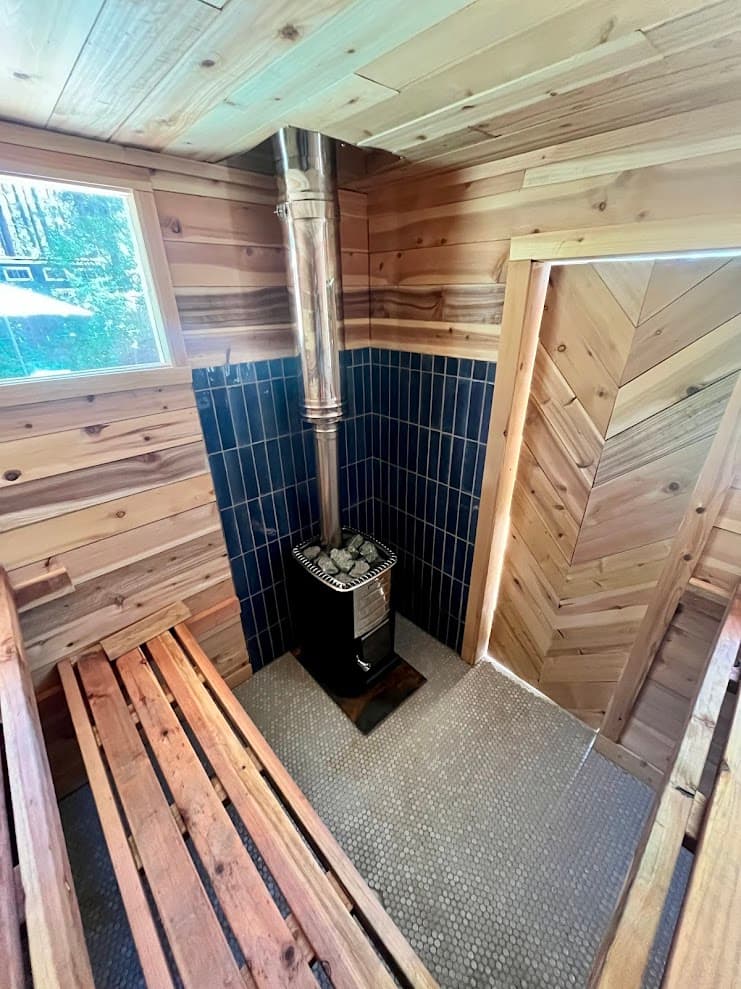
Cedar vs Hemlock vs Aspen for Sauna Interiors — Which Wood to Use
The wood you choose for your sauna interior matters more than most building material decisions. You're sitting on it, leaning against it, and breathing the air around it at temperatures between 170 and 200 degrees Fahrenheit. The wrong wood gets too hot to sit on, off-gasses resins onto your skin, warps after a few months, or just doesn't hold up.
Three species dominate the sauna interior market in North America: western red cedar, hemlock, and aspen. Each has real strengths and real weaknesses. This guide covers how they actually perform in a sauna — not the marketing pitch, but what you'll experience after 50 or 100 sessions.
The Three Contenders at a Glance
Before getting into details, here's the quick comparison:
Western red cedar is the most popular sauna wood in North America. It's aromatic, naturally rot-resistant, dimensionally stable, and attractive. It's also the most expensive of the three and the hardest to source in consistent quality.
Hemlock (western hemlock) is the workhorse option. It's less expensive than cedar, widely available, machines cleanly, and has a subtle, pleasant grain. It doesn't have cedar's strong aroma, which is either a pro or a con depending on your preference.
Aspen is the budget pick that performs better than its price suggests. It's light in color, doesn't splinter easily, stays cool to the touch relative to denser woods, and has almost no scent. It's the traditional choice in many Finnish saunas.
Heat and Touch: How Each Wood Feels at 180 Degrees
This is the most practical difference and the one most people don't think about until they're sitting in a sauna for the first time.
All three species are softwoods with relatively low density, which means they don't absorb and radiate heat the way a hardwood like oak or maple would. You can sit on a cedar, hemlock, or aspen bench at 180 degrees without burning yourself. Try that with a hardwood and you'll learn the lesson fast.
Among the three, aspen has the lowest density (about 26 lb/ft3) and feels the coolest to the touch. This matters most on bench surfaces where your bare skin makes direct contact. If you run your sauna at the higher end — 190-200 degrees — aspen benches will be noticeably more comfortable than cedar benches.
Cedar falls in the middle (about 23 lb/ft3 for western red cedar, but the actual heat feel depends on moisture content and grain orientation). It's comfortable for most people at standard sauna temperatures.
Hemlock is slightly denser than cedar (about 28 lb/ft3) and can feel marginally warmer, but the difference between hemlock and cedar on the bench is not something most people notice in practice.
The practical takeaway: all three work fine for benches up to about 185 degrees. Above that, aspen has a slight edge. None of them will burn you at normal sauna temperatures.
Trusted by homeowners across Tahoe and beyond
Scent and Off-Gassing
This is where cedar dominates or disqualifies itself, depending on who you ask.
Western red cedar has a distinctive, warm, woody aroma that many people associate with saunas. When the sauna heats up, the natural oils in the cedar release their scent. In a new sauna, this scent is strong — almost overwhelming for some people. It mellows over the first year of use but never goes away completely. Most sauna owners love it. Some find it too strong, especially if they have respiratory sensitivities.
Cedar contains natural compounds called thujaplicins that provide its rot resistance and antimicrobial properties. These are not harmful at normal sauna concentrations, but people with chemical sensitivities occasionally report irritation. If you're unsure, spend time in a cedar sauna before committing to it for your build.
Hemlock has a very mild, slightly sweet scent that's barely noticeable. For people who want a neutral sauna environment — or who plan to use essential oils and don't want competing wood aromas — hemlock is the better choice. It doesn't off-gas resins the way pine or spruce do, and it doesn't have cedar's pronounced scent.
Aspen is the most neutral of the three. It has almost no scent, even at high temperatures. This makes it the go-to species for commercial saunas and for people who are sensitive to wood aromas. In Finnish tradition, the neutral scent of aspen lets the birch whisks (vihta) and water aroma define the experience.
One caution about all softwoods: avoid any species that produces resin at high temperatures. Pine, spruce, and fir are common construction woods, but they'll weep sap onto your benches and walls at sauna temperatures. Cedar, hemlock, and aspen are all resin-free at operating temperature, which is why they're the standard sauna species.
Durability and Rot Resistance
Cedar wins this category outright. Western red cedar has natural extractives (those same thujaplicins) that make it resistant to fungal decay, insect damage, and moisture degradation. In a sauna environment where the wood cycles between hot/dry and warm/humid conditions, cedar holds up longer than any other untreated softwood. A cedar sauna interior will last 15-25 years with normal use and basic maintenance.
Hemlock is moderately durable. It doesn't have cedar's natural rot resistance, but in a properly ventilated sauna that dries out completely between sessions, hemlock performs well. Expect 10-20 years from hemlock cladding and benches with good ventilation practices. Where hemlock struggles is in poorly ventilated saunas where moisture sits on the wood for extended periods — it'll develop dark spots and eventually soft spots faster than cedar.
Aspen is the least durable of the three in terms of rot resistance. It's a light, soft wood that can develop surface discoloration if moisture management is poor. However, aspen is easy and inexpensive to replace. Many Finnish sauna owners treat aspen benches as consumable items — they'll replace bench boards every 5-10 years and consider it part of normal maintenance. If your ventilation is dialed in, aspen will last longer than you'd expect from a budget wood.
For all three species, the maintenance rules are the same: run the heater briefly after your last session to evaporate surface moisture, leave the vents open and door cracked for post-session drying, and never seal or stain the interior surfaces. Sealers trap moisture and can off-gas harmful chemicals at sauna temperatures.
Appearance and Grain
Aesthetics are subjective, but here's what each species looks like:
Cedar has a warm, reddish-brown tone with visible grain variation. Some boards are nearly red, others are blonde — the color varies within a single shipment. Over time, the color mellows to a silvery brown if left untreated. In a sauna, the heat accelerates this aging. Many people love the rustic, warm look. If you want uniform color, you'll need to hand-select boards, which adds cost.
Hemlock has a lighter, more uniform appearance — pale cream to light tan with a fine, consistent grain. It looks cleaner and more modern than cedar. For saunas with a minimalist or contemporary design, hemlock is often the better visual fit. It doesn't have the dramatic grain variation of cedar, which can be a pro or con depending on your aesthetic.
Aspen is the lightest of the three — nearly white when freshly milled, darkening to a light golden tone with use. The grain is subtle and understated. Aspen gives a sauna interior a bright, clean, Scandinavian feel. If you've seen photos of traditional Finnish saunas with pale, bright wood interiors, that's usually aspen or European aspen (which looks very similar to North American aspen).
Cost and Sourcing
Pricing varies by region and availability, but here's the general range for kiln-dried, clear-grade boards suitable for sauna interiors (per board foot, retail):
- Western red cedar: $6-$12/bf. The price has increased significantly since 2020 due to supply constraints in British Columbia. Finding consistent, knot-free cedar for sauna use can be difficult. Some suppliers sell "sauna-grade" cedar at a premium — this is typically the same wood, just pre-sorted for fewer defects.
- Hemlock: $3-$6/bf. More widely available and more consistently priced. Western hemlock from the Pacific Northwest is the standard for sauna use. Eastern hemlock works too but is less common in the sauna market.
- Aspen: $2-$5/bf. The most affordable option. Aspen is abundant throughout the northern U.S. and Canada. Sourcing can be easy or hard depending on where you live — lumber yards in Minnesota and Wisconsin stock it routinely; yards in California or the Southeast may not carry it.
For a typical 6x8 sauna interior (walls and ceiling cladding plus two bench tiers), material costs for the wood alone run roughly:
- Cedar: $1,200-$2,400
- Hemlock: $600-$1,200
- Aspen: $400-$1,000
These are rough ranges — actual costs depend on board dimensions, waste factor, and your local market. If you're building in a mountain climate like Tahoe, Truckee, or Reno, we can help source and spec the right materials as part of a design package.
What About Thermally Modified Wood?
Thermally modified wood is worth mentioning because it's becoming more common in North American saunas, though it's been standard in European saunas for years.
Thermal modification is a kiln process that heats wood to 400-500 degrees Fahrenheit in a low-oxygen environment, permanently changing its cellular structure. The result is wood that's more dimensionally stable, more rot-resistant, and darker in color than the original species. You can get thermally modified aspen, pine, or spruce that performs as well as or better than natural cedar in terms of durability.
The trade-off is cost. Thermally modified wood typically runs $8-$15/bf — more than any of the natural options. It's also harder to source in the U.S. market, though availability is improving. If budget allows, thermally modified aspen is an excellent option: you get aspen's neutral scent and cool touch with greatly improved durability.
Mixing Species
You don't have to use one wood for everything. A common approach is to use a more durable wood for the benches (where wear and moisture exposure are highest) and a less expensive wood for the walls and ceiling (where the stress on the material is lower).
Practical combinations:
- Cedar benches, hemlock walls — puts the most durable wood where it matters most, reduces overall cost
- Cedar benches, aspen walls — bright, clean wall appearance with durable bench surfaces
- Aspen benches, hemlock walls — budget-friendly and cool to the touch where it counts
The visual contrast of mixed species can look great if done intentionally. Just make sure you're choosing clear, kiln-dried material from a reputable supplier regardless of species. Green or air-dried lumber will warp and crack in a sauna environment. For bench dimensions and layout, our sizing guide covers the ergonomics.
The Bottom Line
There's no single "best" wood for every sauna. The right choice depends on your budget, your sensitivity to scent, your aesthetic preferences, and how much maintenance you want to do.
Choose cedar if you want the most durable, lowest-maintenance option and you like (or at least don't mind) the aromatic scent. It's the premium choice with good reason.
Choose hemlock if you want a clean, modern look, a neutral scent, and a lower price point than cedar. It's the most practical middle-ground option and what we use in a lot of custom sauna designs.
Choose aspen if you want the most affordable option, the coolest bench surface, and the most neutral scent. It won't last as long as cedar, but it's easy and cheap to replace when the time comes.
And if you're still not sure, reach out. When we do a remote sauna design, the materials spec is part of the package — we'll recommend the right wood for your climate, budget, and preferences.
Frequently Asked Questions
Is cedar or hemlock better for sauna benches?
Cedar is more durable and rot-resistant, so it'll last longer in the high-moisture bench position. Hemlock is less expensive and performs well if your ventilation keeps the sauna dry between sessions. For bench surfaces specifically, aspen is also worth considering — it stays coolest to the touch and is easy to replace when worn.
Does cedar smell go away in a sauna?
The strong cedar aroma mellows significantly over the first 6-12 months of regular use, but it never disappears entirely. Most cedar sauna owners consider the lingering scent a positive feature. If you're sensitive to strong scents or prefer a neutral environment, hemlock or aspen are better choices.
Can I use pine in a sauna?
Pine, spruce, and fir are not recommended for sauna interiors. These species contain resin that melts and weeps at sauna temperatures, creating sticky surfaces and potentially irritating fumes. Stick with cedar, hemlock, or aspen for any surface inside the hot room.
How long does sauna wood last?
With proper ventilation and post-session drying, cedar lasts 15-25 years, hemlock lasts 10-20 years, and aspen lasts 5-15 years in a sauna interior. The biggest factor in wood longevity isn't the species — it's whether you dry the sauna out completely after each session. Poor ventilation shortens the life of any wood.
What wood do Finnish saunas use?
Traditional Finnish saunas primarily use aspen (haapa) and alder (leppä) for interior surfaces. These are light-colored, low-scent woods that stay cool to the touch. Western red cedar is a North American preference — it's not traditionally used in Finnish saunas, though it's gaining popularity in Finland as well. European spruce (kuusi) is common for sauna building in Finland but is thermally modified first to eliminate resin issues.