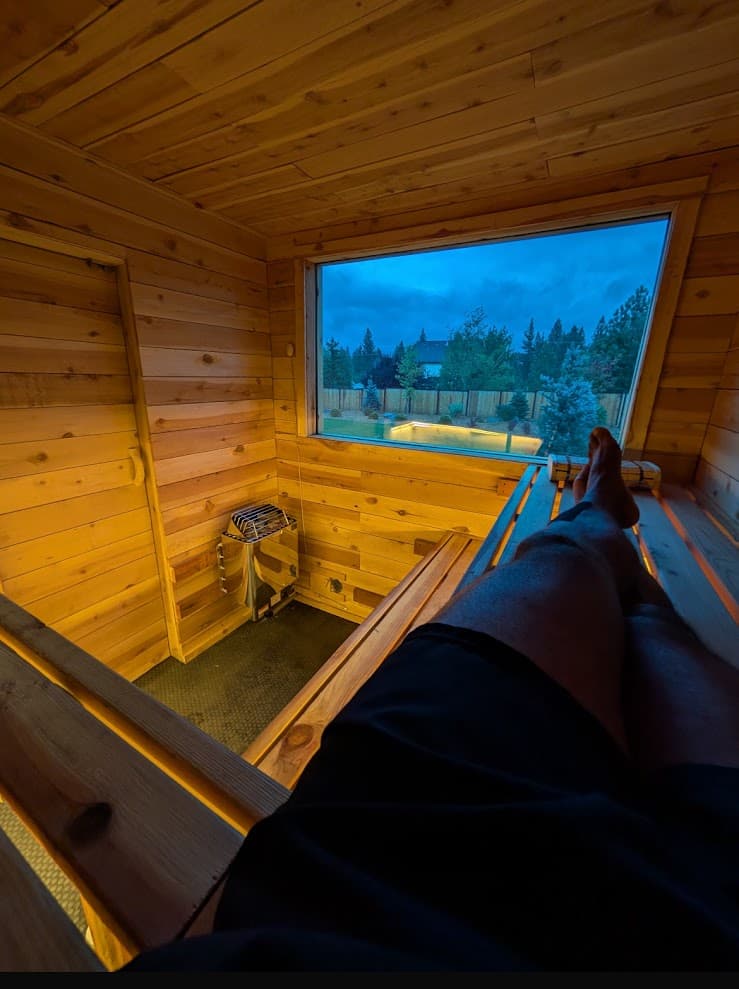
Sauna Cold Feet: Why Your Feet Stay Cold While Your Head Cooks (and How to Fix It)
If your head is baking and your feet are cold, the sauna is the problem, not you. Sauna cold feet is one of the most common complaints we hear, and it almost always traces back to three things: bench height, ceiling height, and where the air moves.
The good news is that most of it is fixable, sometimes with a weekend and a few boards.
Why Your Feet Are Cold: Heat Stratification
Hot air rises. In every sauna, the air near the ceiling is hotter than the air near the floor. That temperature gap between head and feet is called heat stratification, and you can't eliminate it. You can only shrink it.
How much gap is acceptable? Here's the scale we design against, measured head to toe:
- Ideal: under 20°C (36°F) difference
- Good: about 18-22°C difference
- Acceptable: 22-27°C difference
- Poor: 30°C or more, which is typical of North American saunas, with cold feet as the giveaway
Above roughly 27°C, you notice it. Above that, steam also gets rejected before it reaches your feet, because steam is buoyant and prefers the hot air up high. A big stratification gap isn't just uncomfortable. It also reduces how much heat your body takes in, because the point of a sauna is whole-body exposure to even convective heat.
Cause 1: Benches That Sit Too Low
This is the root cause in most cold-feet saunas. The goal is to get your feet at or above the midpoint of the heater stones, in the zone where the convective loop has already spread the heat. If the bench is too low relative to the heater, your feet sit below that zone.
Kit saunas are the worst offenders. Their benches are often positioned low, close to the floor or the stove level, and not raised into the hot zone. The result is the classic hot head, cold feet.
Here's what we build to:
- Upper bench top: 40-48 inches below the finished ceiling
- Middle or lower bench: 16-20 inches below the bench above
- Foot bench: 4-8 inches above the top of the heater stones
That last number is the one people miss. If the foot bench is level with or below the stone tops, stratification fails. Our sauna bench height guide covers how to set each level, and the bench depth post covers the depths.
If you have a low bench you can't move, adding a platform or a raised footrest can help. Raising the bench by even 4-6 inches changes how the room feels.
Trusted by homeowners across Tahoe and beyond
Cause 2: A Low Ceiling
A low ceiling squeezes the hot zone. With 7 feet of interior height, the foot bench may only reach around 131°F when the thermometer near the ceiling reads 194°F. With a 9-foot ceiling at the same ceiling temperature, the foot bench reaches about 165°F.
That's a big difference. It matters for comfort, and it matters for hygiene, because the foot bench needs to hit roughly 55-70°C (131-158°F) to keep mold and bacteria in check. Ideally it gets to 65°C for around 20 minutes.
The usual spec is 7.5-8 feet interior, with 7 feet as the minimum for converting an existing room. If you can't go higher, the fix is to prioritize bench height and ventilation, and to insulate well. Our sauna ceiling height article goes through the trade-offs.
Cause 3: Ventilation That Pulls Air the Wrong Way
Most North American saunas get ventilation backwards, and it's a major contributor to cold feet.
The common mistakes:
- Fresh air coming in low, near the heater or below the foot bench. Cold air sinks, so it flows across the floor and exits without ever reaching you. It also chills your feet.
- Exhaust in the ceiling or high on the wall, which pulls steam out before it gets to the bathers and drags hot air up, widening the gap.
- Natural convection only. It's unreliable with electric heaters, because there's no fire pulling air through.
What works for an electric sauna is mechanical downdraft:
- Fresh air supply above the heater, about 6-12 inches below the ceiling. Air entering there gets pulled into the convective loop and warmed before it reaches you.
- Mechanical exhaust below the foot bench on the opposite wall, using an inline duct fan on the exterior side of the penetration.
- Optional drying vent high on the exhaust wall, closed during use and opened after the session.
In one set of measurements, a well-designed sauna with a 9-foot ceiling and downdraft ventilation measured around a 16°C head-to-foot difference. The same sauna on natural convection alone measured about 32°C. That's the difference between a sauna you stay in and one you leave early.
For sizing, plan roughly 20-25 CFM per person, plus another 15-25 CFM for the heater's high-limit sensor cooling. That's about 100-125 CFM for a four-person room. Our sauna ventilation guide, ventilation diagram and how to add ventilation to a sauna cover the details.
Cause 4: Heater and Room Shape
Heater position matters too. Corner placement and open-sided heaters, as opposed to fully enclosed ones, can modestly improve how evenly heat spreads. A heater placed too high, or a barrel-shaped room with benches near the floor, makes the problem worse. Barrel saunas are the extreme case: with the bench near the floor, the temperature gap can run around 50%, and the löyly suffers.
See our heater placement guide for where the heater should sit relative to the benches.
How to Diagnose Your Own Sauna
You need two thermometers, or one with a probe, and ten minutes.
- Heat the sauna to your normal operating temperature and let it stabilize.
- Put one thermometer about 6 inches below the ceiling and one at foot-bench level.
- Read both at the same time.
- Divide the difference by the ceiling reading to estimate the gap.
If the gap is under about 22°C (40°F), you're in decent shape and cold feet may be about one specific spot. If it's 30°C (54°F) or more, work through the list above in order: bench height first, then ventilation, then ceiling height.
If heat is the larger issue overall, read our post on a sauna not getting hot enough, because cold feet and low temperatures often share the same causes.
A Fix Order That Actually Works
If you're troubleshooting an existing sauna, here's the order we'd go in:
- Raise the foot bench to 4-8 inches above the stone tops.
- Move the intake above the heater. Plug the low one.
- Move the exhaust below the foot bench on the opposite wall, and add a fan.
- Check insulation and air leaks. Gaps let cold air in at floor level.
- Consider a taller ceiling only if you're rebuilding.
Steps 1 through 3 handle most cases and cost a few hundred dollars in materials.
What About Wood-Fired Saunas?
Wood stoves behave differently. A fire pulls air through the room, so a wood-fired sauna can exhaust naturally in a way an electric one can't. That helps, but it doesn't remove the stratification issue. Bench height still has to put your feet at or above the midpoint of the stones, and the fresh air supply still needs to be placed so it feeds the convective loop and doesn't wash cold air across the floor.
Stoves that draw combustion air from outside the room, through the chimney or a dedicated duct, don't pull air from the sauna at all. Treat those like electric heaters and plan for a mechanical downdraft setup.
Is It Ever Fine to Have Some Difference?
Yes. Some difference between head and feet is normal and even pleasant. A sauna where your head is a little hotter than your feet feels natural. The goal isn't a perfectly uniform room. It's a gap small enough that your whole body takes in heat, your feet aren't uncomfortable, and the foot bench still gets hot enough to stay clean.
If your feet feel fine and you're measuring a 25°C gap, don't chase it. If your feet are cold and you're measuring 35°C, you have work to do.
Frequently Asked Questions
Why are my feet cold in the sauna?
Because hot air rises and your feet are sitting below the hot zone. Low benches, low ceilings, and ventilation that brings cold air across the floor are the usual causes. Raising the foot bench and fixing the vents usually helps most.
How much hotter should the top of a sauna be than the floor?
A head-to-toe difference under about 20°C (36°F) is ideal, and up to about 22-27°C is acceptable. Above 30°C, you'll notice cold feet and weak steam.
Will a bigger heater fix cold feet?
Usually not. A bigger heater raises the temperature everywhere, which can make your head hotter without helping your feet. Bench height and ventilation fix the gap, not extra kilowatts.
Does natural ventilation cause cold feet?
Often, yes, especially with electric heaters. Passive vents tend to pull cool air across the floor. A mechanical downdraft setup, with fresh air above the heater and exhaust below the foot bench, reduces the gap by roughly 4-15°C compared with natural convection.
Next Steps
If you're planning a build and want the bench heights, ceiling height and vent locations worked out for your exact room, our remote sauna design service does that for clients across the U.S. The free sauna design checklist will help you catch the details most people miss.