Sauna Pod: What They Are, How They Perform, and What You Give Up
A sauna pod is a prefabricated, self-contained sauna that shows up at your house mostly built. You put it on a pad, an electrician runs a circuit to it, and you're using it a few days later. The category has grown fast — cubes, capsules, teardrops, angular modern boxes — and searches for them have jumped over the past year.
The appeal is obvious. No framing, no insulation, no vapor barrier, no bench math. Someone else already made all the decisions. The question is whether the decisions they made are good ones, and that depends almost entirely on the interior geometry, which is the part nobody photographs.
Here's what a sauna pod actually is, what they run, where they work well, and where they fall short.
What Counts as a Sauna Pod
There's no standard definition, but in practice a sauna pod is a prefab outdoor sauna in the 4x6 to 7x8 foot range that arrives either fully assembled on a trailer or as a flat-pack kit you bolt together in a day or two. Most share a few traits:
- Electric heater, typically 4.5 to 8 kW, wall-mounted
- A large glass front or door — usually the main design feature
- Curved or angled roof that sheds water and gives the unit its look
- Wall assembly of thermally modified wood or cedar, sometimes over a thin insulated core, sometimes not
- Bench for 2 to 4 people, usually one or two tiers
Pods sit between two things you already know. A barrel sauna is a cylinder on its side. A cabin or shed-style sauna is a small building. A pod is a designed object — it's trying to look like furniture or architecture rather than a shed. That aesthetic is the product.
The word gets used loosely. Some companies call an insulated, framed, well-built modular sauna a "pod." Others slap the name on an uninsulated tongue-and-groove box. The label tells you nothing about quality, so you have to look at the spec sheet.
What a Sauna Pod Costs
Prices vary more than in almost any other sauna category:
| Type | Typical price |
|---|---|
| Entry-level flat-pack pod, 2 person | $4,000 – $7,000 |
| Mid-range pod, 4 person, insulated | $9,000 – $16,000 |
| High-end designer pod, CLT or thick insulated wall | $18,000 – $30,000+ |
A few things routinely get left out of the advertised price. The heater is sometimes sold separately — on higher-end units that's another $1,500 to $5,000 depending on the brand and stone capacity. Delivery on a fully assembled unit can run $1,000 to $3,000 and often requires crane or forklift access. And the electrical is always separate.
That last one surprises people. Almost every pod with a 6 kW or larger heater needs a dedicated 240V, 40 to 50 amp circuit run from your panel by a licensed electrician. Depending on the distance from the panel and whether you need a trench, that's $1,000 to $3,000. The electrical requirements for a sauna don't change just because the sauna showed up on a truck.
Add it up and a $12,000 pod is often a $16,000 project. That's the number to compare against a custom build, not the sticker price.
Trusted by homeowners across Tahoe and beyond
Where Sauna Pods Genuinely Work
I'm not against them categorically. There are situations where a pod is the right call:
Height-restricted sites. A properly proportioned cabin sauna with a 7.5 to 8 foot interior ceiling and a pitched roof ends up around 10 feet tall on the outside. That's often more than people expect and can block views or run into HOA or setback limits. Pods are usually 7 to 8 feet tall overall. If you have a hard height constraint, that matters.
Rentals and properties you don't own long-term. Pods can be moved. A framed structure on footings generally can't, or at least not without taking it apart.
Speed. A custom build is 40 to 60 hours of labor with a crew, plus design and material lead time. A pod is a delivery date.
Sites with no build access. If a crew can't get materials into the yard, a crane-set pod may be the only option.
Where They Fall Short
The problems with pods are almost all thermal, and they trace back to one thing: interior height.
The bench can't get high enough
A good sauna gets your feet at or above the top of the heater stones. That's not a preference, it's the mechanism. Heat rises, so the air near the ceiling is significantly hotter than the air near the floor. If you're sitting low relative to the stove, your head cooks and your feet stay cool.
The targets we design to: the top of the upper bench should sit 40 to 48 inches below the finished interior ceiling, and the foot bench should be 4 to 8 inches above the top of the stones. Hitting both of those at once requires roughly 7.5 to 8 feet of interior ceiling.
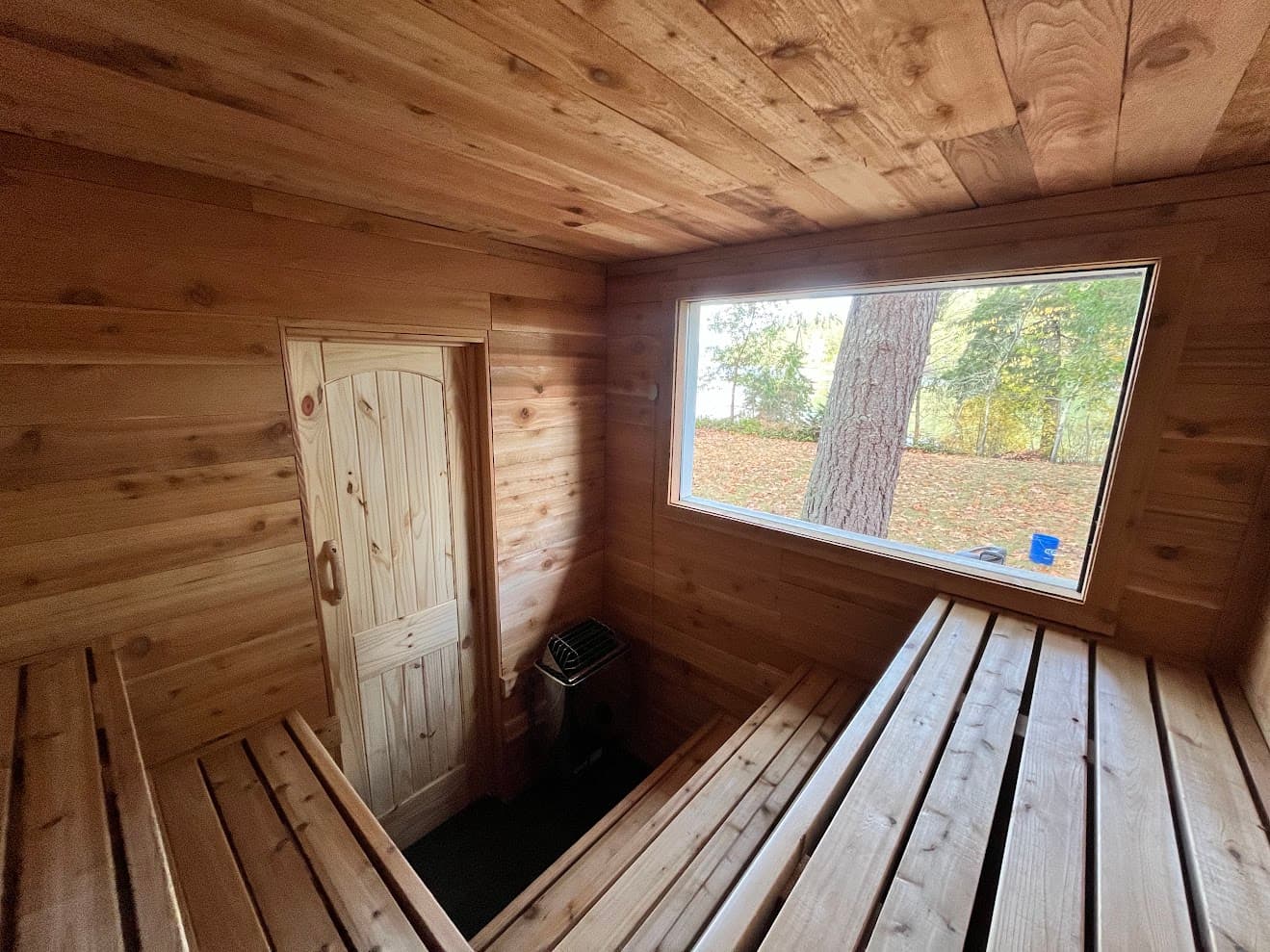
Most pods have 6'6" to 7' of interior height, and many put the bench 18 to 24 inches off the floor because that's all the room there is. You end up sitting with the stove beside you at chest level rather than below you. The result is a sauna that reads hot on the thermometer near the ceiling and feels uneven on your body.
In a well-designed sauna the head-to-foot temperature difference is under 20°C. In a poorly proportioned one it can hit 30°C or more, and barrel-style geometry can be worse than that. This is the single biggest thing separating a sauna that gets used daily for a decade from one that gets used twice a month.
Ventilation is usually an afterthought
Most pods ship with either no ventilation or a pair of passive vents in the wrong places — fresh air low near the heater and exhaust high in the ceiling. Both are backwards for an electric sauna. Cold air entering low sinks and runs across the floor without ever reaching you, and an exhaust in the ceiling pulls the steam out before it does anything.
The arrangement that actually works is fresh air entering near or above the top of the heater — about 12 inches above the top of the stove and 12 inches to the right of it, where the rising plume grabs it and warms it — and mechanical exhaust below the foot bench on the opposite wall, pulling roughly 20 to 25 CFM per person down through the bench zone where you're breathing. That's what keeps CO2 under 700 ppm during a 20-minute session with three or four people in a small room. Without it, CO2 in a sealed pod climbs past 1,200 ppm and you get the heavy, stuffy, slightly dizzy feeling people mistake for "the heat getting to them."
You can retrofit this. Cutting two holes in a pod you just paid $14,000 for is a hard thing to talk yourself into, but it's the highest-value change you can make. Our sauna ventilation guide walks through the placement.
Glass costs you more than you'd think
The full-glass front is the reason most people buy a pod. It also loses far more heat than an insulated wall — even double-pane tempered glass is nowhere close to an R-21 wall assembly. In a cold climate, a pod with a glass wall will take longer to heat, cost more to run, and struggle to hold 180°F on a windy night.
If the view is worth it, keep the glass but size the heater up. A pod rated at 6 kW with a mostly-glass front is realistically a 8 kW room. The baseline is about 1 kW per 45 cubic feet, adjusted up for outdoor exposure and glass, and our sauna heater sizing guide covers how to run that math for your specific unit.
Wall construction varies wildly
This is where the price spread comes from. At the low end you get 1x4 or 1x6 tongue-and-groove boards that are simultaneously the structure, the insulation, and the finish. There's no framing cavity, no vapor barrier, no air gap. Wood expands and contracts with every heat cycle, boards separate, and within a few seasons you're seeing daylight through the joints. That means water intrusion, insects, and heat loss.
At the high end you get 5 to 6 inches of insulated wall or solid cross-laminated timber, a foil vapor barrier, and a proper air gap behind the interior paneling. Those units perform. They also cost about what a custom build costs.
The spec to ask for is the wall thickness and R-value, plus whether there's a vapor barrier. If a company can't or won't tell you, that answers the question.
What to Check Before You Buy One
Run through this list against any pod you're considering:
- Interior ceiling height. Under 7 feet is a real compromise. Under 6'6" is a lounge chair with a heater.
- Upper bench height relative to the ceiling. You want 40 to 48 inches of headroom above the bench.
- Foot bench height relative to the top of the stones. It should be above them, not level or below.
- Wall R-value and whether there's a vapor barrier. Bare T&G is not a wall assembly.
- Ventilation. Where are the vents? If the answer is "there's a gap under the door," plan on retrofitting.
- Heater stone capacity. More stone mass means softer steam and fewer temperature swings. 40 lbs is typical; more is better.
- Electrical spec. Confirm the circuit requirement and get an electrician's quote before you order, not after.
- Foundation requirement. Most need a level gravel pad or piers with drainage and airflow under the unit.
- What the warranty actually covers, and whether it survives being placed outdoors in your climate.
When a Custom Build Makes More Sense
The honest comparison is at the $12,000-and-up mark. Below that, a pod does something a custom build can't — it gets you a functional sauna cheaply and fast. Above it, you're paying custom-build money for a room you didn't get to size.
Materials for a well-built 8x8 outdoor sauna run about $5,000 to $6,000. With a crew building it, the finished number is typically $12,000 to $20,000 depending on finishes. For that you get 7.5 to 8 foot ceilings, L-shaped benches you can actually lie down on, R-21 walls and an R-30+ ceiling, correct vent placement, and a heater sized for the actual room. It's the difference between a sauna that fits your yard and one your yard has to accommodate.
If you're weighing the two, our sauna kit vs. custom build cost comparison breaks the numbers down side by side, and the 8x8 outdoor sauna plan shows what the layout looks like at that size.
Frequently Asked Questions
How much does a sauna pod cost?
Entry-level 2-person pods start around $4,000 to $7,000. Insulated 4-person units run $9,000 to $16,000, and high-end designer pods with thick insulated or CLT walls run $18,000 to $30,000 or more. Budget another $1,000 to $3,000 for the dedicated 240V electrical circuit and, on assembled units, $1,000 to $3,000 for delivery and placement.
Do sauna pods need a foundation?
Yes. Most need a level, well-draining base — either a compacted gravel pad or concrete deck blocks with pressure-treated sleepers. The unit needs airflow underneath so the floor structure dries out, and the pad needs to shed water away from the sauna. Setting a pod directly on soil or grass will rot the floor.
How hot does a sauna pod get?
A well-insulated pod with a correctly sized heater will hold 170 to 200°F, same as any traditional sauna. The problem in most pods isn't peak temperature, it's stratification — the difference between the air at your head and the air at your feet. A low bench in a short room can read 190°F at the ceiling while your feet sit in 140°F air.
Is a sauna pod better than a barrel sauna?
Usually, but not always. Both are prefab units with limited interior height, and both put you close to the stove. Pods tend to have flatter ceilings and slightly better bench geometry, and the better ones are actually insulated, which barrels generally aren't. A cheap uninsulated pod and a barrel sauna are about the same product in different shapes.
Can you add ventilation to a sauna pod?
Yes, and it's usually worth doing. You need a 3 to 4 inch intake on the heater wall, about 12 inches above the top of the stove and 12 inches to the right of it, and an exhaust below the foot bench on the opposite wall with a small inline fan mounted outside the hot room. Check with the manufacturer first — on some units cutting the shell voids the warranty.
If You're Still Deciding
If a pod solves a real constraint for you — height limits, no build access, a property you're leaving in two years — buy the best-insulated one you can with the tallest interior, and plan on adding ventilation.
If you're buying one mainly to avoid the design work, that's the part worth reconsidering. We do remote sauna design for clients nationwide who have a local contractor but no local sauna expertise, and the deliverable is a plan set your builder can work from. It usually costs less than the delivery fee on a high-end pod.
Either way, the free sauna design checklist is a good place to start. It's the same list I use when a client sends me a pod spec sheet and asks whether it's any good.