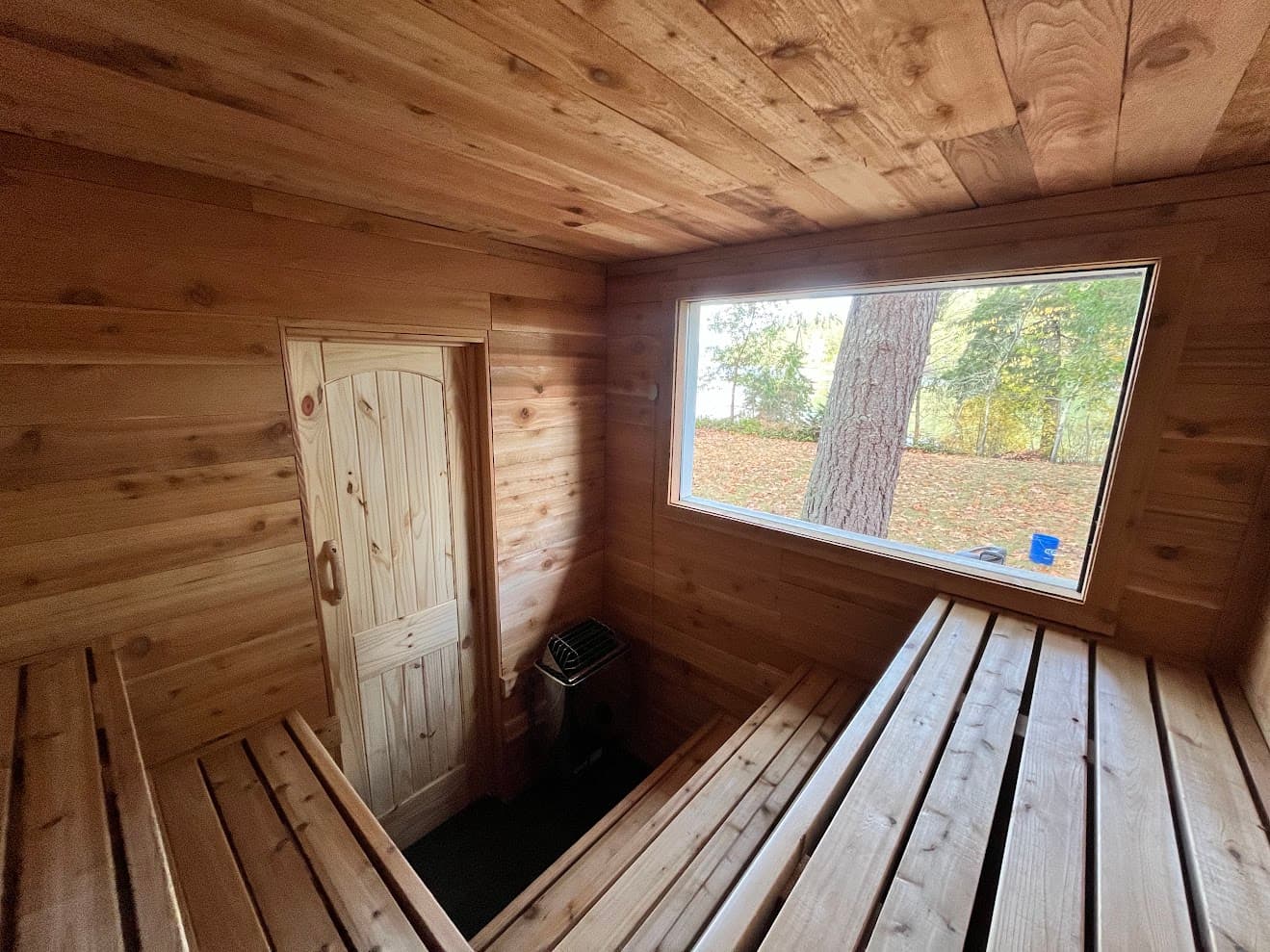
The sauna is more than a structure in Finland — it's woven into the national identity. With 3.3 million saunas serving a population of 5.5 million people, Finland has the highest sauna density in the world. This isn't coincidence. The sauna has been central to Finnish life for over 2,000 years, and understanding its cultural roots deepens your appreciation for what a sauna truly is.
This guide explores the history, traditions, and spiritual significance of the sauna, and what modern sauna builders can learn from Finnish practice.
The earliest evidence of sauna in Finland dates back to around 2000 BCE, making it one of the oldest bathing practices in the world. Early Finnish saunas were simple pit dwellings — holes dug into hillsides with fires built inside. Smoke filled the chamber, and the heat was used for bathing and spiritual purification.
By the medieval period, the sauna had evolved into a more permanent structure. Medieval Finnish records describe saunas as essential to daily life, used by all social classes. Unlike European bathhouses of the same era, which were often associated with disease and regarded with suspicion, the Finnish sauna was viewed as a place of cleanliness, health, and spiritual renewal.
The sauna was also the traditional place of birth in Finland. Pregnant women would enter the sauna in labor, attended by midwives. The warm, isolated space provided a hygienic environment and the heat was believed to ease pain and accelerate delivery. This tradition reinforced the sauna's role as a sacred, transformative space.
The smoke sauna, or savusauna, is the oldest and most traditional form of Finnish sauna. In a smoke sauna, wood is burned directly inside the chamber, filling it with smoke until the fire burns down to coals. The smoke is then allowed to escape through a small vent or opening, leaving the stones hot and the air relatively clear.
The savusauna differs fundamentally from the modern wood-burning sauna with a chimney. There is no stack drawing smoke out; instead, smoke accumulates, then clears. This creates a unique sensory experience: bathers are immersed in smoke, heat, and the aroma of burning wood, then experience the gradual clearing as the fire dies down.
Smoke saunas are still built and used throughout Finland, though they're less common than modern saunas. They're slower to heat (often 2-3 hours), require constant tending, and need a skilled operator to manage the fire safely. But many Finns consider the smoke sauna experience superior to modern electric or wood-fired alternatives — there's a spiritual quality to the smoke, the layering of temperatures, and the deliberate pace.
Trusted by homeowners across Tahoe and beyond
Löyly (pronounced "low-loo") is perhaps the most important concept in sauna culture, and it has no direct English translation. Literally, löyly refers to the steam that rises when water is poured over hot stones. But the term encompasses much more: the mood, the spiritual essence, the satisfaction, and the perfect thermal experience of the sauna.
To say a sauna has "good löyly" means the heat is distributed evenly, the air feels alive and rejuvenating, and the experience is psychologically and physically satisfying. To say there's "no löyly" means the sauna feels stagnant, the steam is weak, or the thermal sensation is off.
Creating good löyly requires skill: the right stone mass (not too few, not too many), proper ventilation so fresh hot air cycles, the right amount of water (not too much, which scalds, not too little, which creates no steam), and patience. A sauna with excellent löyly feels alive — the heat comes in waves, the air feels fresh and clean, and bathers feel genuinely rejuvenated.
This concept should inform how you design your own sauna. Prioritizing löyly means investing in proper stone capacity, ventilation design, and heater selection — not just building a hot box.
In Finland, the sauna transcends bathing. It's a place where business deals are negotiated, friendships are deepened, and families bond. The sauna is gender-neutral and class-neutral — a CEO, a farmer, and a student sit together as equals, naked and vulnerable, stripped of the social hierarchy that governs daily life.
This democratic quality is fundamental to sauna culture. There is no "best" place to sit or "proper" status. Everyone experiences the same heat, breathes the same air, and participates in the same ritual. The shared vulnerability creates a unique form of trust and openness. This sauna equality — the social leveling effect — is central to Finnish values and has deep therapeutic significance. The vulnerability of nudity and shared heat creates openness that's difficult to achieve in clothed social spaces.
In modern Finland, many families have saunas in their homes or cabins, but public and communal saunas remain important. There are saunas in apartment buildings, saunas on beaches, saunas on islands. Some saunas are attached to sports clubs or workplaces. The variety reflects the sauna's role as both an intimate personal space and a communal gathering place.
The Finnish approach to sauna bathing follows a specific ritual, refined over centuries. The core practice is the hot-cold-rest cycle — not a single session but repeated rounds that produce most health benefits:
In Finland, the sauna is often called "the most important room in the house." It's not hyperbole. The sauna represents Finnish values: simplicity, equality, honesty, and respect for nature. It's also deeply connected to Finnish wilderness — most traditional saunas are built by water, in forests, in places where people are close to the natural world.
The sauna's prevalence reflects a broader Finnish philosophy: that discomfort and challenge (heat, cold, vulnerability) build character and connection. Ice swimming (avanto), which often follows sauna sessions, embodies this same principle.
For Finns, the sauna is not a luxury but a necessity — as essential as a kitchen or a bedroom. This mindset differs sharply from many Western cultures, where sauna is seen as a spa amenity or a fitness tool. Understanding this perspective enriches how you design and use your own sauna.
Modern Finland blends ancient sauna traditions with contemporary technology. Electric heaters and sophisticated temperature controls have replaced wood fires for many, allowing saunas to be built anywhere and operated with minimal effort. Yet the fundamental experience — the ritual, the heat, the cleansing — remains unchanged.
Most Finnish homes built in the last 50 years include a sauna, either attached to the house or in a separate structure. These modern saunas honor traditional practice while offering convenience: they heat quickly, maintain stable temperatures, and can be used year-round.
Even as technology has evolved, Finnish sauna culture has preserved its values. The experience still centers on simplicity, equality, and the transformative power of heat and community.
Building a sauna inspired by Finnish tradition doesn't require a 2,000-year-old structure. Instead, focus on these principles:
Sauna traditions vary across Finland, reflecting geography and local history. Coastal regions have strong traditions of sauna-by-the-water, with lakeside cabins featuring saunas. Rural areas maintain smoke sauna traditions more persistently. In cities, apartment building saunas serve as communal gathering spaces.
Southern Finland, with its longer history of urban development, has more modern electric saunas. Northern Finland, closer to wilderness, maintains stronger connections to traditional wood-burning and smoke saunas.
These variations remind us that sauna is not a monolithic tradition but a living practice that adapts to local conditions while preserving core values.
12 decisions that determine how well your sauna performs — insulation, bench height, heater sizing, ventilation, and more.
Have questions about your project? Send us a message or schedule a free 15-minute intro call.
Schedule a free 15-minute intro call or send us a message about your project.
We'll learn about your space, goals, and timeline — and recommend the right next step for your project.