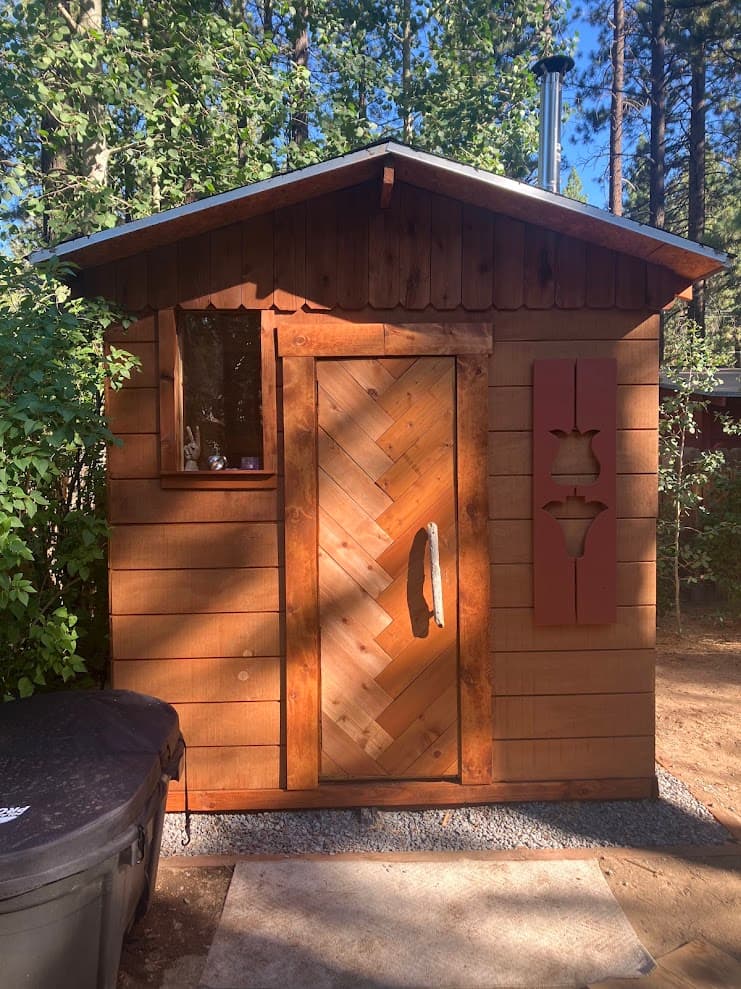
Before you break ground on a home sauna, you need to understand what your project actually requires: space, electrical power, ventilation systems, insulation, and structural support. This guide covers every requirement so you can plan accurately and avoid costly surprises.
A 4×4 sauna is the theoretical minimum for one person. In practice, it's cramped and uncomfortable. A 4×6 is tight but workable for a couple. Most residential projects start at 6×6 or 6×8.
Standard: 7.5–8 feet interior. This allows the upper bench to sit 40–48 inches below the ceiling, putting your head and shoulders in the hottest zone (180–200°F). Lower ceilings (6.5–7 feet) work for small saunas but make tall people crouch.
A sauna wall with framing (2×4 studs) + insulation + vapor barrier + interior panels is about 5 inches thick on each side. When planning, add 10 inches total to your interior dimensions to account for exterior footprint. A 6×8 sauna interior needs an 6.8×8.8 foot exterior space.
All residential saunas with electric heaters require 240V (three-phase or single-phase, depending on heater size). You cannot run a sauna heater off a standard 120V household circuit.
The heater size determines circuit requirements:
Licensed electrician required. You cannot DIY electrical work for a sauna in most jurisdictions. Electrical work requires a permit and inspection.
If the sauna is far from your panel, wire size and cost increase. A sauna 200 feet from the panel costs significantly more to wire than one 20 feet away. This should factor into your location decision.
Trusted by homeowners across Tahoe and beyond
Critical per Trumpkin Research: Proper ventilation is the #1 problem plaguing North American saunas. The standard design (fresh air entering LOW, exhaust near ceiling) fails because it doesn't remove CO₂ and creates poor stratification. Mechanical downdraft ventilation (fresh air ABOVE heater, exhaust BELOW foot bench) is the only design that works reliably for electric saunas.
Fresh air supply: 3–3.5 inch diameter passive vent on the heater wall, about 12 inches ABOVE the top of the stove and 12 inches to the right of it (beside the heater, not directly over it), ideally with an adjustable cover. Air entering there gets grabbed by the heater's rising convection plume, so it's warmed and mixed into the hot air instead of sinking cold across the floor.
Mechanical exhaust: Inline duct blower (Fantech or equivalent) positioned on the opposite wall BELOW the foot bench. Flow rate: 100–125 CFM for a 4-person sauna. The fan pulls the mixed air down through the bench zone where people sit and breathe and takes the CO₂-rich air out at the lowest point, without dumping the steam at the ceiling.
Drying vent: Optional. 3-inch vent near ceiling on exhaust wall, opened 1–2 hours after use.
Result: CO₂ stays below 700 ppm, stratification improves 4–15°C, foot bench maintains hygiene temps (55–70°C), and steam quality is dramatically better. Verify with an Aranet4 air quality monitor during sessions to confirm your ventilation is performing as designed.
If mechanical ventilation isn't feasible, use three 3-inch vents:
All three vents must duct to the exterior. You cannot vent a sauna into the living space — the moisture and heat will damage walls and insulation. Run ducts through external walls or ceiling to open to the outside.
Typical ducts are 4-inch diameter. Longer runs may need 5-inch or 6-inch ducts to reduce resistance. Install dampers on intake and exhaust to control airflow and prevent heat loss when the sauna is not in use.
Most residential saunas use passive ventilation (gravity and natural air pressure differences). For larger saunas (8×8+), a small in-line duct fan (50–75 CFM) can improve air exchange without making the sauna drafty.
Good ventilation is critical. If moisture builds up and doesn't exhaust, mold and wood decay result. The high vent (drying vent) should be open when the sauna is not in use to allow interior moisture to escape.
Minimum R-13 in walls (3.5-inch cavity with fiberglass batts). Better: R-15 to R-21 using thicker cavities (5.5 inches) or denser insulation. This insulation sits between the 2×4 studs on the warm (interior) side of the vapor barrier.
Minimum R-30 in the ceiling. This is where heat loss is most significant. R-38 is better. Use full-thickness batts or blown insulation to fill the cavity completely.
A continuous aluminum or polyethylene vapor barrier on the warm (interior) side of the insulation is critical. This prevents moisture from the sauna air from entering the insulation. If insulation gets wet, it loses effectiveness and wood decay starts. No exceptions — every sauna must have a vapor barrier. Sauna Vapor Barrier | Radiant Barrier Roll
Leave a small air space (0.5–1 inch) between the vapor barrier and interior cedar panels. This allows any moisture that enters to escape without getting trapped. A furring strip creates this gap naturally.
Often overlooked. If your sauna sits on a concrete slab, you lose significant heat through the floor. R-10 to R-20 under the slab or on top of the slab (under flooring material) makes a noticeable difference in heating efficiency.
Your sauna foundation must support the weight of the structure + benches + people + heater. Typical options:
A filled 8×8 sauna with 6 people on benches, heater, and water weighs roughly 5,000–7,000 pounds total. That's 60–85 PSF (pounds per square foot), which is within the design capacity of a standard residential deck or slab.
Standard 2×4 studs on 16-inch centers. Nothing special — it's like building a small shed. The framing must be securely fastened because bench loads (and heat) stress connections. Use 3–4 inch screws to mount bench frames into wall studs.
Your roof must be designed for your climate and local building code. In Lake Tahoe or Truckee (heavy snow), a roof must handle 80+ PSF snow load. This typically means:
Flat or low-pitch roofs in snowy climates require structural engineer approval.
Cedar siding is typical and beautiful, but it needs protection: exterior stain/sealant applied every 2–3 years. Metal roof prevents snow and ice buildup better than shingles in cold climates. All penetrations (flashing around pipes, vents) must be sealed to prevent water intrusion.
Western Red Cedar is the standard for sauna benches. It resists heat cracking, is soft on skin, and looks beautiful. Never use pressure-treated wood (chemicals leach at high temperature). Hemlock and aspen work but are less durable. Redwood is good but more expensive.
Cedar or hemlock tongue-and-groove boards create the interior walls. 5/4 boards (true 1 inch thick) are standard. Install with nails or stainless screws to avoid rust staining.
Ceramic or porcelain tile is ideal — it doesn't rot, drains well, and handles heat. Some people use cedar slats over a drain, but tile is more durable long-term.
Solid wood (cedar or hemlock) door, typically 24 inches wide by 78–80 inches tall. Tempered glass is optional for aesthetics but adds cost. Hinges and handles must be stainless steel or aluminum (not regular steel, which rusts).
You don't need a frost-protected foundation in moderate climates if you're on a level, well-draining site. Concrete blocks or concrete piers work fine.
Many people assume saunas need a drain. They don't. A floor drain is helpful if you want to rinse the floor, but it's optional. If you do install one, it must drain away from the foundation (not under it).
You don't need windows in a sauna. They reduce insulation value, add cost, and limit privacy. Many builders skip them entirely. If you want natural light, a single small window on a non-bench wall is sufficient.
Don't overthink ventilation. The three-hole passive system works great. You don't need ducts, fans, or complicated controls in most residential saunas.
12 decisions that determine how well your sauna performs — insulation, bench height, heater sizing, ventilation, and more.
Have questions about your project? Send us a message or schedule a free 15-minute intro call.
Schedule a free 15-minute intro call or send us a message about your project.
We'll learn about your space, goals, and timeline — and recommend the right next step for your project.