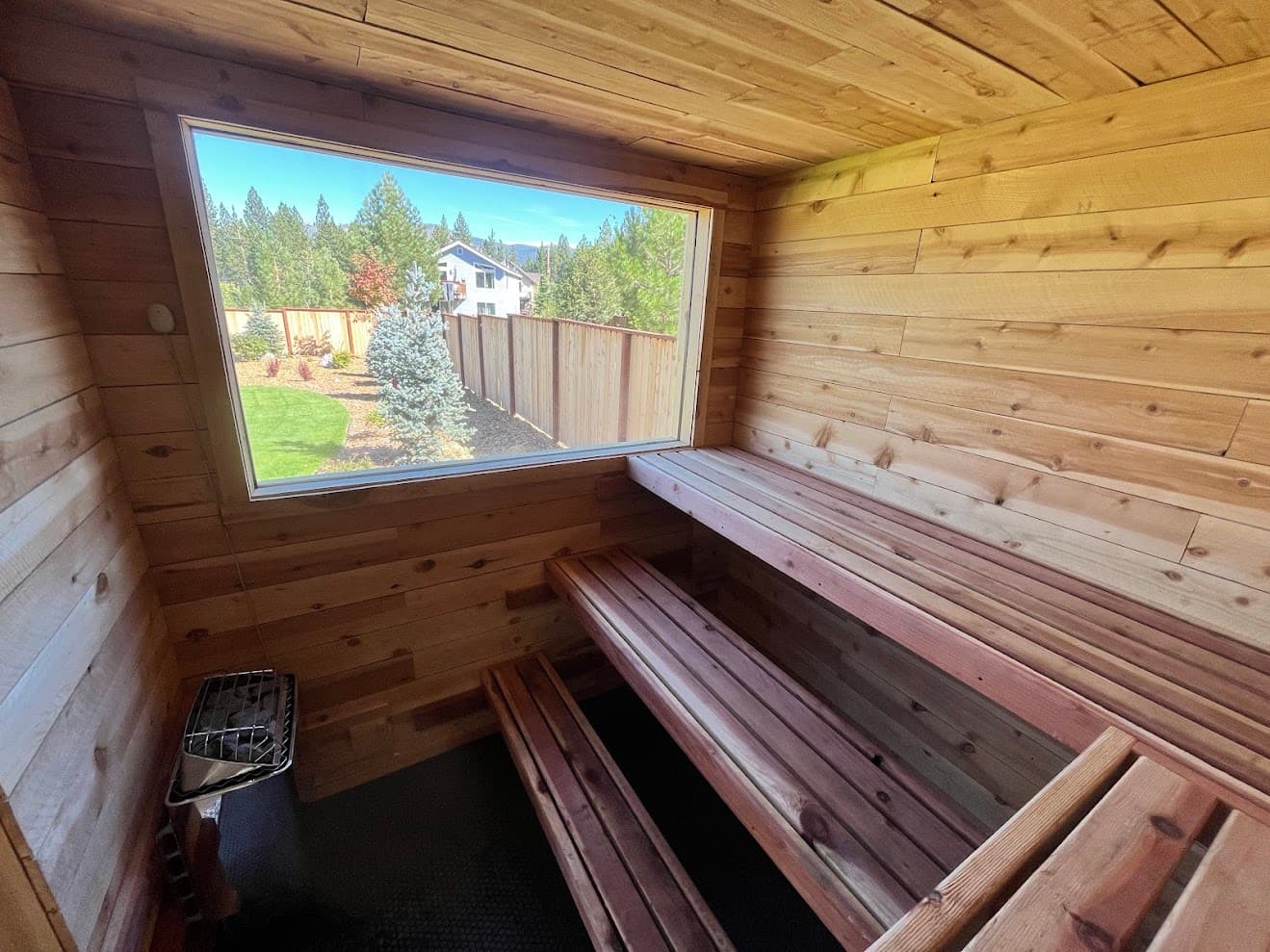
Your floor plan determines how the sauna functions: bench arrangement, heater placement, door location, and the overall flow of the experience. This guide walks through floor plans for each standard size and explains the design logic behind bench positioning, heater safety clearances, and entry flow.
Before diving into specific layouts, understand the principles that drive good sauna design:
The heater should sit in a corner or on the short wall, positioned away from where people enter. It needs manufacturer-specified clearances (typically 6–12 inches) from combustibles. You want it visible from the upper bench (aesthetically) but not directly in your face when you're sitting.
Most important: Position the upper bench so your feet sit 10–20cm (4–8 inches) ABOVE the heater's stone tops. This is the löyly cavity where convective heat is evenly distributed. Benches positioned too close to or below the heater create cold feet and poor steam. This is the single biggest design mistake in North American saunas—don't make it.
The door always opens outward to prevent heat loss if someone accidentally leaves it ajar. Standard size is 24×78 to 24×80 inches (narrower = less heat loss). Position it to avoid blocking bench access. In an L-shaped layout, the door typically goes on the short wall opposite the heater.
Leave a clear path from the door to the bench access point. If benches are cramped or the entry path is blocked, the sauna feels claustrophobic. Minimum 18-inch clear pathways are acceptable; 24 inches is better.
The sauna requires a three-hole ventilation system: intake on the heater wall near or above the top of the heater (about 12 inches up and 12 inches to the side of the stove), a fan-driven exhaust on the opposite wall below the foot bench, and drying vent near the ceiling. These don't take center stage in floor plans, but they drive wall penetration locations.
Always position the upper bench 40–48 inches below the ceiling. This is the design anchor. Lower benches space 16–20 inches below upper benches.
A 4×6 sauna is compact. You get one bench along the long wall, the heater on the short wall, and the door on the opposite short wall or along the long wall away from the bench.
Single bench along the 6-foot wall. Depth: 16–20 inches (one or two 2×4 boards). Width: 6 feet total, which is tight for two people side-by-side (3 feet per person). One person comfortably, or a parent and child.
Corner of the 4-foot wall (away from the bench long wall). Minimum 6 inches clearance to framing.
24×78-inch door on the short wall opposite the bench, or on the long wall adjacent to the heater.
DIY materials: $3,000–$5,000. Professional build: $8,000–$12,000. Quick to build (2–3 weeks for professional).
Trusted by homeowners across Tahoe and beyond
A 5×7 sauna is less common but works well as a bathroom addition or for tight lots. It's larger than 4×6 but smaller than 6×8. An L-shaped bench is possible with care.
L-shaped bench along the long wall and one short wall. Upper bench depth: 20 inches. Spacing: 16 inches between upper and lower benches. This gives you room for 2–3 people comfortably.
Corner of the short wall (away from the L-bench). 6–8 inches clearance.
24×80-inch door on the opposite short wall or adjacent long wall, avoiding the bench entry path.
DIY materials: $3,500–$6,000. Professional build: $10,000–$15,000.
A 6×8 sauna is the most common residential size. It's large enough for a full L-shaped bench with 2–3 levels, yet compact enough to fit most residential properties.
L-shaped bench wrapping two walls. Upper bench along the long wall (8 feet) and one short wall (6 feet), both at 24-inch depth. Lower bench below, with 18 inches vertical spacing. This gives you:
Corner where the L-bench doesn't extend (typically the short wall away from the L). 8-inch clearance minimum.
24×80-inch door on the short wall opposite or adjacent to the heater. Position to not interfere with bench entry.
Intake near or above the top of the heater (about 12 inches up and 12 inches to the side), fan exhaust on the opposite long wall below the foot bench, drying vent near ceiling on the same wall as exhaust.
DIY materials: $4,000–$7,000. Professional build: $15,000–$25,000. Timeline: 3–4 weeks for professional.
An 8×8 sauna is the sweet spot. The square footprint allows flexible bench layouts (L-shaped or U-shaped), and the volume is ideal for standard heater sizing and residential electrical service.
Upper bench along two walls (8 feet + 8 feet), 24-inch depth. Lower bench below at 16 inches depth, with 18–20 inches vertical spacing. Capacity:
Upper bench along three walls. Lower bench below on two walls. This maximizes capacity for social/entertainment use, but requires careful heater placement and more complex bench joinery. Capacity: 8–10+ people across multiple levels.
Corner not wrapped by benches (typically one short wall corner). 8–10 inches clearance. Ensure it's visible from the upper bench but not in direct line-of-sight that creates uncomfortable radiant heat.
24×80-inch door on one short wall, positioned to not interfere with bench access. Ideally on the same wall as the heater or opposite, leaving long walls for benches.
Intake on the heater wall near or above the top of the heater (about 12 inches above the stove, 12 inches to the side). Fan-driven exhaust on the opposite short wall, below the foot bench. Drying vent near ceiling on the same wall as exhaust. The rising heat grabs the fresh air and the fan pulls it down through the benches and out at the lowest point — good airflow without disrupting the sauna experience.
DIY materials: $5,000–$8,500. Professional build: $20,000–$35,000. Timeline: 4–6 weeks for professional.
An 8×10 or larger sauna is designed for groups, guests, or commercial use. The rectangular footprint allows a U-shaped bench wrapping three walls with multiple levels.
U-shaped bench wrapping three walls. Upper bench along all three walls, lower bench along two walls. Three levels are possible. Total capacity: 10–15+ people. Bench entry requires careful planning to not block access.
One short wall corner (not wrapped by benches). Heater is prominent and visible from all bench levels, which is good for aesthetics but requires extra clearance consideration. 10–12 inches clearance.
Typically on one long wall or the short wall with the heater. Wider clearance (36 inches) is better for larger groups.
More complex. Intake near or above the top of the heater, fan exhaust on the opposite wall below the foot bench. Multiple drying vents near ceiling on different walls to ensure airflow reaches all bench levels.
DIY materials: $7,000–$12,000. Professional build: $30,000–$50,000+. Timeline: 6–8 weeks.
Benches must be mounted securely to wall framing using 3–4 inch screws into studs. Plan for L-brackets or support posts if benches extend far from walls. Upper benches need more substantial support than lower benches.
The entryway should feel welcoming and not cramped. A bench near the door (lower level, short seating) can serve as a dressing bench. Ensure at least 18–24 inches of clear path from the door to bench access.
The upper bench is the premium zone. Design your layout so that someone sitting on the upper bench has sightlines to the rest of the sauna (not staring at a wall). This improves the social experience.
Your layout affects heat layering. A well-positioned upper bench (40–48" below ceiling) captures the hottest air. Lower benches sit in cooler zones. Design bench spacing to allow heat to circulate from the stove down and around.
Plan for easy access to the heater for cleaning, repairs, and seasonal maintenance. Don't bench yourself into a corner where the heater is unreachable.
12 decisions that determine how well your sauna performs — insulation, bench height, heater sizing, ventilation, and more.
Have questions about your project? Send us a message or schedule a free 15-minute intro call.
Schedule a free 15-minute intro call or send us a message about your project.
We'll learn about your space, goals, and timeline — and recommend the right next step for your project.