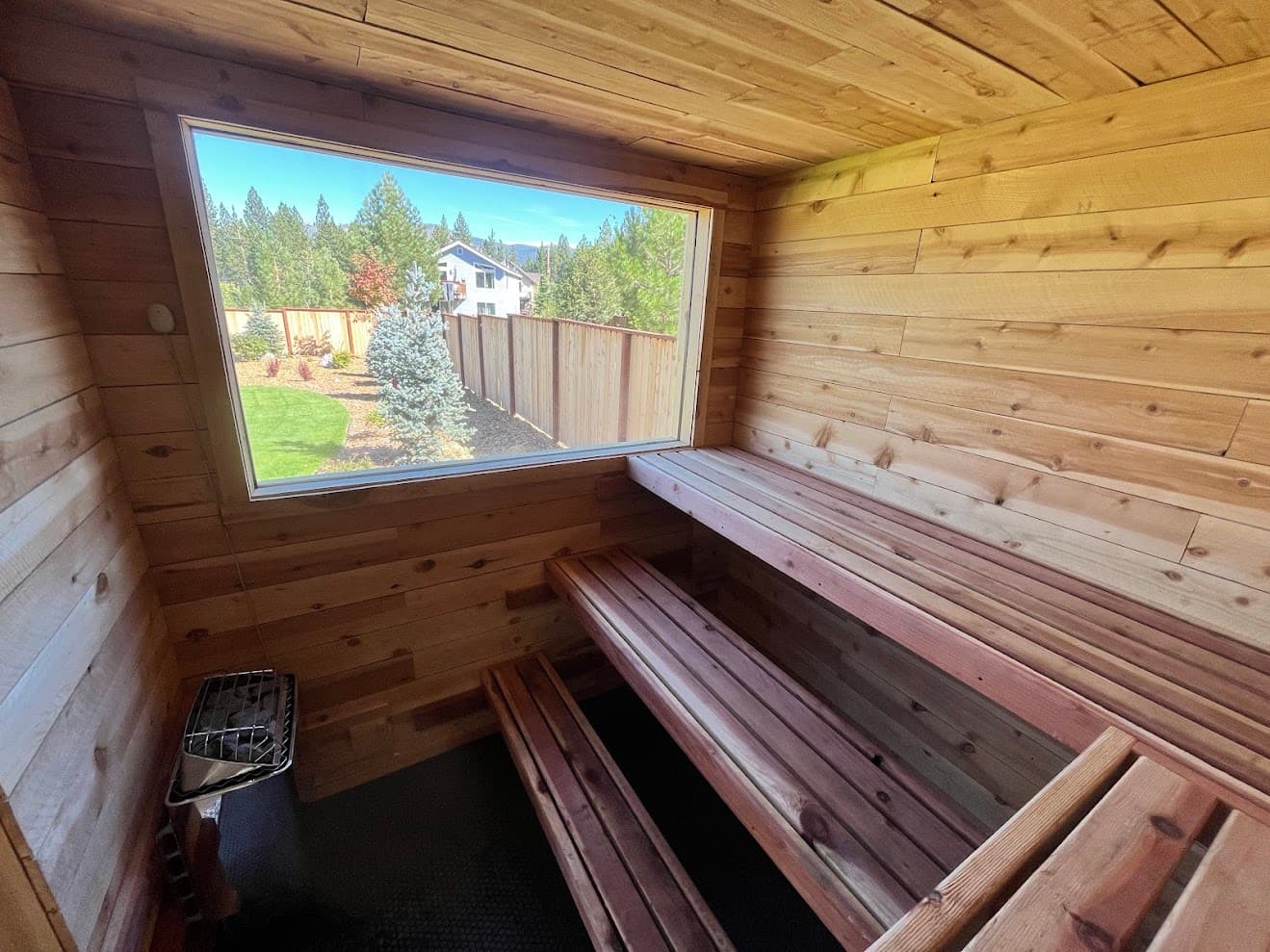
Barrel saunas have aesthetic appeal — they're iconic, compact, and visually striking. But they're more complex to build than cabin-style saunas, and they have unique challenges. This guide walks through the process and helps you decide if a barrel is the right choice.
A barrel sauna is a cylindrical structure made from curved wooden staves (boards) held together by metal bands (hoops). The curved design is attractive and space-efficient, but it requires different construction techniques than a rectangular cabin.
Typical dimensions: 4–8 feet long, 4–6 feet in diameter. Interior headroom at the center is usually 5–6 feet.
The staves are the vertical wood boards that form the barrel's body. Each stave is slightly curved and must be cut and fitted precisely.
Most people buy pre-cut stave kits rather than cutting them from scratch. This is wise — stave cutting requires specialized equipment and expertise.
Trusted by homeowners across Tahoe and beyond
Steel bands hold the staves together. Bands are tightened progressively as the staves settle. This is critical — loose bands allow staves to shift and gaps to form.
Band maintenance is ongoing. Every few months (especially in the first year), you'll need to check and tighten bands. Over time, wood shrinks, and bands loosen. This is one of the biggest maintenance differences from cabin saunas.
Budget $50–$200/year for band maintenance and potential re-tightening.
In a barrel sauna, benches are typically L-shaped or wrap around the interior. The curved walls and roof height limit bench configuration.
Challenge: The highest bench is limited by the barrel's diameter and roof curve. A 6-foot diameter barrel gives you only limited upper bench height, which reduces thermal stratification (you can't access the hottest zone as easily).
Compare this to a rectangular cabin where you can stack benches 3–4 feet high — this gives better heat layering.
Placing an electric heater in a barrel requires careful clearance planning (the heater needs space on all sides). You can compare electric sauna heaters at Select Saunas to find compact models that fit barrel dimensions. Wood-fired heaters are common in barrels and can look beautiful, but require chimney installation and building permits.
Ventilation is trickier in a curved space. You need both intake (usually low, near the heater) and exhaust (high, near the roof). Designing these in a curved geometry requires thought.
Barrel saunas are marketed as affordable, but the true cost depends on whether you buy a kit or build from scratch — and whether you factor in the short lifespan.
| Approach | Material Cost | Total with Labor |
|---|---|---|
| Pre-cut kit (4–person, cedar) | $3,000–$6,000 | $5,000–$10,000 |
| DIY from scratch (stave cutting) | $4,000–$8,000 | $4,000–$8,000 + 60–100 hrs labor |
| Cabin sauna (6×8, for comparison) | $5,000–$10,000 | $8,000–$15,000 |
The cabin costs more upfront but lasts 30+ years. A barrel at $5,000 that needs replacement in 3–5 years costs $10,000–$15,000 over the same period. Factor in higher operating costs ($2–$5/hour vs $1/hour) and the cabin pays for itself within 1–3 years. See our full sauna renovation cost guide for indoor conversion options that cost less than a barrel.
Most people should buy a pre-cut stave kit rather than cutting staves from scratch. Here's why:
If you're set on building from scratch, budget $2,000–$3,500 for cedar or spruce lumber alone, plus $200–$500 for steel bands. You'll need access to a jointer, planer, and router table at minimum.
Building a barrel is roughly:
Timeline: 40–80 hours for a skilled builder to construct a barrel from pre-cut kits.
Recent research from Trumpkin (localmile.org), a respected US sauna researcher, reveals significant problems with barrel saunas that most builders overlook:
A proper sauna requires 3 m³ (105 cubic feet) per person. A typical 6-foot diameter barrel provides only ~1 m³ per person. Result: CO2 levels increase 2–4x faster than proper saunas, causing dizziness, light-headedness, and users leaving early. You can measure this yourself with an Aranet4 air quality monitor — it'll show exactly how fast CO₂ climbs in a small-volume sauna.
Barrel saunas create head-to-toe temperature differences of 60–120°F (ideal is 20–36°F). Your head might be 180°F while your feet are 80–100°F. This "cold feet" problem persists even with feet on the bench (62–88°F stratification remains). It limits health benefits because core body temperature rise is lower.
Natural convection doesn't work in cylindrical geometries due to lack of height. Poor ventilation means inadequate CO2 and VOC removal, plus rapid heat loss at door opening (no heat cavity above door). Operating cost: $2–5/hour for barrels vs ~$1/hour for cabin saunas — a $1,000–$3,000/year premium.
Typical barrel sauna lifespan: 2–4 years of actual use before disuse. Real estate data shows only 0.3% of actual saunas are barrels despite 13–22% of sales being barrels — they disappear from properties. Mold grows on benches that never reach 65°C (150°F). Embedded bacteria odors can't be eliminated even after cleaning.
Building or buying a second barrel after the first one deteriorates often costs $3,000–$8,000 more than a single cabin sauna build.
Consider a barrel only if:
Choose a cabin-style sauna instead if:
The data is clear: A 6×7×8.5' cabin sauna (~$8,600 professionally built) pays for itself versus a barrel in 1–3 years through lower costs and better experience, and lasts 30+ years instead of 3–5.
We recommend against building a barrel sauna in almost every case. The research from Trumpkin and real estate data shows they fail long-term due to poor air quality, extreme temperature stratification, high operating costs, and short lifespan.
If you're genuinely constrained by property limits (height restrictions or space), a barrel is a fallback. Otherwise, invest in a cabin sauna — better experience, lower cost over time, lasts decades instead of years.
If building a cabin isn't possible due to zoning, consider building on a trailer for code flexibility instead of settling for a barrel.
A DIY barrel sauna from a pre-cut kit costs $3,000 to $6,000 for materials. A professionally assembled barrel sauna runs $5,000 to $10,000 installed. Custom-built barrels from scratch cost $4,000 to $8,000 in materials alone. A comparable cabin-style sauna costs more upfront ($8,000–$15,000) but lasts 30+ years versus 3–5 years for a barrel.
Research shows typical barrel sauna lifespan is 2–4 years of actual use before disuse. Real estate data shows only 0.3% of actual saunas are barrels despite 13–22% of sales being barrels. Band maintenance, mold growth on benches that never reach 150°F, and embedded bacteria odors contribute to the short lifespan.
Buy a kit. Stave cutting requires specialized equipment and precise curve-radius matching. Pre-cut kits cost $2,000–$5,000 and save 20–40 hours of precision woodworking. Most DIY barrel failures come from improperly cut staves that create gaps and poor sealing.
Build a cabin sauna in almost every case. Barrels have extreme temperature stratification (60–120°F head-to-toe difference versus 20–36°F ideal), poor air quality, high operating costs ($2–$5/hour versus $1 for cabin), and 3–5 year lifespan versus 30+ years. The only exception is strict height restrictions or extreme space constraints.
Cedar is the best choice due to its natural rot resistance, which is critical for barrel staves exposed to weather. Spruce costs 30–40% less but has significantly less rot resistance. Thermally modified wood is the premium option and adds 2–3 years of lifespan.
12 decisions that determine how well your sauna performs — insulation, bench height, heater sizing, ventilation, and more.
Have questions about your project? Send us a message or schedule a free 15-minute intro call.
Schedule a free 15-minute intro call or send us a message about your project.
We'll learn about your space, goals, and timeline — and recommend the right next step for your project.