Two sauna styles dominate the outdoor sauna market: the barrel sauna and the cabin (or shed-style) sauna. Both are popular, both work, but they solve the sauna problem in fundamentally different ways. Understanding those differences is the key to making a choice that matches your expectations.
This comparison is not marketing — we'll walk through the actual design tradeoffs, the thermal consequences, and the durability differences. Some projects are genuinely better as barrels. Most aren't.
A barrel sauna is a cylindrical structure — imagine a giant wooden barrel laid on its side. The shape is created by curved wooden staves (planks) bound tightly together by steel bands running around the perimeter. The ends are flat, and access is through a door on one of the flat ends.
Barrel saunas are primarily outdoor structures, typically made from cedar or spruce. They come in kit form — the staves, bands, and minimal hardware ship flat, and you assemble on-site. Interior dimensions are small: 4–6 feet wide, 8–10 feet long. A typical barrel sauna sleeps 4–6 people on a single bench or two stacked benches.
The appeal is clear: they're visually distinctive, they arrive ready to assemble (no framing or insulation required), and they fit a compact footprint. A barrel sauna can go almost anywhere a hot tub might go — on a deck, a patio, or a gravel pad.
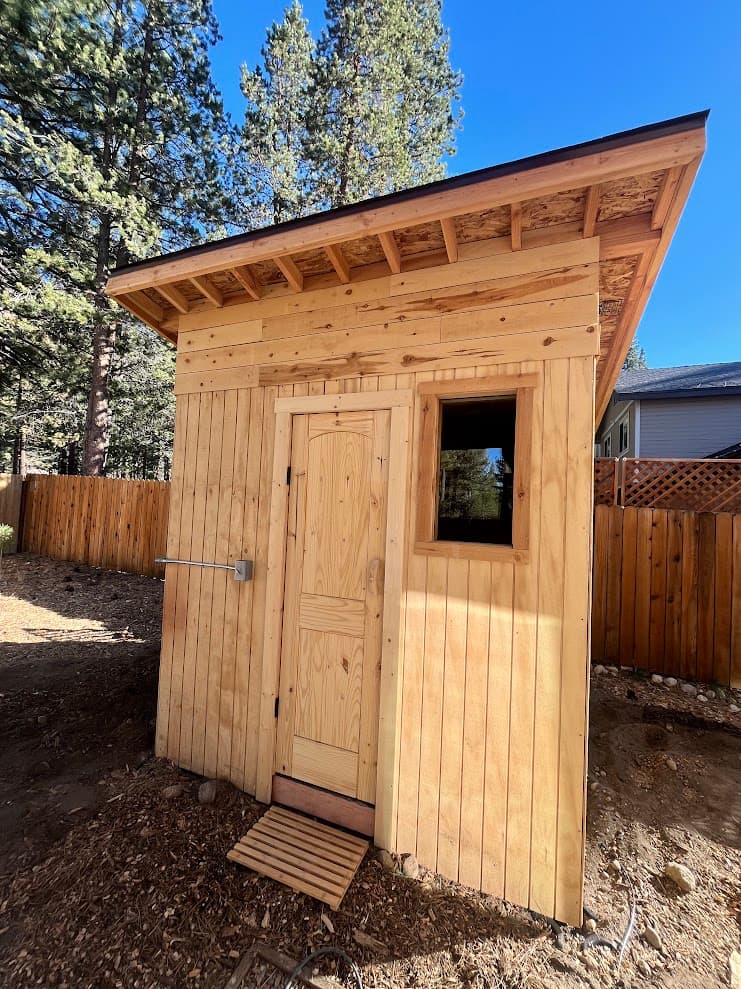
A cabin or shed-style sauna is a traditional framed structure: 2×4 studs, a roof, and walls. It's built like a small house — proper joists, rafters, sheathing, insulation between the studs, a vapor barrier, and interior cedar paneling. The footprint is rectangular, and interior dimensions are typically 6×8 or 8×8 feet.
Unlike a barrel, a cabin sauna is built on-site (or arrives as pre-cut panels to be assembled on-site). It requires a proper foundation — a concrete slab, grade-level deck framing, or helical piers — and an actual roof engineered for your climate. In mountain regions, this means proper snow load calculations and roof pitch.
The interior is fully customizable: bench heights, shelving, lighting, door placement. You can design a true two-level bench system with an upper bench where your shoulders are near the ceiling (the hottest zone) and a lower bench where guests can sit more upright.
The cost range depends heavily on foundation choice, exterior cladding, electrical distance, and local labor rates. Lake Tahoe and Truckee projects typically land at the higher end.
Trusted by homeowners across Tahoe and beyond
The cylinder shape creates two fundamental problems that most barrel sauna marketing glosses over: insufficient volume and extreme temperature stratification.
A proper sauna requires a minimum of 3 m³ (105 cubic feet) per person. This volume is essential for air quality — without it, CO2 builds up dangerously and bathers feel compelled to leave early.
A typical 6-foot diameter barrel (4-person capacity) contains only ~1 m³ per person — roughly one-third the required amount. The consequence: CO2 levels increase 2–4x faster than in a properly designed sauna. Users report dizziness, light-headedness, and the sensation of poor air quality after just 15–20 minutes. If you want to see for yourself, put an Aranet4 air quality monitor inside during a session — you'll watch CO₂ climb past safe levels fast.
In a well-designed sauna, the upper bench should sit 40–48 inches below the ceiling, and head-to-toe temperature difference should not exceed 20–36°F. This creates an even, comfortable thermal experience.
In a barrel sauna, the reality is brutal: head-to-toe temperature difference of 60–120°F — far exceeding the threshold for what's called "cold feet." Your head might be at 180°F while your feet are at 80–100°F. Even with feet up on the bench, thermal stratification of 62–88°F persists because the barrel's shallow height doesn't allow proper heat layering.
The cylinder geometry doesn't allow for proper bench heights either. You sit essentially at floor level with minimal vertical space above. There's no room for a second bench level, and the single bench sits too low. Your head is in the mid-temperature zone, but your feet are near the floor where the air is much cooler still.
Result: an uneven, uncomfortable thermal experience that limits both enjoyment and health benefits (core body temperature increase is lower due to poor circulation).
The barrel design looks elegant, but the engineering has fundamental weaknesses that limit real-world lifespan.
The wooden staves are bound together with steel bands. When the sauna is cold, the bands are tight. When you heat the interior to 180°F (or higher), the wood expands. The bands relax slightly. Then, after the sauna cools, the wood contracts, and the bands no longer grip as tightly.
Over dozens of heat cycles, the bands loosen progressively. Gaps begin to appear between staves. Water from rain or snow intrudes. Insects find entry points. Heat loss accelerates. Many barrel sauna owners report having to re-tighten bands every few months — a never-ending maintenance cycle.
In barrels, the foot bench rarely reaches 65°C (150°F) — the temperature needed to kill pathogens. Combined with poor ventilation (see below), moisture accumulates. Mold and bacteria colonize the benches and interior surfaces, creating odors and hygiene issues.
Direct radiant heat from the heater creates uneven thermal exposure: one side of your body faces the hot stove directly (uncomfortably hot), while the other side stays cool. This asymmetrical heating is undesirable and inefficient.
Typical barrel sauna lifespan: 2–4 years of actual use before disuse. Real estate agents report that most used barrels found on properties are rotted and homeowners request removal. Used barrels don't reseal properly after disassembly — embedded bacteria and mold odors are nearly impossible to eliminate.
A cabin sauna, built like a conventional structure, is engineered differently. The framing is rigid, the insulation is sandwiched between studs and protected by vapor barriers. The roof is sealed. Over 30+ years, you might reseal cracks or re-stain the exterior, but the core structure remains solid.
Barrel saunas have a critical flaw: natural convection doesn't work in cylindrical geometries due to lack of height. Without proper ventilation, CO2 and VOCs (volatile organic compounds) accumulate, and pathogens don't get removed.
Result: poor air quality and rapid heat loss at the door (no heat cavity above the door to maintain temperature). Operating cost: $2–5/hour for barrels versus ~$1/hour for properly designed cabin saunas.
Over 5 years of regular use, this difference compounds: barrel operating costs run $1,000–$3,000 MORE per year than a cabin sauna.
Barrel saunas rely on the wooden staves themselves as the insulation layer. Typical construction uses 2–3 inch thick boards with an R-value of roughly R-5 to R-8 — barely adequate. As gaps develop and bands loosen, efficiency drops further.
A cabin sauna is insulated properly: R-13 to R-21 in walls, R-30+ in ceiling. With vapor barriers and sealed penetrations, it holds heat efficiently. In a cold climate like Lake Tahoe or Truckee, a barrel sauna requires a significantly larger heater to compensate for poor insulation — another cost burden.
On the surface, barrel saunas look cheaper. But the full cost of ownership tells a very different story.
10-year total: $26,500–$54,000
10-year total (professional): $16,000–$27,000
Even a professionally built cabin sauna is 50–67% cheaper over 10 years than a barrel sauna. The $8,600 cabin sauna (referenced in Trumpkin research) pays for itself vs. a barrel in 1–3 years through lower operating costs + better experience.
Where barrel saunas genuinely win is aesthetics and fit. The cylindrical form is distinctive, looks like a sauna at a glance, and reads as intentional landscaping. Some properties — especially those with compact decks or patios — have space for a barrel but not a 6×8 or 8×8 cabin.
If your property has height constraints (an HOA height limit, a low pergola overhead, or a steep lot) a barrel's lower profile (typically 6–7 feet tall versus 9–10 feet for a cabin) can be an advantage.
But if you have the space and no height constraints, the aesthetics argument weakens. A well-built cedar cabin sauna, properly finished with a covered entry and landscaping, is equally attractive and becomes a permanent addition to your property rather than a structure that will need maintenance and repair every few years.
The data is stark: 13–22% of sauna sales in the US are barrels, but only 0.3% of actual saunas found on properties are barrels (1 in 320). They disappear from real estate listings at rates suggesting owners remove them after abandonment.
Why? The novelty effect: high initial use (Year 1), declining use (Year 2–3), complete abandonment (Year 4+). Barrels don't deliver the experience customers expected, and the maintenance burden discourages long-term ownership.
Perceived savings are deeply misleading: initial cost is lower, but operating costs + repairs + short lifespan make barrels expensive long-term. Health benefits are also limited: high stratification means lower core body temperature increase, reducing sauna wellness benefits.
Otherwise, the data strongly recommends: build a cabin sauna on a trailer or permanent foundation. The experience, durability, and long-term cost make it the only rational choice.
For most projects — especially those without strict space or height constraints — a cabin sauna delivers a better overall experience:
We recommend against barrel saunas in almost every case where a cabin sauna is physically possible.
The barrel's low upfront cost comes with severe trade-offs: poor air quality (excessive CO2), extreme temperature stratification (60–120°F head-to-toe difference), short lifespan (2–4 years actual use), high operating costs ($2–5/hour vs $1/hour), and inevitable mold/hygiene issues.
Research shows that only 1 in 320 actual saunas are barrels despite representing 13–22% of sales. The rest are removed from properties due to poor long-term experience and maintenance burden.
Better alternative: A 6×7×8.5' cabin sauna (~$8,600 with proper ceiling/benches) pays for itself versus a barrel in 1–3 years through lower operating costs and better experience, lasts 30+ years, and delivers the thermal suite experience customers actually want.
Build on a trailer for code flexibility if needed — the design and thermal experience are incomparably better than a barrel.
Not inherently. They're well-designed for specific constraints — small spaces, height restrictions, or quick deployment. But in most situations where you have room and no restrictions, the thermal performance, durability, and long-term value of a cabin sauna outweigh a barrel's convenience.
With proper maintenance and regular band re-tightening, 8–12 years is typical. Some last longer if you stay ahead of repairs. A cabin sauna, maintained properly, can last 30+ years without major intervention.
You can use a larger heater, but the small interior volume means it will overshoot temperature quickly. The real issue is efficiency: if the barrel has loosened bands and gaps, no amount of heater size will recover the efficiency of a properly sealed structure.
Yes — it requires framing, roofing, insulation, and electrical work. But it's no more complex than building a small shed, and many DIYers successfully complete cabin sauna builds. A barrel arrives as a kit and is faster to assemble, but actual construction skills for a cabin are straightforward and well-documented.
You can wrap a barrel with foam insulation and cladding, but this defeats the aesthetic and quick-assembly advantage. You're then building a custom structure anyway — at that point, a cabin design makes more sense.
12 decisions that determine how well your sauna performs — insulation, bench height, heater sizing, ventilation, and more.
Have questions about your project? Send us a message or schedule a free 15-minute intro call.
Schedule a free 15-minute intro call or send us a message about your project.
We'll learn about your space, goals, and timeline — and recommend the right next step for your project.