People talk about sauna air quality in the abstract — CO2 “builds up,” the air gets “stale.” We wanted the actual number. So we put a research-grade CO2 monitor on the bench of a real sauna and ran a normal session, first on the sauna's passive vents alone, then with a mechanical exhaust fan running. The gap between the two is the whole argument for ventilation, in one reading.
The Result
On the sauna's passive vents alone, the monitor climbed to 1,302 ppm after a few rounds — into the red, and well past the point where the air feels heavy and your head goes foggy. Switch on the mechanical exhaust and it falls back below the 700 ppm healthy line, trending toward the roughly 400 ppm of outdoor air. Same sauna, same session, same heat — the only variable was whether air was actually moving.
The Evidence
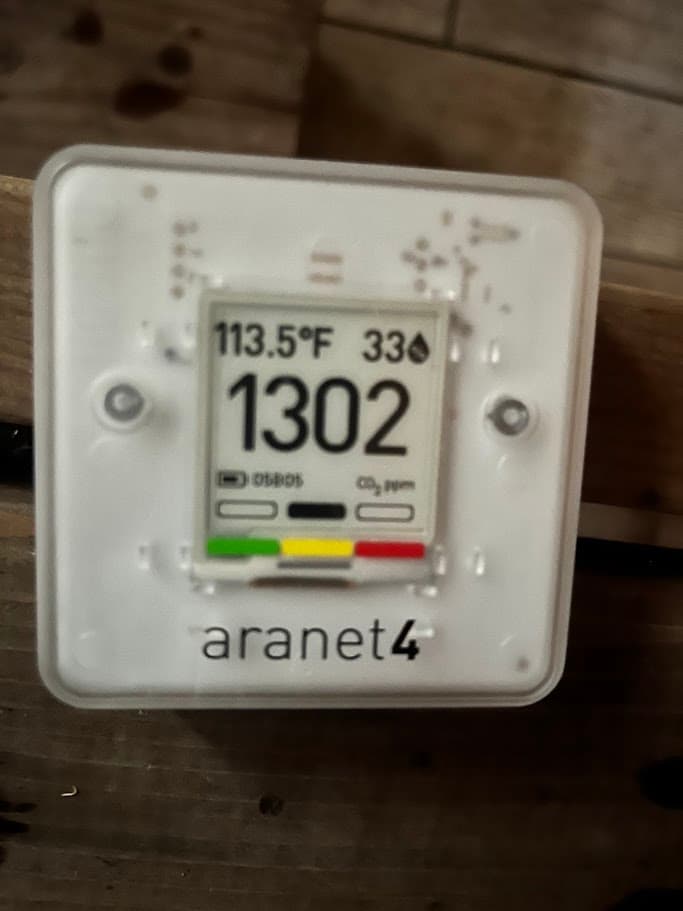
1,302 ppm on passive vents, before the fan comes on. That's the heavy, foggy-headed feeling as a number.
Watch on our YouTube channel — subscribe for more builds →
Trusted by homeowners across Tahoe and beyond
How We Measured It
The monitor is an Aranet4 — a portable, research-grade air quality monitor built around an NDIR CO2 sensor accurate up to 9,999 ppm, the same class of tool used in Finnish sauna ventilation studies. The method was deliberately simple, so anyone can repeat it:
- Monitor placed on the bench at breathing height, where the air you actually breathe is.
- A normal heat session with the door closed.
- First run on the sauna's passive vents only; CO2 logged as it climbed.
- Then the mechanical exhaust fan switched on, and the drop watched in real time.
No special conditions, no lab. This is what happens in an ordinary sauna on an ordinary evening — which is the point.
What the Numbers Mean
Outdoor air runs about 400 ppm. Under 700 ppm is the healthy target for a sauna in use; under 550 ppm is ideal. From 700 to 1,000 ppm the air is borderline, and over 1,000 ppm is where most people feel it — heavy, foggy, a little short of breath. At 1,302 ppm, this sauna was firmly in that zone. It's worth being clear about what this isn't: these are comfort and air-quality levels, not the point where CO2 is acutely toxic, which is far higher. The reason it matters is that bad air quietly ruins the session. Full breakdown of the levels is on our sauna air quality & CO2 page.
Why Passive Vents Weren't Enough
This sauna had vents. It still hit 1,302 ppm. That's the lesson: in an electric sauna, passive vents rely on the heat to drive airflow, and an electric heater doesn't create strong enough convection to reliably move air. The vents were there; the air wasn't moving. A small mechanical exhaust is what turns two holes into actual air exchange. We go deeper on this in mechanical vs. natural ventilation.
Measure Your Own Sauna
The best part of a number is that you can get your own. Set a CO2 monitor on your top bench, run a normal session with the door shut, and read it after 15-20 minutes. Under 700 ppm and your ventilation is doing its job; over 1,000 ppm and it's not, whatever the sauna feels like. If you want the monitor and the fix together, we bundle the Aranet4 with our ventilation kit — the same kind of mechanical exhaust that took this reading back down toward fresh air.
Frequently Asked Questions
How much CO2 did the sauna reach?
1,302 ppm on passive vents at 113°F, versus about 400 ppm outdoors. With the mechanical exhaust running it dropped below 700 ppm toward outdoor levels.
How was it measured?
With an Aranet4 research-grade NDIR monitor on the bench at breathing height, during a normal session — first on passive vents, then with a fan.
Does mechanical ventilation actually lower sauna CO2?
Yes — you can watch it. Over 1,300 ppm on passive vents fell below 700 ppm with the exhaust fan on. That's the case for a fan over passive vents in an electric sauna, in one measurement.