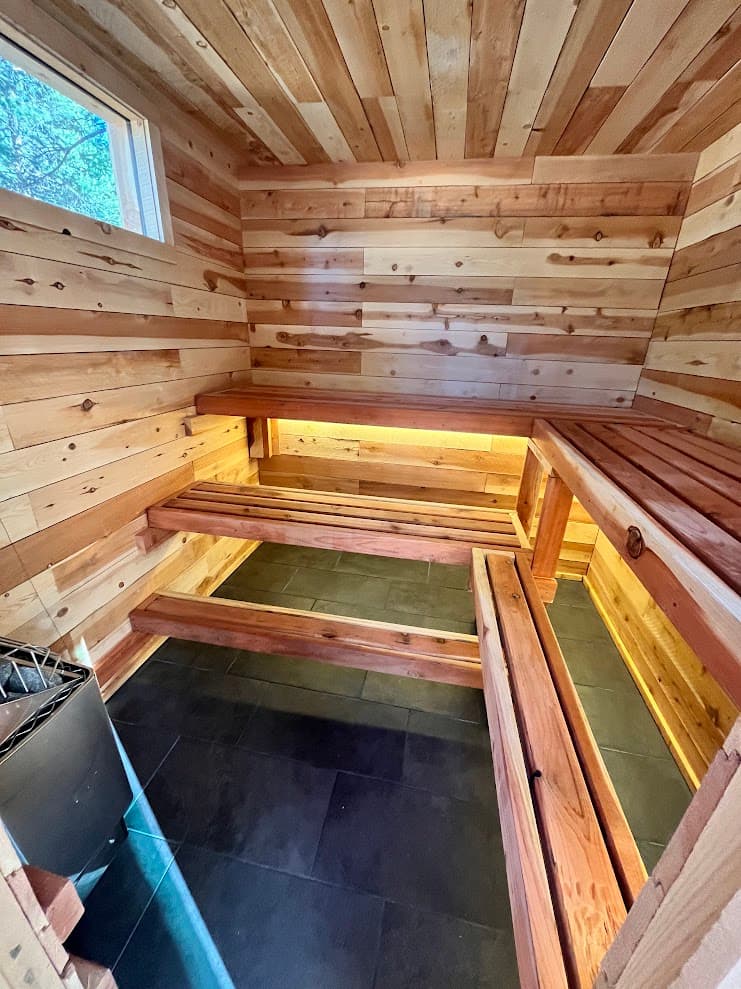
If your sauna feels close, heavy, or hard to breathe after a couple of rounds, the instinct is to blame the heat and turn it down. That almost never helps, because the heat isn't the problem. The air is. In a closed room, the CO2 you breathe out builds up and the oxygen drops, and that's the heavy, foggy-headed feeling you're calling stuffy. It's fixable, and it doesn't mean giving up any heat.
Outdoor air sits around 400 ppm of CO2. In a sealed sauna with a few people, it commonly climbs past 1,000 ppm within 15-20 minutes, and a fully closed-up sauna can reach 1,500-2,000 ppm. Somewhere over 1,000 ppm is where most people start to feel it: the head gets heavy, breathing feels like work, and you want out sooner than you should.
You can't see or smell CO2, so it masquerades as the heat. The tell is that it gets worse the longer the door stays shut and the more people are inside — which is exactly how CO2 behaves, and not how heat behaves. For the full picture of what the numbers mean, see sauna air quality & CO2.
Trusted by homeowners across Tahoe and beyond
A surprising number of saunas — especially prefab kits and DIY builds — have no real air exchange. The room is sealed for heat, nobody added vents, and the CO2 has nowhere to go. This is the worst case and the most common. Fix: add an intake and a mechanical exhaust.
Vents only work if they're positioned right. The two classic mistakes are putting both vents on the same wall (air short-circuits straight from one to the other without mixing through the room) and putting the exhaust up in the ceiling (which pulls off the hottest, freshest steam instead of the stale air down at bench height). Fix: intake and exhaust on opposite walls, with the exhaust low — at or below bench level. See exactly where each vent goes.
Passive vents rely on the heat to drive airflow. A wood fire does that well. An electric heater doesn't — it can't create strong enough convection to reliably clear the air. So a lot of electric saunas have two vents and still feel stuffy, because those vents aren't actually moving enough air. Fix: add a small mechanical exhaust fan. More on this in mechanical vs. natural ventilation.
Even a decent setup will feel stuffy if everything is closed tight and the sauna is packed. More people means more CO2, faster. If you run long sessions with a full bench, you need active air exchange, not just a couple of holes.
You don't have to guess. Put a CO2 monitor on the top bench and run a normal session with the door closed. We use the Aranet4 — it reads CO2, temperature, and humidity, and it settles the question fast. Under 700 ppm and your air is fine. Over 1,000 ppm and you've found your stuffy. We measured over 1,300 ppm in a real sauna on passive vents before switching a fan on — the full measurement is here.
For an electric sauna, the reliable fix is mechanical: a small exhaust fan pulling stale air out at bench height, with fresh air coming in near the heater so it's warmed on the way. That clears the CO2 and evens out the head-to-feet heat at the same time, and the fan only runs when you want it to. It's a small trade in efficiency for a big jump in how the sauna feels.
If you'd rather not source and size the parts yourself, our pre-assembled ventilation kit is the direct fix — a complete intake-and-exhaust system that installs in about an hour on any sauna, and it's the exact system that took that 1,300 ppm reading back down toward fresh air.
It's the air, not the heat. CO2 builds up and oxygen drops in a closed room. Past about 1,000 ppm, most people feel heavy and short of breath — and it builds within 15-20 minutes without you seeing or smelling it.
Either the vents are in the wrong spots (same wall, or exhaust up in the ceiling) or they're passive vents on an electric sauna, which don't move enough air on their own. Correct placement plus a mechanical exhaust fixes both.
In a home sauna it's rarely dangerous — these CO2 levels cause discomfort and headaches, not acute poisoning. But it cuts your session short and works against the benefits, so it's worth fixing.
12 decisions that determine how well your sauna performs — insulation, bench height, heater sizing, ventilation, and more.
Have questions about your project? Send us a message or schedule a free 15-minute intro call.
Schedule a free 15-minute intro call or send us a message about your project.
We'll learn about your space, goals, and timeline — and recommend the right next step for your project.