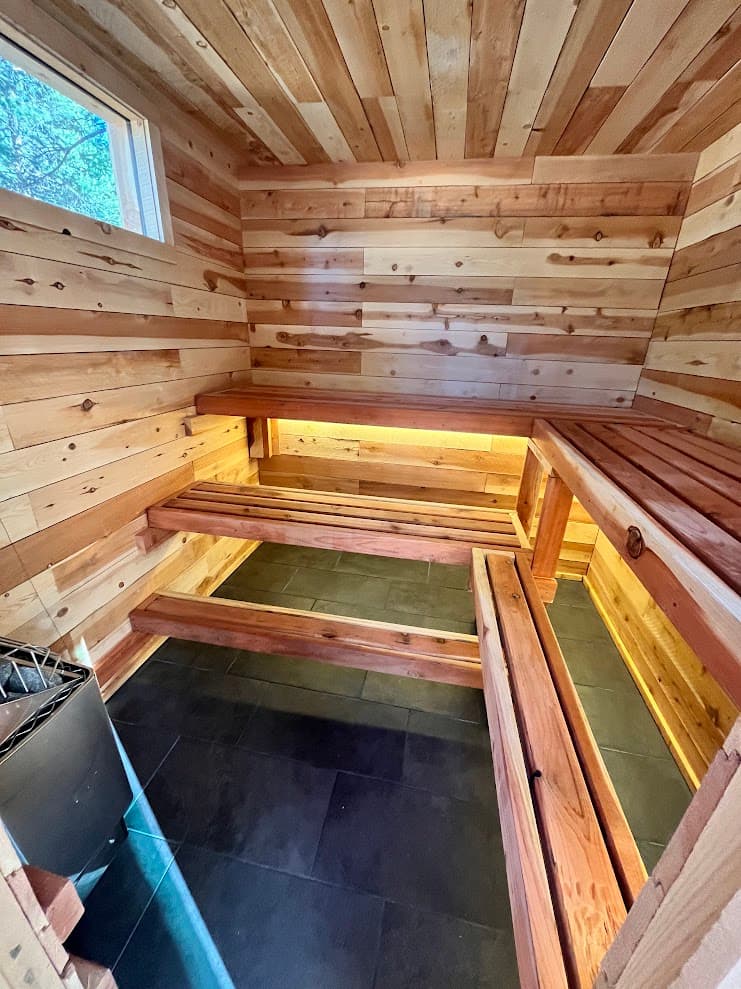
When people say a sauna feels stuffy, close, or hard to breathe, they usually blame the heat. It's almost never the heat. It's the air going stale — oxygen dropping and carbon dioxide building up while the door stays shut. You can't see it or smell it, so you just feel heavy and foggy-headed and cut the session short without knowing why.
The good news is that air quality in a sauna is measurable and fixable. This page covers what actually happens to the air during a session, what the CO2 numbers mean for how you feel, how to check your own sauna with a monitor, and how to fix it if the numbers are bad.
A sauna is a small, sealed room built to hold heat. That's exactly what you want thermally, and exactly what works against the air. Shut the door with a few people inside and three things start moving in the wrong direction at once.
CO2 climbs. Every breath you exhale adds carbon dioxide to a room that isn't exchanging air with the outside. Outdoor air sits around 400 ppm. In a closed sauna with two to four people, CO2 commonly passes 1,000 ppm within 15-20 minutes, and a fully sealed sauna can reach 1,500-2,000 ppm. That rise is the main thing you feel.
Oxygen drops. The flip side of the same process. It's not a dramatic drop in a home sauna, but combined with the CO2 and the heat, it adds to the lightheaded, short-of-breath feeling.
Humidity and moisture build. Sweat and löyly push humidity up, and if that moisture has nowhere to go after the session, it soaks into the wood and grows mold over time. Air quality isn't only about the session you're in — it's about what the trapped moisture does to the room between sessions.
CO2 is the number to watch because it tracks how stale the air is and it's easy to measure. Here's how the levels map to how you feel:
One honest caveat: these are air-quality and comfort thresholds, not the point where CO2 becomes acutely dangerous — that happens at far higher levels than a home sauna reaches. The reason to care isn't poisoning. It's that bad air quietly ruins the thing you got in the sauna for. You feel worse, you leave sooner, and you don't get the calm, clear-headed session you were after.
Trusted by homeowners across Tahoe and beyond
Rather than take the numbers on faith, we put a CO2 monitor on the bench of a real sauna and ran a normal session. On passive vents alone — two holes in the wall and the hope that air moves on its own — the CO2 climbed past 1,300 ppm, into the monitor's red zone, after a few rounds. Then we switched on the mechanical exhaust fan and watched it fall back toward fresh air.
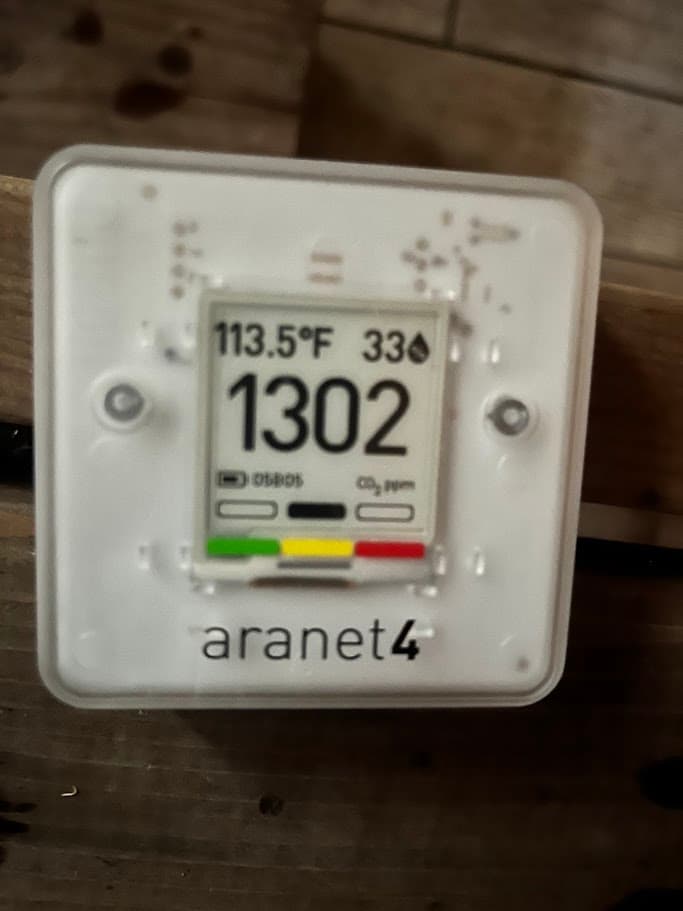
1,302 ppm on passive vents alone, before the fan comes on. That's the heavy, foggy-headed feeling — as a number.
Watch on our YouTube channel — subscribe for more builds →
This is the whole point of measuring: the difference between hoping your air is fine and watching it on a screen. You can't feel the gap between 600 and 1,200 ppm as a specific thing — you just feel better or worse. The monitor turns “the sauna feels stuffy” into a number you can actually do something about.
You need a portable CO2 monitor. We use the Aranet4 — it uses a research-grade NDIR CO2 sensor, reads temperature and humidity too, runs for years on two AA batteries, and needs no wiring or hub. You set it on the bench and read it. It's the same tool Finnish sauna researchers use for ventilation studies.
The test is simple:
A monitor also doubles as a löyly gauge, since it reads temperature and humidity — so you get a fuller picture of the room than a thermometer alone. If you want the monitor together with the fix, we bundle the Aranet4 with our ventilation kit so you can measure the problem and solve it in one go.
If the numbers are bad, the fix is air exchange — moving stale air out and fresh air in while you're using the sauna. The reliable way to do that in an electric sauna is mechanical downdraft ventilation: fresh air enters above the heater, and a small exhaust fan pulls stale, CO2-heavy air out below the foot bench on the opposite wall. That keeps CO2 under 700 ppm and evens out the head-to-feet heat at the same time.
Passive vents — two holes and no fan — usually aren't enough on their own in an electric sauna. The heater doesn't drive strong enough convection to reliably clear the air, which is why so many saunas feel stuffy despite having vents. For the full reasoning, see our sauna ventilation guide and the comparison of mechanical vs. natural ventilation.
If you already have a sauna and just want it fixed, our pre-assembled ventilation kit is the direct answer — a complete intake-and-exhaust system that installs in about an hour on any sauna, kit or custom. It's the exact system that took that 1,300 ppm reading back down toward fresh air.
CO2 is the biggest and most measurable piece, but it's not the only one.
Moisture and mold. Trapped humidity is the slow version of a sauna air problem. If the room can't dry out between sessions, moisture soaks into the wood and grows mold, which then affects the air every time you use it. A drying vent and a simple post-session routine handle this — see how to prevent mold in a sauna.
Materials and off-gassing. What your sauna is built from matters for the air too. Use proper sauna woods and avoid treated lumber, glues, and finishes inside the hot room — heat drives off-gassing, and you don't want to breathe that. Our best wood for sauna guide covers what belongs inside and what doesn't.
Fresh-air source. Ventilation only helps if it's pulling from clean air. Draw intake from outside or a clean space, not from a musty basement, an attached garage, or right next to an exhaust outlet.
The heat is fine — it's the stale air that's the issue. In a closed sauna, CO2 builds up and oxygen drops, which is what makes you feel heavy and short of breath. It's rarely dangerous in a home sauna, but it cuts your session short and works against the benefits. The fix is ventilation, not less heat.
Under 700 ppm during use, and under 550 ppm is ideal. From 700 to 1,000 ppm the air is borderline; above 1,000 ppm most people feel it clearly. These are comfort and air-quality thresholds, well below where CO2 becomes acutely toxic.
Often yes, and sometimes worse than a traditional sauna — infrared cabins are small, sealed tight, and frequently have no ventilation at all. With one or two people, CO2 climbs fast in that small volume. A monitor will show it, and adding air exchange fixes it.
Cracking the door helps in a pinch, but it dumps heat and gives you no control. It's a workaround, not a fix. A small exhaust fan moves air steadily without killing the session, which is why mechanical ventilation is the real answer.
12 decisions that determine how well your sauna performs — insulation, bench height, heater sizing, ventilation, and more.
Have questions about your project? Send us a message or schedule a free 15-minute intro call.
Schedule a free 15-minute intro call or send us a message about your project.
We'll learn about your space, goals, and timeline — and recommend the right next step for your project.