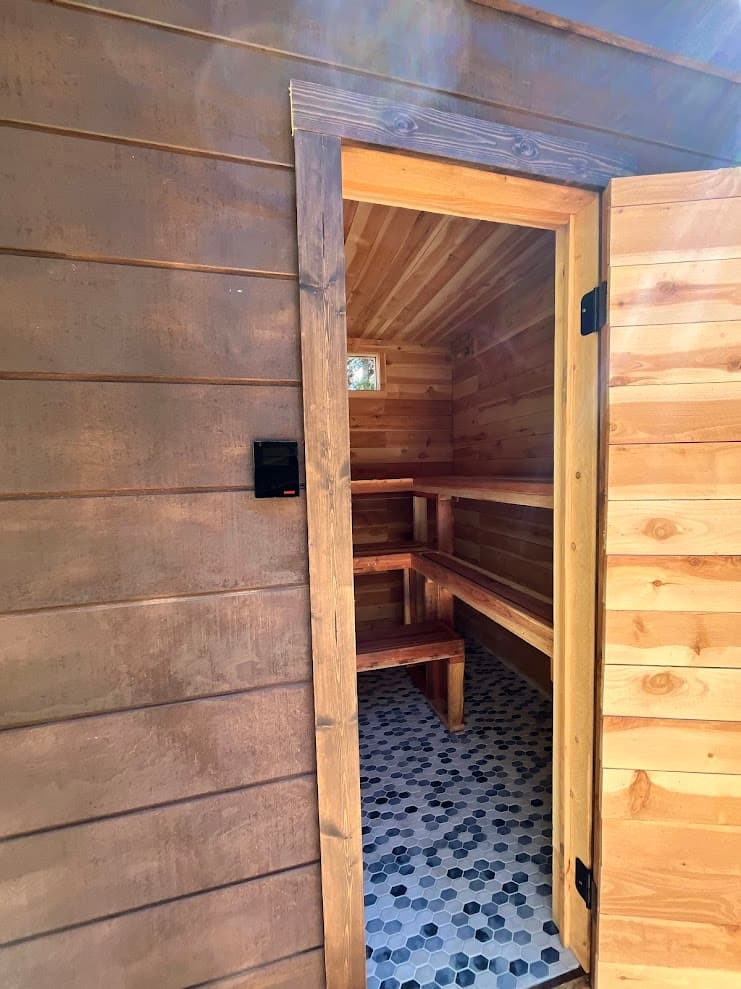
While a sauna by itself delivers excellent health benefits, adding a dedicated changing room elevates the entire experience. A changing room provides a dry transition space for undressing, storing clothes and towels, and cooling down after your sauna session. It's the difference between a sauna tucked in a basement corner and a true wellness retreat.
If you're planning a permanent home sauna installation, adding a changing room is a worthwhile investment that typically costs $1,000 to $3,000 more than a sauna-only build, but significantly enhances comfort and usability.
Moisture Management: A changing room is dry and separate from the sauna interior. This prevents moisture from spreading into your home and makes the transition smoother. You cool down in a comfortable, dry environment before dressing.
Storage: Dedicated hooks and a bench mean your clothes, towels, water bottle, and accessories have a home. No dragging wet items through your house or leaving them scattered on a bench inside the sauna.
Comfort: Undressing in a cool changing room is more comfortable than stripping in the sauna itself. Some families prefer the privacy and dignity of a separate space, especially for guests.
Experience: A well-designed changing room signals that your sauna is a dedicated wellness space, not an afterthought. It encourages regular use and makes the sauna feel like a retreat.
Contrast Therapy: If you're pairing your sauna with a cold plunge or outdoor shower, a changing room between them provides an organized flow: undress → sauna → cool down in changing room → cold exposure → dress. This creates a structured wellness ritual.
A functional changing room should be at least 4 feet by 6 feet (24 sq ft). This is enough space for one or two people to comfortably change and move around.
Smaller than this and the space feels cramped. Larger is always better if you have the space and budget — 5x8 or 6x8 feels luxurious and allows room for a small bench, hooks, and open floor space.
Height: Minimum 7 feet to allow comfortable movement and hanging clothes. If your building can accommodate 8 feet or higher, even better — it reduces that cramped feeling.
Trusted by homeowners across Tahoe and beyond
Door Between Sauna and Changing Room: This is critical. A solid door (preferably with a step-down threshold to catch water) separates the hot, humid sauna from the dry changing room. This door slows heat loss and controls moisture.
Benches: A bench along one wall (36-48 inches long) gives people a place to sit while undressing or putting on shoes. Height should be 18-20 inches — standard seating height.
Hooks & Pegs: Install 4-6 hooks or pegs at varying heights (some at 60 inches, some at 72 inches) for robes, towels, and clothes. Stainless steel or wooden pegs work well.
Shelving: A shelf or open cubbies near the door can hold towels, water bottles, and bathrobe if your changing room is large enough.
Flooring: Non-slip tile or sealed concrete prevents water from tracking. If your sauna drains to a floor drain, position it to direct water away from the changing room.
One of the smartest design moves for sauna + changing room is venting both spaces vertically to allow hot, humid air to rise and escape. Acathedral ceiling (open to the rafters) or vented upper wall creates this effect naturally.
Hot air rises. If your sauna and changing room share a vaulted or cathedral ceiling, moisture naturally rises and exits through roof vents rather than condensing on walls. This dramatically improves long-term durability.
Practical example: If your sauna is 8 feet tall and you open the ceiling to 12-14 feet, that extra space acts as a buffer zone. Moisture has room to rise and disperse. You'll notice less condensation on the ceiling and better overall moisture control.
This approach requires good roof ventilation (soffit and ridge vents) but is worth the effort during construction planning.
Sauna Exhaust: Your sauna needs active ventilation — typically an exhaust duct that vents humid air outside. This duct should be 4-6 inches in diameter and insulated to prevent condensation inside the duct.
Changing Room Makeup Air: As the sauna exhausts, you need fresh air to enter. Install a makeup air duct or crack a window in the changing room. Without replacement air, the sauna can't properly exhaust.
Door Threshold: The step or threshold between sauna and changing room should be at least 1-2 inches high to slow water flow and separate the wet zone from the dry zone.
Walls: Cedar, hemlock, or tile. Many builders use tile or sealed drywall for the changing room (unlike the sauna interior, which is never sealed). Tile is easy to clean and handles humidity well.
Floor: Non-slip tile, sealed concrete, or vinyl planks rated for wet environments. Avoid wood — it swells and splinters in a humid space. Slope the floor gently toward a drain if possible.
Ceiling: If cathedral, exposed wood beams look beautiful and age well. If flat, drywall or cedar work. Ensure good insulation above to prevent condensation.
Door: Solid core or wood door with a rubber seal. Many builders use a simple flush door with a threshold. Cedar or hemlock doors match the sauna aesthetic.
Install light fixtures in the changing room so people can see while undressing. Waterproof or damp-rated fixtures are recommended. Aim for soft, warm lighting (2700K) rather than bright commercial lighting.
Consider an exhaust fan with an integrated timer (20-30 minute delay) that runs automatically after sauna use to clear humidity. Alternatively, a simple wall switch gives users control.
If installing a heated towel rack or under-floor heating, plan electrical runs during construction. Under-floor heating in the changing room is a luxurious touch that improves comfort.
Framing & Insulation: $500–$800. Basic stud walls, insulation, and vapor barrier.
Flooring (tile or sealed concrete): $400–$700. Includes prep, tile or coating, and sealing.
Wall finish (tile or drywall + paint): $300–$600. Depends on material and size.
Door & hardware: $150–$350. Wood door, frame, hardware, and threshold.
Fixtures (bench, hooks, shelving, drain): $200–$400. Custom or semi-custom options vary widely.
Exhaust system & makeup air: $300–$500. Ducts, fans, and vents.
Lighting & electrical: $200–$400.
Total: $1,800–$3,750 depending on finishes and complexity. A modest changing room adds $2,000–$2,500 to a typical sauna build.
The Linear Layout (4x6): Sauna and changing room side by side, connected by a door. The changing room is narrow (4 feet) but functional. Good for tight spaces.
The L-Shape (6x8 total): Sauna in one corner, changing room wraps around it. Allows a larger changing area (5x6 or more). Good for corner locations.
The Dedicated Room (6x8 changing room, separate sauna):If you have the budget and space, a spacious changing room feels like a true spa. This layout allows a larger bench, more hooks, and room to relax.
The Sauna Pod (sauna + changing room integrated, cathedral ceiling): A single space with a tall ceiling. The sauna occupies one half, the changing area wraps around. Venting to the ceiling peak works beautifully.
No door between spaces: Without a door, humidity spreads everywhere. Always separate the sauna from the changing room.
Too-small changing room: If the changing room is smaller than 3x5, it will feel claustrophobic. Plan for at least 4x6.
Inadequate ventilation: A changing room with no exhaust fan or makeup air will trap humidity. Coordinate your ventilation plan with your sauna's exhaust.
Bench at wrong height: Too low (16 inches) and you feel like you're sitting on a kid's stool. Too high (22+ inches) and it's awkward. Aim for 18-20 inches.
No threshold or drain: Water from the sauna will flow into the changing room. A threshold and small drain protect the space.
When budgeting your sauna project, don't treat a changing room as an afterthought. Plan it during the design phase, not after the sauna is built. This allows your builder to:
A changing room designed during planning costs $1,500–$2,500. One added after the sauna is complete costs 40% more because of rework and coordination challenges.
Once you have the basics, consider these enhancements if your budget allows:
Outdoor shower: An outdoor shower between your sauna and changing room (or cold plunge) creates a spa-like experience. Hot sauna → cool rinse → changing room.
Heated towel rack: A 500-1000W rack keeps towels warm and adds luxury. Costs $150–$500 depending on quality.
Radiant floor heating: Under-floor heating in the changing room is a game-changer in cold climates. Costs $400–$800 to add during construction.
Custom bench & cabinetry: Instead of a simple bench, a custom built-in with cubbies for each family member. Costs $800–$2,000.
Sauna-style door: A handcrafted wooden door instead of a standard flush door. Costs $300–$800 but looks beautiful.
12 decisions that determine how well your sauna performs — insulation, bench height, heater sizing, ventilation, and more.
Have questions about your project? Send us a message or schedule a free 15-minute intro call.
Schedule a free 15-minute intro call or send us a message about your project.
We'll learn about your space, goals, and timeline — and recommend the right next step for your project.