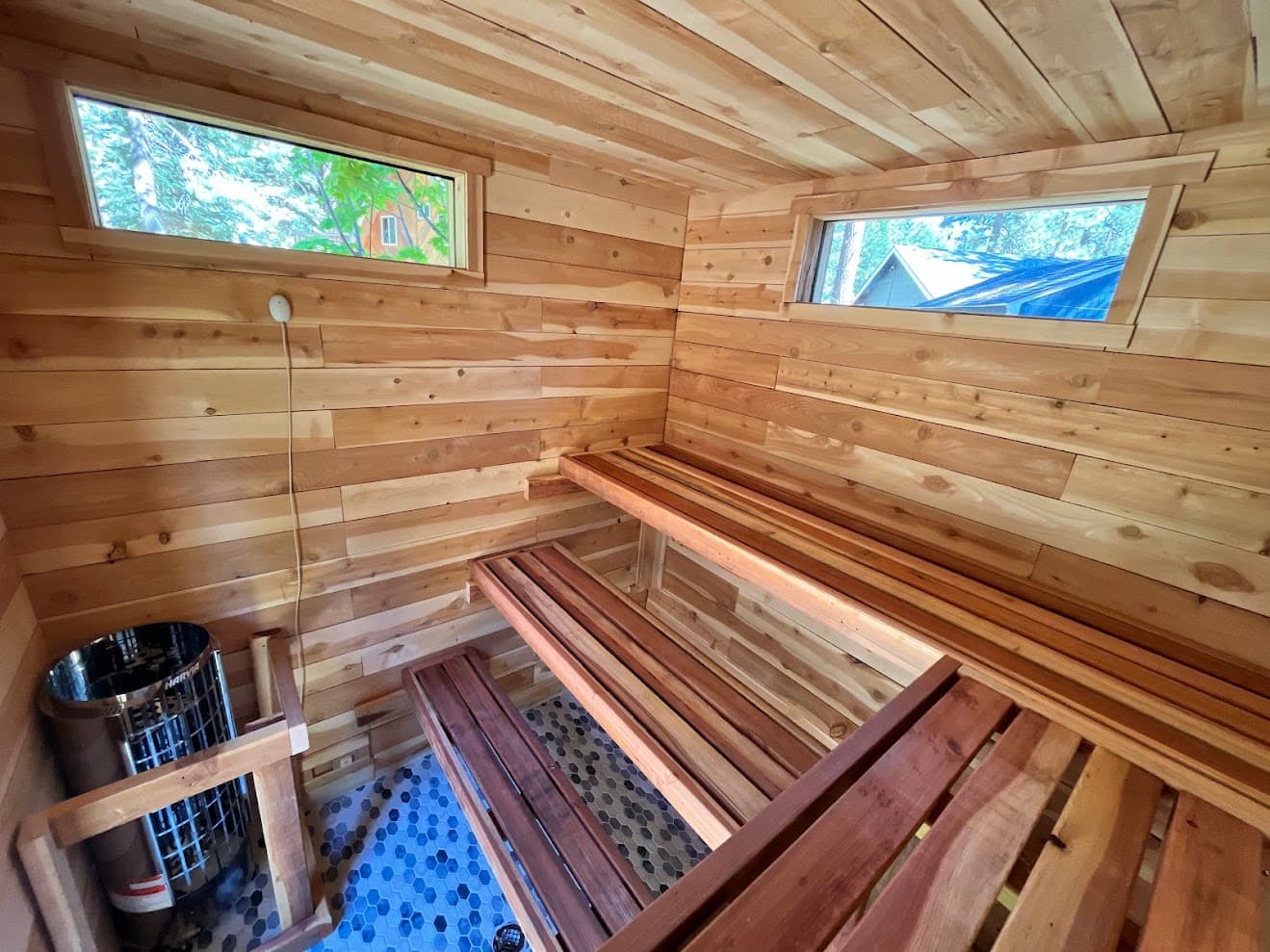
An outdoor sauna is the gold standard — a dedicated structure that lets you design proper bench heights, choose your heater type, and enjoy the full outdoor experience of stepping from hot to cold. This guide walks through everything from site selection through final touches.
Whether you're a seasoned DIYer or planning to hire help, understanding the full process helps you make informed decisions about design, materials, and budget.
Choosing Your Sauna Spot
Site selection affects everything: how you'll access the sauna in winter, water drainage, electrical routing, and privacy. Consider these factors before you stake out your location.
- Level ground: Avoid slopes or low spots that collect water. A slightly elevated site sheds rain naturally.
- Electrical access: Run electrical from your main panel to the sauna location. Longer distances require heavier gauge wire and higher cost. Under 100 feet is ideal.
- Drainage: Don't place the sauna in a swale or where runoff collects. You want water to flow away naturally.
- Proximity to house: In cold climates (like Tahoe/Truckee), proximity to the house matters for winter access. A 50-foot walk in -5°F is miserable. 20–30 feet is better.
- Views and privacy: Positioning for views or shielding from neighbors affects orientation and landscaping.
- Height restrictions: Remember the exterior peak can reach 10+ feet with a pitched roof. Check setbacks, HOA restrictions, and tree clearance.
Sizing Your Outdoor Sauna
Size affects cost, heat-up time, and how many people can use the sauna comfortably. Trumpkin's research recommends a minimum of 3 m³ per person for proper thermal comfort and stratification control.
Recommended: 8x8 feet — This accommodates 4–6 people comfortably on an L-shaped bench layout (our go-to design). Interior ceiling height should be 7.5–8 feet. With an 8-foot-high interior and pitched roof, your exterior peak runs 10–11 feet depending on roof pitch.
Interior dimensions:
- 8x8 allows upper and lower benches on three walls (L-shaped arrangement).
- Upper bench: 24–30" depth, positioned 40–48" below ceiling. Feet should sit 10–20cm (4–8 inches) above the heater's stone tops—this puts you in the löyly cavity where convective heat is evenly distributed.
- Lower bench: 16–20" depth, positioned 16–20" below the upper bench.
- Width remains 8 feet, allowing clearance for passage and comfort.
Smaller (6x6) is cheaper but tight — limited bench arrangement, less comfortable for multiple people. Larger (10x10) requires more materials, longer heat-up time, and bigger heater. Stick with 8x8 as the efficiency sweet spot.
Trusted by homeowners across Tahoe and beyond
Foundation for Outdoor Saunas
A solid, level foundation is non-negotiable. Outdoor saunas face moisture from the ground and seasonal freeze-thaw cycles.
- Floating deck block footings: Nine blocks (3x3 grid) under the perimeter and center of the frame.
- Gravel base: 4–6 inches of compacted gravel below grade level. This provides drainage and a stable base.
- Level all blocks: Use a long level and shims. Critical — uneven foundation causes wall and door problems.
- Pressure-treated floor joists: 2x8 or 2x10 running perpendicular to the 8-foot span. 16" on center.
- Square the foundation: Measure both diagonals. They must be identical within 1/4".
- OSB subfloor: 3/4" OSB fastened to joists every 8 inches with 2.5" nails or screws.
Framing and Roof Design
Standard 2x4 stud framing, 16 inches on center, with a shed (single-pitch) roof for simplicity. The critical design principle: regardless of exterior roof pitch, the interior ceiling must be flat.
- Wall framing: 2x4 studs, 16" OC. Double top plate.
- Door and window openings: Rough openings 1/4" larger than actual frame size.
- Shed roof (recommended for DIY): Single-pitch from low wall to high wall. 4:12 pitch (4" rise per 12" run) is standard and sheds snow/rain efficiently.
- Flat interior ceiling (CRITICAL): This is essential per Trumpkin's research. Regardless of exterior roof pitch, the interior ceiling must be flat. A sloped interior ceiling creates uneven convective heat distribution and poor stratification. Install ceiling joists (2x6 or 2x8) at 16" OC perpendicular to the ridge, parallel to the low/high walls. Sheath with 1/2" OSB decking. The angled rafters go ABOVE this flat ceiling, creating an attic cavity for ventilation. The interior side of the flat ceiling becomes your finished ceiling (covered with cedar after insulation).
- Exterior roof covering: Underlayment + drip edge + shingles over the angled rafters above the flat ceiling. Consider hiring a roofer for this phase if it's unfamiliar work.
Cold Climate Considerations (Mountain Regions)
If you're building in Lake Tahoe, Truckee, or similar high-altitude/cold regions, account for freeze-thaw cycles, snow load, and system durability.
- Extra insulation: R-21+ for exterior walls, R-30+ for ceiling. This minimizes frost bridging and keeps heating costs down.
- Snow load on roof: Design rafters for the worst-case snow load in your area. Tahoe/Truckee areas typically require 30–50 lb/sq ft snow load capacity. A structural engineer or builder familiar with the region can size rafters correctly.
- Combi water heater drainage: If you have a water heating unit (for in-sauna showers or combi heater systems), drain it completely after use. Freezing water can crack the tank.
- Foundation depth: In freeze zones, consider deeper footings (12+ inches below grade) or insulated pads below blocks to minimize heave from frost.
- Material selection: Redwood and cedar hold up better in mountain climates than softer woods. Budget 10–20% more for materials in cold regions.
Building Envelope and Moisture Control
The exterior envelope protects the frame and insulation from weather and controls moisture.
- Moisture barrier (housewrap): Applied over OSB sheathing before siding. Sheds liquid water while allowing vapor to escape.
- Soffit vents and ridge vent: These are separate from sauna interior ventilation. They allow the building envelope (the cavity between exterior siding and interior insulation/vapor barrier) to dry. Install soffit vents along the roof edge and a ridge vent at the peak.
- Weather-resistant siding: Cedar shingles, T1-11 plywood, or metal cladding. All shed water and provide aesthetics. Stain or seal every 2–3 years.
Interior Build Sequence
Once the roof and envelope are closed, the interior build follows the same sequence as indoor saunas. See our complete step-by-step guide for detail on each phase:
- Insulation: Mineral wool or fiberglass batts, R-13 to R-21 walls, R-30+ ceiling. In mountain climates (Tahoe/Truckee), go R-21+ for walls.
- Vapor barrier: Non-adhesive aluminum foil, sealed at all seams and penetrations with aluminum tape. Continuous coverage from floor to ceiling. This is critical for durability. Sauna Vapor Barrier | Radiant Barrier Roll
- Air gap: 1/4–1/2" furring strips
- Interior paneling: Western Red Cedar, Hemlock, or Aspen T&G, installed horizontally with male edge down
- Floor: Tile on cement board with epoxy grout, or non-organic substrate with proper drainage
- Benches: 2x4 redwood or cedar, properly bolted to studs. Upper bench positioned 40–48" below ceiling, with feet 4–8" above heater stone tops.
- Stove installation: Electric or wood-burning, per manufacturer specs. Stone mass should be 6–12 kg/m³ ideally. Use olivine diabase or peridotite stones only.
- Door: Solid wood slab, opens outward, door latch
- Ventilation (Trumpkin design): Fresh air intake 3–3.5" diameter on the heater wall, about 12" above the top of the heater and 12" to the right of it, so incoming air is grabbed by the heater's rising plume and mixed into the hot air. Mechanical exhaust blower (100–125 CFM for 4-person sauna) positioned below the foot bench on the opposite wall, pulling that mixed air down through the bench zone and out at the lowest point. Drying vent optional, near ceiling. This design minimizes CO₂ buildup and stratification.
The Cathedral Ceiling Option
Some outdoor saunas use a "cathedral" ceiling — open to the rafters and pitched roof interior — instead of a flat ceiling.
This adds visual interest and can aid moisture management (air circulates near the peak). However, it complicates ceiling insulation, requires careful vapor barrier work around the roof line, and loses some heating efficiency. For a first build, flat ceilings are simpler and more practical.
The Changing Room Option
Some outdoor sauna designs include a small changing/cooling room adjacent to or integrated into the sauna structure. This is practical in cold climates (you don't have to dash to the house in winter) but adds cost and complexity.
A 4x4 or 4x6 changing room (unheated but insulated and dry) can be added to one end of the sauna structure. The changing room's floor sits slightly higher (4–6 inches) to help moisture management — water from wet feet doesn't pool into the sauna.
Our Reference Build: 8x8 Outdoor Sauna
Here's what our typical 8x8 outdoor sauna looks like (as of late 2025):
- Size: 8x8 feet, 8 feet interior height, flat ceiling. Shed roof (4:12 pitch).
- Foundation: Nine floating deck blocks with 2x8 pressure-treated joists, OSB subfloor.
- Framing: 2x4 studs, 16" OC. Standard roof framing and sheathing.
- Insulation: Mineral wool batts, R-19 walls, R-30 ceiling.
- Interior: Western Red Cedar T&G panels, tile floor with epoxy grout, redwood benches (three-level L-shaped layout).
- Heater: 8kW electric heater with built-in controls.
- Exterior: Cedar siding, standard composition shingles, painted trim.
- Materials cost (as of late 2025): $5,000–$6,000 for high-quality components (cedar, mineral wool, tile, redwood benches).
Permitting and Electrical Inspection
Most jurisdictions require permits for sauna structures.
- Electrical permit: Almost always required. For a 9kW heater on 240V, 50A circuit.
- Building permit (new structure): Most areas require a permit for new structures over a certain size (usually 120+ sq ft). Costs vary but expect $250–$1,000 in permits and fees.
- Wood-burning appliance permit: If you choose a wood stove, expect additional permitting for the chimney and hearth.
- Electrical must be performed by a licensed electrician and inspected. Non-negotiable for code compliance and safety.