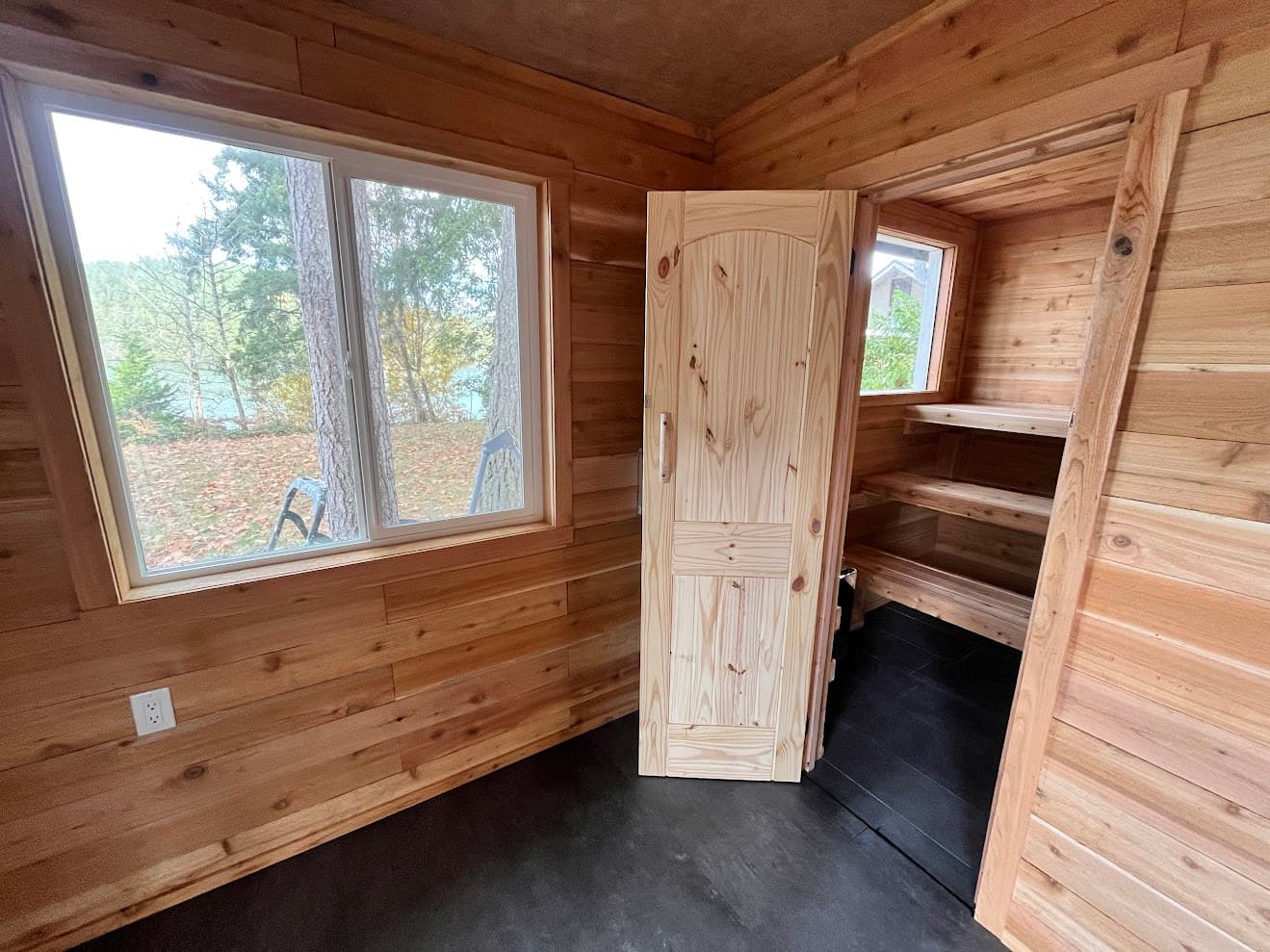
Most "budget sauna" articles list products without telling you what you're actually giving up at each price point. Having designed dozens of saunas across a wide range of budgets, I can tell you exactly where the quality drops happen and where your money matters most.
The short version: you can get a real, functional sauna for under $3,000 if you're willing to do the labor yourself. Below that, you're making significant compromises. Above $3,000, each additional dollar buys meaningful improvements in comfort and longevity.
Here's what each price tier actually gets you:
Tent-style saunas use a fabric frame with a small electric or steam heater. They cost $200–$600, fold for storage, and set up in minutes.
The reality: most tent saunas max out at 100–110°F, which is warm but nowhere near the 170–200°F range of a traditional sauna. The fabric traps moisture poorly, durability is low (2–3 years typical), and they feel cramped. Most people I talk to who started with a tent sauna stopped using it within 6 months.
When it makes sense: You want to test whether you enjoy sauna-like heat before investing. You're renting and can't modify the space. You genuinely have zero room for anything permanent.
When it doesn't: If you already know you like saunas, skip this tier entirely. The $300–$500 you spend here is money that could go toward a real build.
Single-person infrared cabins are plug-and-play — no installation, no electrical work, fits in a bedroom corner. They heat up in 10–15 minutes and use regular 120V outlets.
The trade-off is significant: infrared saunas operate at 120–150°F, use radiant panels instead of convective heat, and don't have rocks or steam. It's a different product category from a traditional Finnish sauna. Many people enjoy them for the heat therapy benefits, but if you're looking for the traditional sauna experience — the löyly, the intense heat, the ritual — this won't deliver that.
Operating cost: About $0.50–$1.00 per session on a standard outlet. Very efficient.
Good brands to look at: Dynamic Saunas, Radiant Health, and JNH Lifestyles all make reasonable budget infrared cabins. Avoid anything under $500 — the panel quality drops off sharply.
Best for: Apartment dwellers who can't install a traditional sauna. People who want dry heat therapy. Testing sauna interest before committing to a build.
Trusted by homeowners across Tahoe and beyond
Some companies sell DIY sauna kits — pre-cut cedar panels, framing, benches, and sometimes a heater. You assemble in a spare room, basement, or garage over a weekend.
Quality varies wildly at this price point. Budget kits often use thin lumber (1/2" tongue-and-groove instead of 3/4" or thicker), skip insulation entirely, or include underpowered heaters. Some are genuinely solid. The difference between a $1,500 kit and a $2,500 kit is usually the wood thickness, heater quality, and whether insulation is included.
What to check before buying a kit:
Good for: People comfortable with basic assembly who want a pre-planned build. Interior installations where you already have a suitable room.
Barrel saunas have become the most popular budget outdoor sauna option, and for good reason. The curved shape concentrates heat efficiently (the reduced air volume heats faster than a rectangular room of similar footprint), they look great in a backyard, and they require no foundation beyond a level gravel pad or concrete blocks.
A 6-foot barrel sauna kit (seats 2–4) runs $2,500–$3,500. An 8-foot model (seats 4–6) runs $3,500–$4,500. Most kits include pre-cut staves, metal bands, a door, benches, and sometimes a heater.
The main downsides:
Best barrel sauna brands under $4,500: Almost Heaven, Dundalk LeisureCraft, and ALEKO all make decent barrel kits in this range. Avoid no-name brands on Amazon — the stave quality and hardware are usually poor.
Best for: People who want an outdoor sauna without a construction project. Backyards where aesthetics matter. Renters with a patio or deck (barrel saunas are technically movable).
This is the best value option if you have basic DIY skills and a space to build in — a garage corner, basement room, or even a large closet. A 4×4 or 4×5 foot sauna seats 1–2 people and can be built with standard materials from any lumber yard.
Materials breakdown for a 4×5 corner sauna:
Total materials: $1,500–$2,500. With a $500 buffer for unexpected costs: $2,000–$3,000.
Electrical note: A 6kW heater needs a dedicated 240V/30A circuit. Budget $200–$500 for an electrician if you don't already have the right circuit available. This is the one part you shouldn't DIY unless you're licensed.
Why this is the best value: You get a real traditional sauna — proper 170–200°F temperatures, rocks, löyly capability — for roughly the same price as a mediocre prefab. It'll last 20+ years with basic maintenance. You can upgrade components over time (better heater, nicer door, backrests). And it adds genuine value to your home.
If you can stretch to $3,000–$5,000 in materials, you open up a 4×6 or even 6×8 foot sauna — room for 2–4 people, proper two-tier benches, and higher-quality finishes. This is the sweet spot where the cost-per-year-of-use becomes exceptional.
The extra $1,000–$2,000 over a corner sauna gets you: a better heater (8kW Harvia or Huum with separate controls), thicker cedar interior boards, a proper glass door, two bench tiers with comfortable depths, and professional-grade ventilation components.
At this budget, I'd strongly recommend getting a design checklist or even a basic design consultation before you start. The cost of bad bench placement or wrong heater sizing is way more than the cost of getting it right upfront.
Big-box retailers and Amazon sell prefab saunas for $1,500–$3,000 that look good in photos. Having seen many of these in person, here's what you're typically getting:
The math works against you: a $2,500 prefab that lasts 7 years costs $357/year. A $3,000 DIY build that lasts 25 years costs $120/year. The "budget" option is actually the expensive one.
Checking Facebook Marketplace, Craigslist, or local classifieds for used saunas can save 40–60% off new prices. People sell barrel saunas, prefab kits, and even professional-grade heaters when they move, renovate, or upgrade.
What to look for: Check the wood condition (any black mold or soft spots means rot), test the heater (bring a 240V tester if possible), and inspect the stones (cracked or crumbling stones need replacement). The heater is the most expensive component — if the heater works, the deal is probably worth it.
What to avoid: Any used sauna with visible mold, warped or delaminating panels, or a non-functioning heater. Also be cautious with used infrared saunas — the panels degrade over time and replacements can cost as much as a new unit.
Budget planning doesn't end at the purchase. Here's what ongoing costs look like:
Electric sauna (6kW heater): At average US electricity rates ($0.16/kWh), a 1-hour session costs about $0.75–$1.00. Using it 3–4 times per week runs $10–$16/month. A well-insulated sauna costs less because it reaches temperature faster and holds heat better — another reason insulation matters more than people think.
Wood-fired sauna: A session uses about 10–15 lbs of firewood. Depending on your area, that's $1–$3 per session, or $5–$15/month at 3–4 uses per week. Free if you have your own wood supply.
Maintenance: Interior wood needs minimal care — just wipe down benches and let the sauna air out after use. Exterior wood (for outdoor saunas) needs staining every 1–2 years ($30–$60 in stain). Replace sauna stones every 2–3 years ($30–$50). Budget $100–$150/year total for maintenance.
If your budget is tight, here's where to allocate your dollars for the best long-term result:
Spend on:
Save on:
Under $500: Get a tent sauna to test your interest, understanding it's a temporary product. If you use it consistently for 3 months, start planning a real build.
$500–$1,500: An infrared cabin is your best bet. Not a traditional sauna, but legitimate heat therapy that you'll actually use. Good stepping stone.
$1,500–$3,000: Build a small corner sauna yourself. This is the entry point for a real sauna. If you can handle basic framing and have access to 240V power, this is the highest-impact option in the entire guide.
$2,500–$4,500: A barrel sauna kit is the best ready-made option. Less DIY than a custom build, looks great, heats efficiently. Just understand the bench limitations.
$3,000–$5,000: DIY standard sauna (4×6 or 6×8). This is the sweet spot. You get everything — proper bench tiers, quality heater, room for 2–4 people, and a build that lasts decades.
What I always tell people: If you're on the fence between a $1,500 prefab and saving another $1,000 for a DIY build, save the money. The difference in quality and longevity is enormous, and you'll thank yourself 5 years from now.
A DIY corner sauna (4×4 or 4×5 feet) using standard lumber and a budget electric heater costs $2,000–$2,800 in materials. This gives you a real traditional sauna with proper temperatures (170–200°F), löyly capability, and a 20+ year lifespan. It's the best value per dollar for a genuine sauna experience.
Most prefab saunas under $2,000 use thin walls, inadequate insulation, and underpowered heaters. They struggle to reach proper sauna temperatures and typically last 5–10 years before deteriorating. A DIY build with quality materials costs about the same and performs far better long-term.
A 6kW electric sauna heater used 3–4 times per week costs roughly $10–$16 per month at average US electricity rates ($0.16/kWh). A well-insulated sauna costs less because it reaches temperature faster and holds heat longer. Wood-fired saunas cost $5–$15 per month in firewood for similar usage.
Barrel sauna kits ($2,500–$4,500) are a solid middle-ground option. They heat faster than rectangular saunas due to the curved shape concentrating heat, require no foundation beyond a level pad, and look great in a backyard. The main downsides are limited bench configurations and no insulation, which means slower heat-up in cold climates.
For under $3,000 in materials (DIY labor), you can build a 4×4 to 4×6 foot sauna that comfortably seats 2 people. This includes framing lumber, insulation, cedar or aspen interior boards, a 6kW electric heater, sauna stones, a basic door, and bench materials.
12 decisions that determine how well your sauna performs — insulation, bench height, heater sizing, ventilation, and more.
Have questions about your project? Send us a message or schedule a free 15-minute intro call.
Schedule a free 15-minute intro call or send us a message about your project.
We'll learn about your space, goals, and timeline — and recommend the right next step for your project.