How to Winterize an Outdoor Sauna: What to Do Before the First Freeze
Winterizing an outdoor sauna isn't about shutting it down. Winter is when you'll use it most — the whole point of a backyard sauna in a cold climate is stepping out into 20°F air after a session. What you're actually doing in the fall is making sure nothing freezes, nothing leaks, and the structure can carry whatever snow lands on it.
We do this walkthrough on our own builds every September and October. Most of it takes an afternoon, and skipping it is how people end up with a cracked water tank or a rotted door jamb in March.
Start With Anything That Holds Water
This is the part that causes actual damage. Everything else on the list is maintenance; this one is the difference between a working sauna and a repair bill.
Combi heater water tanks. If you have a combi unit — a heater with a built-in water tank and a dedicated element for adjustable humidity — drain it after every use once temperatures start dipping below freezing. The tank is a small reservoir of standing water sitting in an unheated building. It will freeze, and it will crack. This is the single most common winter failure we see on outdoor builds, and it's completely avoidable. Get in the habit in October, not in December after the first hard night.
Steam generators and any plumbed lines. Same principle. Drain them, and if there's a supply line running to the sauna, either blow it out or make sure it's below frost depth with no unheated section. Anything above grade and unheated is a burst waiting to happen.
Buckets and ladles. Empty the bucket. A full cedar bucket that freezes solid will split its staves. Bring it inside or store it upside down.
Floor drains. If you have a drain, pour a cup or two of RV antifreeze (the pink, propylene-glycol kind) down it before a long cold stretch. The trap holds standing water. When it freezes it can crack the trap, and even if it doesn't, the ice blocks the drain — so the next time you rinse the floor the water has nowhere to go.
Check the Envelope Before the Weather Does
A sauna that leaks air in September leaks a lot more heat in January. Every gap costs you heat-up time and energy for the whole season.
Walk the building and look for:
- Separated wall boards. Tongue-and-groove moves with heat cycling. Look for gaps where you can see light or feel a draft from inside.
- Door seal and alignment. The door is the biggest single heat-loss point in normal use, and it's also the thing most likely to have shifted over a season. It should close square with no gap you can slide a card through, except the intentional half-inch under the bottom if that's your passive intake. Adjust hinges before the frame swells with winter moisture.
- Vent caps and dampers. Exterior wall caps need working backdraft dampers. If a damper is stuck open, you've got a cold-air pipe straight into the room. If it's stuck closed, you've lost your ventilation. Both are worth ten minutes to check.
- Caulk at penetrations. High-temp silicone around exterior vent caps and window flashing. Redo anything cracked or pulled away.
- Exterior finish. If the siding needs a coat, do it in the fall while the wood is dry. Applying finish over damp wood before winter traps moisture in the boards.
Our sauna insulation guide covers the R-values behind all of this — R-21 to R-30 walls and R-30 to R-38 ceiling on an outdoor build in a cold climate. If your sauna is chronically slow to heat, fall is a reasonable time to find out whether the envelope is the reason.
Trusted by homeowners across Tahoe and beyond
Snow and Roof Load
This is the one that varies most by where you live, and it's the one people in newly snowy areas underestimate.
Know your design load. A properly designed sauna roof in a heavy-snow region is engineered for it. If yours was built without that conversation, find out what it can carry before you find out the hard way. Ground snow loads in the Tahoe basin and similar mountain areas can run well past 100 psf, and a shed roof that's fine in Ohio isn't fine at 6,500 feet.
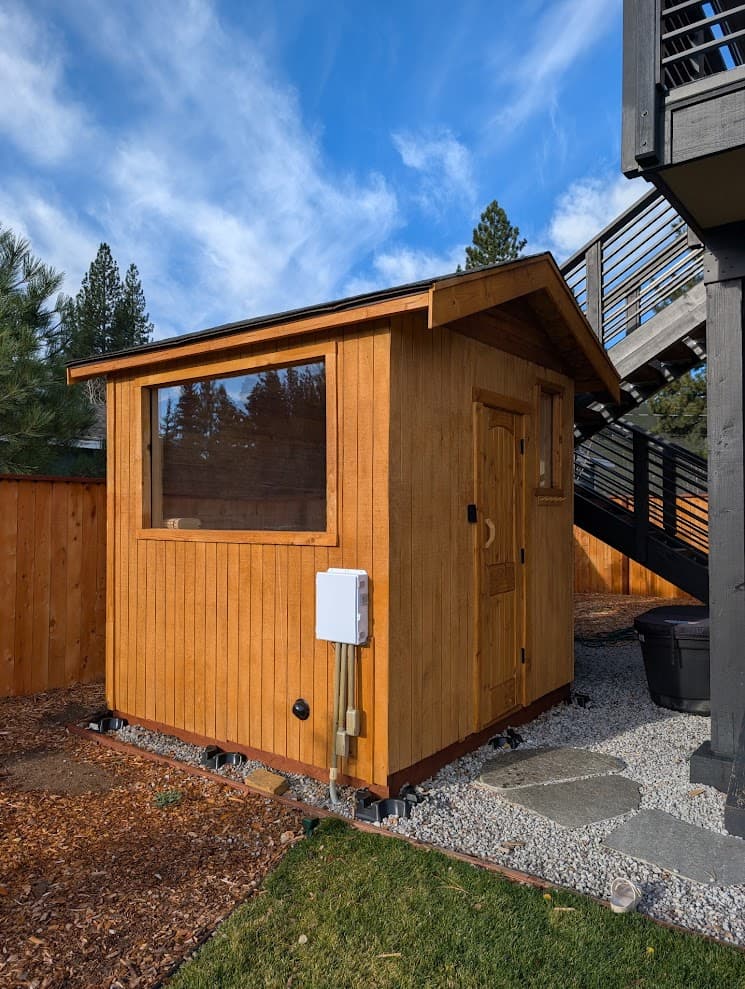
Keep the roof shedding. A single-pitch shed roof sheds well if nothing is blocking it. Clear leaves and needles from the low edge in the fall so meltwater has somewhere to go instead of backing up under the shingles and freezing.
Watch where the snow lands. If the roof sheds toward the door, you'll be digging out every storm, and worse, a snow pile against the door frame holds moisture against the jamb all winter. Same for windows — snow piled against glass adds load and creates a breakage risk. If the shedding direction is wrong, a small diverter or a relocated path is easier than moving the door.
Check the foundation. Deck-block foundations can heave with frost. Look for any block that's shifted or any corner that's out of level. Catching a quarter-inch of movement in October beats discovering a racked door frame in February. Our post on outdoor sauna foundations covers frost depth and drainage if you're diagnosing a heave problem.
The Heater and Chimney
Electric heaters. Not much to do. Inspect the stones — if any are cracked, crumbling, or packed tight, pull and reload them. Loosely packed, flat side up, at least 14 inches of depth above the elements. Cracked rock restricts airflow through the cavity and makes an already-slow winter heat-up worse. Olivine diabase or peridotite only; if someone loaded river rock or granite in there, replace it entirely.
Wood stoves. Fall is chimney season. Clean the flue before your first winter fire — creosote buildup over a season of use is a real fire risk, and it also kills draft, which means slower heat-up and smoke coming back into the room. Check the storm collar, flashing, and cap. Confirm the cap isn't blocked by a nest.
Firewood. Get it under cover and get it dry now. Wet wood in January means a smoky fire and a sauna that takes two-plus hours instead of one. Split, stacked, and covered by October.
Controls. If you run a Wi-Fi controller, this is the season it earns its cost. Being able to start the heater from your phone twenty minutes before you walk out means you never stand in a cold sauna waiting. Confirm the app connection still works before you need it.
Ventilation and Drying — Don't Shut It Down
The instinct in winter is to close everything up to keep heat in. Resist most of that.
You still need ventilation during use. When two or more people sit in a sealed room for 20 minutes, CO₂ climbs fast — in a poorly ventilated sauna it can hit 1,200 ppm or more, versus about 700 ppm with proper mechanical downdraft. That feeling of stuffiness and fatigue people blame on the heat is usually air quality, not temperature. The full setup is in our sauna ventilation guide.
Drying matters more in winter, not less. The sauna gets very wet during a session, and the surrounding air is cold. Run the exhaust fan or open the drying vent for an hour or two after each session so moisture leaves the room instead of condensing on cold surfaces. Cold, dry mountain air actually helps here — cold air holds less moisture, so drying is generally easier in the Mountain West than it is in the humid Southeast. But that only works if the moist air can get out. Our post on preventing mold in a sauna goes deeper on the drying cycle.
What you can do is keep the vents closed during warm-up. Adjustable interior grilles let you shut the intake and exhaust while the room comes up to temperature, then open them for the session. That's a real savings in winter and it costs you nothing.
Interior Wood and Benches
Give the interior a proper cleaning before the season. Scrub the benches with water and a stiff brush, let everything dry fully, and check the underside of the benches and the floor beneath them — that's where sweat and moisture accumulate, especially if the bench fronts are enclosed.
Don't seal or varnish the interior. Nothing film-forming goes inside a sauna. If you want protection, a paraffin-based sauna oil on benches is the only thing we'd use, and it's optional. Our post on sauna wood treatment covers what will actually ruin the wood.
If a bench slat is cracked or a cleat has loosened, fix it now. Wood movement over a cold season won't improve it.
If You're Closing It Down for the Season
Most people shouldn't — a sauna that sits unused all winter is a wasted asset, and cold weather is the best sauna weather. But if you're leaving a property vacant:
- Drain every water-holding component completely, including the combi tank, and leave drain valves open
- Antifreeze in the floor drain trap
- Cut power at the breaker so a controller fault can't energize the heater unattended
- Prop the door slightly open so the room can breathe, or leave the drying vent open
- Leave the interior bone dry — do a final long dry cycle with the heater before shutting it down
- Arrange for someone to clear snow off the roof after big storms
That last one matters. An unoccupied structure with nobody watching the roof is how saunas get damaged in heavy-snow winters.
Frequently Asked Questions
Can you use an outdoor sauna in winter? Yes, and it's the best time to use one. Cold-climate regions are where sauna culture came from. The only real adjustments are 10-20 minutes of extra heat-up time from a colder starting point, and being disciplined about draining any water-holding components after each session.
Will my sauna heater freeze? An electric heater itself won't — there's no water in it. What freezes is a combi unit's water tank, a steam generator, plumbed supply lines, a floor drain trap, and any bucket left full. Drain all of those.
Do I need to heat the sauna periodically in winter if I'm not using it? Not for the structure's sake if it's fully drained and dry. If there's any water-holding equipment you can't drain, then yes — run it warm periodically. But draining is the better answer than heating an empty building all winter.
How much longer does an outdoor sauna take to heat up in winter? Typically 10-20 minutes more than in mild weather. A well-insulated 6x8 that hits 185°F in about 40 minutes in the fall usually lands around 50-60 minutes in deep winter. Much beyond that points to an insulation or air-sealing problem — see how long a sauna takes to heat up.
Should I shovel snow off my sauna roof? Depends on the design load and your snowfall. A properly engineered roof in a snow region should handle a normal season. But if you're getting an unusual accumulation, if the roof is flatter than it should be, or if you don't know what it was designed for, clear it. Roofs are cheaper to shovel than to replace.
Planning a Sauna for a Cold Climate
A lot of winter problems are design problems that showed up later. Roof pitch and snow load, foundation depth, whether the door faces the shedding side, whether the combi tank was the right call for an unheated outbuilding — those all get decided on paper.
If you're building in snow country, our guide to building a sauna in cold climates covers the specifics. And if you want a plan set built around your actual site, snow load, and how you'll use it through the winter, we do that remotely for clients nationwide — see remote sauna design, or start with the free sauna owner's guide for use and maintenance basics.