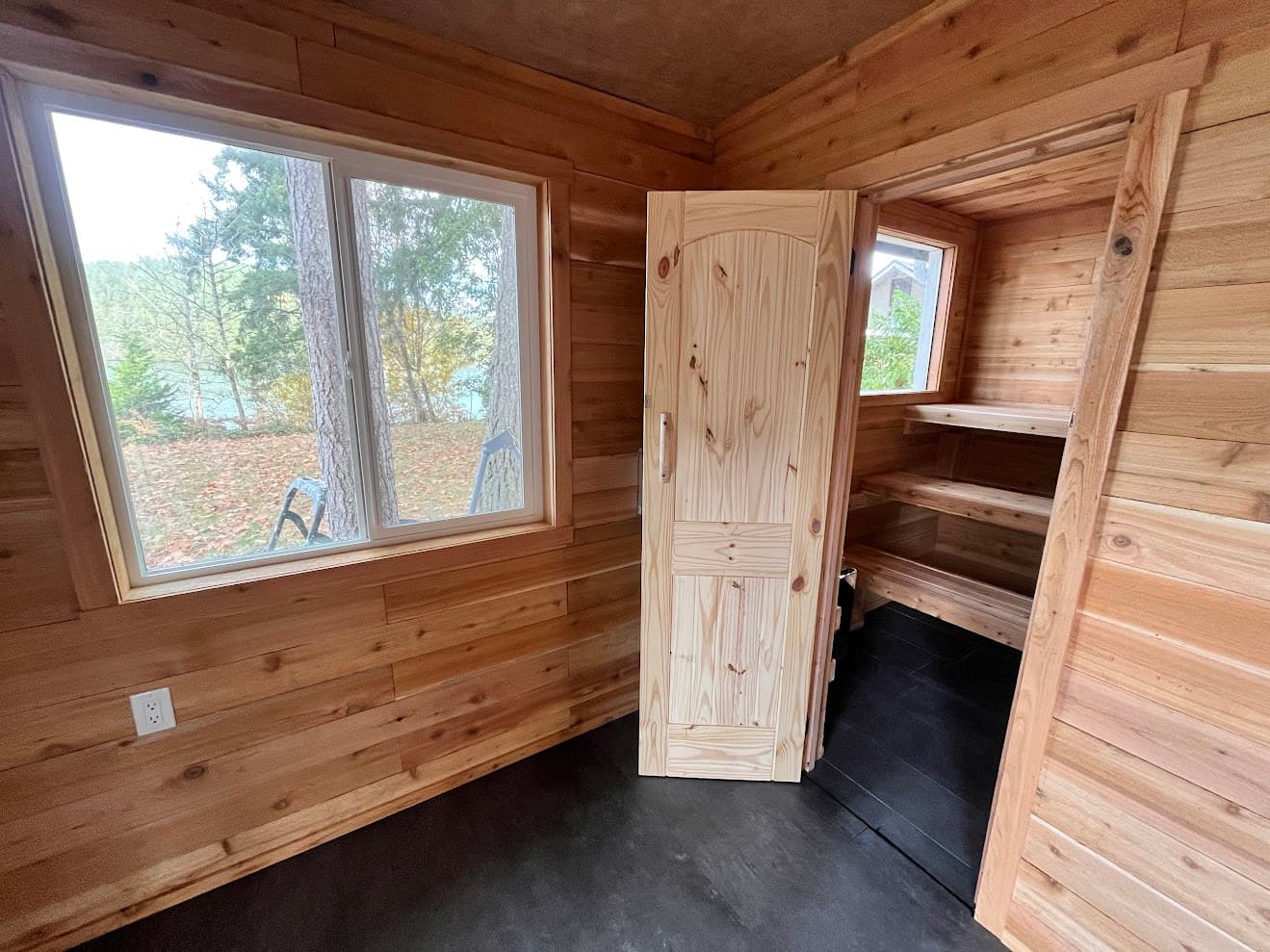
2-Person Sauna: Sizes, Layouts, and What It Costs to Build One
A 2 person sauna sounds simple — it's small, so how hard can it be to size? But "two people" can mean two people sitting upright shoulder to shoulder, or two people who both want to lie down at the same time. Those are very different rooms, and most of the disappointment with small saunas comes from building for the first when the owner wanted the second. If you're planning a two-person sauna, the dimensions are the whole game.
Here's how to size a 2 person sauna so it actually works, plus the layouts, heater, and rough costs to expect.
What "2 person" actually means for the size
The honest starting point is to decide whether you want two people to sit, or two people to lie down. A sauna where two adults can sit comfortably is genuinely small. A sauna where both can stretch out flat at the same time is closer to what most people picture but didn't budget the space for.
For two people sitting upright on a single bench, you need roughly 4x4 feet of interior floor space. That's tight but real — it's the classic compact sauna. The catch is that nobody's lying down, and there's no room for a second tier of benching, so everyone sits at the same height.
For a 2 person sauna where one person can lie down while the other sits, plan for around 4x6 feet. For both people to lie down at once, you're looking at roughly 5x7 to 6x6 feet so you can run an L-shaped bench or two benches long enough to actually stretch out on. A bench needs to be about 6 feet long for an average adult to lie flat, and that single requirement drives most of the footprint.
So the real range for a "two-person" sauna is anywhere from 4x4 up to about 6x6, and which end you land on depends entirely on lying down. Our sauna size guide breaks down dimensions across more occupancy levels if you're still deciding how big to go.
Bench layout is where small saunas succeed or fail
In a small room, the bench layout matters more than the raw square footage. You can waste a 5x7 sauna with bad benching, or make a 4x6 feel surprisingly roomy with good benching.
The single most important rule: get the upper bench high enough that your feet sit at or above the top of the heater's stones. Heat stratifies — the air near the ceiling is dramatically hotter than the air near the floor. If your upper bench is too low, you're sitting in the cool layer and the sauna feels weak no matter how powerful the heater is. In a compact sauna with a 7-foot ceiling, that usually means an upper bench around 38 to 42 inches off the floor, with a lower bench or step around 18 inches to climb up and rest your feet.
Bench depth is the other thing people shortchange. A bench you can only perch on is 16 to 18 inches deep. A bench you can actually lie down on, or sit cross-legged on, needs to be at least 24 inches deep — and 28 is better if you're tall. In a two-person sauna, I'd rather give up a little floor area to get a proper-depth upper bench than have a roomy floor and benches nobody can recline on.
For two people lying down, an L-shaped bench in a 6x6 room is usually the most efficient — it gives you two long perpendicular runs that meet in the corner, so two people can both stretch out without bumping feet. If you only need one person reclining, a single long upper bench down one wall in a 4x6 works fine. We get deeper into bench arrangements in our sauna floor plan layouts guide.
Trusted by homeowners across Tahoe and beyond
Heater sizing for a 2 person sauna
Small saunas need small heaters, and oversizing is a common mistake. Heater output is matched to the room's air volume, not to the number of people, so a compact sauna doesn't need much.
For a typical two-person sauna in the 4x4 to 5x7 range with a 7-foot ceiling, you're looking at roughly 200 to 350 cubic feet of volume, which puts you in the 3 to 4.5 kW range for an electric heater. A 4x4 room can run on a 3 kW heater; a 5x7 with a lying-down layout might want 4.5 kW. Glass doors, an exterior wall, or an uninsulated space push you toward the higher end because they bleed heat.
The reason not to oversize: an oversized heater in a small room cycles on and off constantly, overshoots the thermostat, and can make the air feel harsh rather than enveloping. Right-sized heat in a small room is one of the nicer experiences in saunas — it comes up to temperature fast and holds steady. Our sauna heater sizing guide has the full kW-by-room-size breakdown, including the adjustments for glass and exterior walls.
One practical note for small saunas specifically: a 3 to 4.5 kW heater can sometimes run on a standard 240V circuit at a lower amperage than the big heaters need, which can simplify the electrical. It still needs a dedicated circuit and a licensed electrician, but a compact sauna is often the cheapest to wire.
Where a two-person sauna fits
Part of the appeal of a 2 person sauna is that it fits places a bigger one can't. A 4x6 footprint slots into a spare bathroom, a corner of a garage, a basement nook, or a small outdoor pad without taking over the space.
Bathroom conversions are popular for two-person saunas because the room is often already close to the right size and has the moisture-tolerant finishes and drainage nearby. If that's your plan, the existing ventilation and electrical are the things to check first — we cover the specifics in our bathroom sauna conversion guide.
Couples are the other big audience here, and a two-person sauna designed for two people to lie down is a genuinely different experience than two people sitting upright in a phone booth. If you're building for two to actually relax together, the lying-down dimensions are worth the extra footprint. We wrote more specifically about that in our sauna for couples guide.
Outdoors, a small footprint is easier on permits, foundation, and cost — there's less structure to build, less weight to support, and a smaller heater to power. It's often the most achievable first sauna for someone testing whether they'll actually use it.
What a 2 person sauna costs
A two-person sauna is on the lower end of the cost range simply because it's small — less wood, a smaller heater, less labor. But "small" doesn't mean cheap if you want it built well.
A bare-bones DIY two-person build using a kit can land around $4,000 to $7,000 depending on the heater and wood. A custom two-person sauna built properly — good cedar or hemlock interior, a right-sized heater, real ventilation, a proper bench layout — more often runs $8,000 to $15,000 including the electrical hookup, with outdoor builds at the higher end because of the foundation and weatherproof exterior. Our home sauna cost guide walks through the full line items if you want to build up a number for your specific plan.
The trade-off worth understanding: the heater, ventilation, vapor barrier, and electrical are close to fixed costs whether the sauna is two-person or four-person. So going from a two-person to a three- or four-person sauna often costs less per added seat than people expect. If you're on the fence about size and have the space, it's worth pricing both — sometimes a slightly bigger room is only marginally more money and far more flexible.
Common mistakes with small saunas
The most common mistake is building a 4x4 because "it's just for two" and then realizing nobody can lie down. If reclining matters to you, you can't get there in 4x4 — plan for the footprint up front.
The second is putting the upper bench too low to save on ceiling height. A short sauna with a low bench keeps you in the cool layer and feels weak. Protect the bench-height-to-heater relationship even in a small room.
The third is skipping ventilation because the room is small. Small saunas still need a proper intake-and-exhaust setup to bring in fresh air and dry out between sessions — a tiny room with no airflow gets stuffy fast and stays damp. Our sauna ventilation guide covers the placement, which doesn't change much just because the room is compact.
Frequently Asked Questions
What size is a 2 person sauna?
It depends on whether you want to sit or lie down. Two people sitting upright fit in roughly 4x4 feet. For one person to lie down while the other sits, plan for about 4x6. For both to lie down at once, you need around 5x7 to 6x6 feet, because a bench has to be about 6 feet long for an adult to stretch out flat.
How big should the heater be for a two-person sauna?
For a compact two-person room with a 7-foot ceiling, a 3 to 4.5 kW electric heater is usually right. Heater size tracks the room's air volume, not the number of people, so a small sauna needs a small heater. Add capacity if you have a glass door, an exterior wall, or limited insulation, since those bleed heat.
Can two people lie down in a 4x6 sauna?
Not both at the same time. A 4x6 fits one person lying down on a 6-foot bench while the other sits. For two people to lie down simultaneously, you need an L-shaped or double-bench layout, which means a footprint closer to 5x7 or 6x6.
How much does a 2 person sauna cost?
A DIY kit-based two-person sauna runs roughly $4,000 to $7,000. A properly built custom two-person sauna usually lands between $8,000 and $15,000 including electrical, with outdoor builds at the higher end. Because the heater, ventilation, and electrical are near-fixed costs, stepping up to a slightly larger sauna often adds less than people expect.
Is a two-person sauna big enough?
For most couples and small households, yes — as long as it's sized for how you'll actually use it. If you only ever sit, 4x4 is plenty. If you want to recline, build for lying down from the start. The regret usually comes from building too small to lie down, not from the room being two-person.
Planning a compact sauna and want it sized right the first time? A remote sauna design gets you a plan dialed to your exact space, bench layout, and heater — so a two-person build actually works for two people. Take a look and let me know what you're working with.