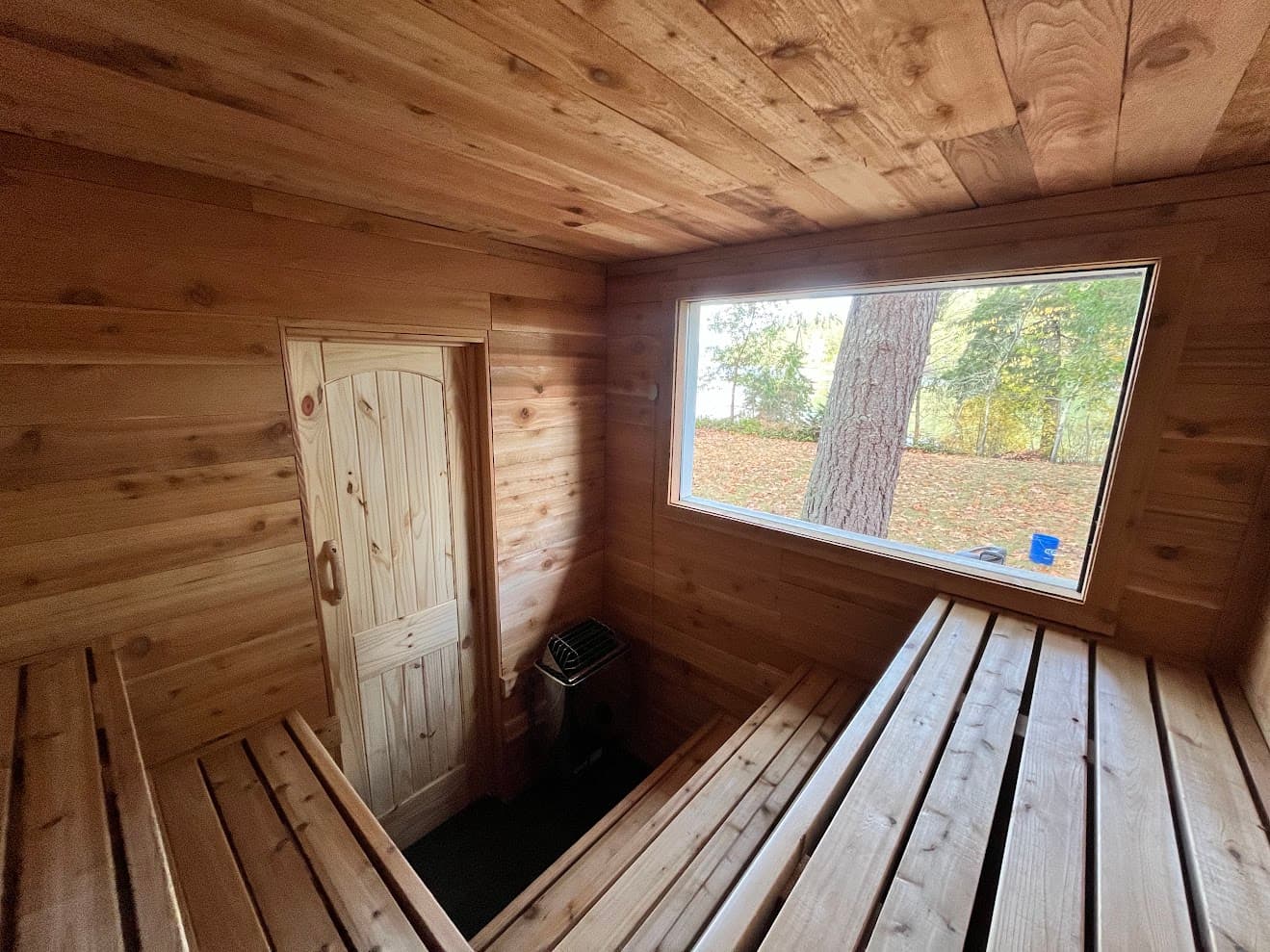
Converting an existing space into a sauna is the most cost-effective way to get a quality sauna at home. You skip the most expensive parts of a new build — foundation, roofing, exterior siding, structural framing — and work within walls that already exist.
A sauna renovation typically costs $2,500 to $10,000 depending on the space you're converting, the heater you choose, and whether you hire a contractor or do it yourself. That's 30–50% less than building a new standalone sauna from scratch.
I've designed saunas for over a dozen renovation projects — basements, garages, bathrooms, walk-in closets, even a laundry room. The costs below come from those real projects, not estimates from a calculator.
These ranges assume a sauna sized for 2–4 people (roughly 4×6 to 6×8 interior) with a quality electric heater and standard cedar paneling.
| Renovation Type | Cost Range | What's Involved |
|---|---|---|
| Closet or small room (4×4 to 4×6) | $2,500–$5,000 | Insulation, vapor barrier, cedar paneling, heater, electrical, door |
| Basement room (6×8) | $3,500–$7,000 | Frame walls if needed, insulation, moisture management, cedar, heater, electrical |
| Bathroom conversion (5×6 to 6×8) | $4,000–$8,000 | Demo existing fixtures, waterproofing, insulation, cedar, heater, electrical |
| Garage partition (6×8) | $5,000–$10,000 | Frame new walls, heavy insulation, vapor barrier, cedar, heater, electrical, ventilation |
DIY builds cut total cost by 30–50% by eliminating labor. But electrical work still requires a licensed electrician — that's not optional.
Materials account for 40–60% of total cost in a contractor-built renovation, or nearly 100% if you do the work yourself. Here's where the money goes for a typical 6×8 conversion:
This is your biggest material cost and the most visible choice. You need tongue-and-groove paneling for walls and ceiling, plus thicker stock for benches.
| Wood Species | Cost per Board Foot | 6×8 Room Estimate |
|---|---|---|
| Western red cedar | $5–$8 | $1,800–$3,000 |
| Hemlock | $3–$5 | $1,100–$1,800 |
| Aspen | $3–$5 | $1,000–$1,600 |
| Nordic spruce | $4–$6 | $1,400–$2,200 |
Cedar is the go-to for most renovations. It's naturally rot-resistant, smells great, and looks beautiful. If budget is tight, hemlock or aspen get the job done at 40–50% less cost. See our complete wood comparison guide for the full breakdown.
The heater is the mechanical heart of your sauna. For a renovation, electric is almost always the right choice — no chimney, no gas line, no combustion air requirements.
A 6×8 room at 7-foot ceilings needs a 6–9 kW heater. Budget heaters from Harvia or HUUM start around $800–$1,200. Mid-range options with WiFi controls run $1,500–$2,500. Premium units from Saunum or HUUM DROP push $2,500–$3,500.
Browse electric sauna heaters at Select Saunas or read our electric heater buying guide for specific recommendations by room size.
R-13 to R-15 mineral wool for walls, R-23+ for the ceiling. Add 6-mil polyethylene or aluminum foil vapor barrier on the warm side (facing the sauna interior). Budget $200–$400 for insulation and $50–$150 for vapor barrier materials. This is not the place to cut corners — under-insulating forces your heater to work harder and extends preheat time.
A basic solid cedar sauna door runs $200–$400. Tempered glass doors are $400–$800 and let light into the space. The door must open outward for safety. See sauna door options for details.
Stainless steel screws, foil tape, vent dampers, thermometer, lighting. Small items that add up.
Trusted by homeowners across Tahoe and beyond
If you hire a contractor for the full build, expect to pay $1,500–$4,000 in labor depending on complexity and your market. Here's the breakdown:
| Trade | Cost Range | Notes |
|---|---|---|
| General carpentry (framing, paneling, benches) | $1,000–$2,500 | 2–4 days for a typical renovation |
| Electrician | $500–$2,000 | Dedicated 240V circuit, GFCI, control unit wiring |
| Demolition (bathroom conversions) | $300–$800 | Removing fixtures, tile, plumbing caps |
| Permits and inspection | $100–$300 | Electrical permit is almost always required |
The electrician is the one trade you can't skip. A sauna heater needs a dedicated 240V circuit at 40–50 amps. This isn't something you can plug into an existing outlet. If your electrical panel is full or far from the sauna location, electrical costs can push toward $2,000.
The simplest and cheapest renovation. A walk-in closet that's at least 4×4 feet with 7+ foot ceilings works well. You're essentially lining the walls with insulation, vapor barrier, and cedar, then installing a small heater (4–6 kW).
The trade-off is size — a 4×4 sauna fits one person comfortably, maybe two if you're close. But for a single-person sauna, this is hard to beat on cost.
Basements are ideal for sauna conversions. The concrete provides thermal mass, the temperature is stable year-round, and you usually have easy access to the electrical panel. The main concern is moisture — you need a proper vapor barrier and ventilation that exhausts to the exterior, not back into the basement.
Most basement conversions involve framing a new room within the basement, insulating, and finishing. If you have an existing framed room, costs drop further. Read our full basement sauna guide for step-by-step details.
Bathroom conversions cost more because you're removing existing fixtures first. Demo adds $300–$800 for pulling out a tub/shower, toilet, and vanity. Plumbing needs to be capped. Existing tile and waterproofing must be removed or properly isolated from the sauna's vapor barrier.
The advantage: bathrooms already have ventilation paths, drain access, and often a 240V circuit nearby (from an existing electric water heater or dryer). Our bathroom conversion guide covers the process in detail.
Garages are popular but more expensive than indoor conversions because garages aren't heated. You need heavier insulation (R-19 walls, R-30 ceiling), more robust vapor barrier work, and the heater works harder against the cold ambient temperature. In a climate like Tahoe, preheat time in a garage sauna can be 30–45 minutes longer than a basement sauna in winter.
The big advantage of garages: usually plenty of space, fewer structural constraints, and easy access from outside. See our garage sauna guide for the full build process.
After designing renovation projects across a range of budgets, here's where the money matters most:
These are the line items that catch people off guard:
A typical sauna renovation takes 1–2 weeks from start to first session:
DIY projects typically take 2–4 weekends because you're working in available time. The electrician visit usually needs to be scheduled 1–2 weeks out.
| Category | Renovation (6×8) | New Build (6×8 outdoor) |
|---|---|---|
| Foundation | $0 (existing) | $500–$2,000 |
| Framing | $0–$500 | $1,500–$3,000 |
| Roofing | $0 (existing) | $800–$2,000 |
| Exterior siding | $0 (existing) | $600–$1,500 |
| Insulation + vapor barrier | $200–$600 | $400–$800 |
| Interior wood | $800–$3,000 | $800–$3,000 |
| Heater | $800–$3,500 | $800–$3,500 |
| Electrical | $500–$2,000 | $800–$2,500 |
| Door | $200–$800 | $200–$800 |
| Total | $2,500–$10,000 | $8,000–$25,000 |
The renovation saves $3,000–$10,000 by leveraging existing structure. The trade-off: you work within the constraints of the space — ceiling height, room dimensions, location of electrical panel, ventilation paths.
For a full breakdown of all build types, see our complete sauna cost guide.
If you have an existing space that meets the basic requirements — 4×4 minimum footprint, 7+ foot ceilings, access to a 240V electrical circuit — a renovation is the fastest and cheapest path to a quality sauna. Most of our design clients who go the renovation route spend $4,000–$7,000 total and are using their sauna within two weeks.
The two things that make or break a renovation: insulation quality and ventilation design. Get those right and the rest is finish carpentry.
Not sure which space in your home would work best? Book a free consultation and we'll help you evaluate your options.
Converting an existing room into a sauna typically costs $2,500 to $8,000. A small closet conversion runs $2,500 to $5,000, a basement conversion $3,500 to $7,000, a bathroom conversion $4,000 to $8,000, and a garage partition $5,000 to $10,000. You save by not needing foundation, roofing, or exterior framing.
Renovating is almost always cheaper. You save $3,000 to $10,000 by not needing foundation, roofing, siding, and structural framing. The trade-off is that existing spaces come with constraints like low ceilings, limited electrical, or inconvenient layouts.
Electrical work is the most commonly underestimated cost. A dedicated 240V/40–50A circuit costs $500 to $2,000 depending on panel distance and whether your panel has capacity. If your panel needs an upgrade, add $1,500 to $3,000.
In most jurisdictions, yes. Electrical work almost always requires a permit. Some areas also require building permits for changes to room use, especially if you're modifying plumbing, ventilation, or structural elements. Budget $100 to $300 for permit fees.
You can DIY most of the work except electrical, which requires a licensed electrician. DIY saves 30–50% on total cost by eliminating labor. You need basic skills in framing, insulation, and finish carpentry. Material costs are the same regardless of who installs them.
12 decisions that determine how well your sauna performs — insulation, bench height, heater sizing, ventilation, and more.
Have questions about your project? Send us a message or schedule a free 15-minute intro call.
Schedule a free 15-minute intro call or send us a message about your project.
We'll learn about your space, goals, and timeline — and recommend the right next step for your project.