Dry Sauna: What It Actually Is, How Hot It Gets, and How to Build One
"Dry sauna" is one of the most confusing terms in the sauna world. Gyms use it to mean the wood room next to the steam room. Infrared companies use it to describe their cabins. And plenty of people assume a dry sauna is one where you're not allowed to put water on the rocks.
None of those is quite right. A dry sauna is a traditional sauna: an insulated wood room with a heater and a rock pile, running hot air at low base humidity. The "dry" only exists to separate it from a steam room. This post clears up what the term actually means, what the real numbers are, and what it takes to build one that feels good.
What Is a Dry Sauna?
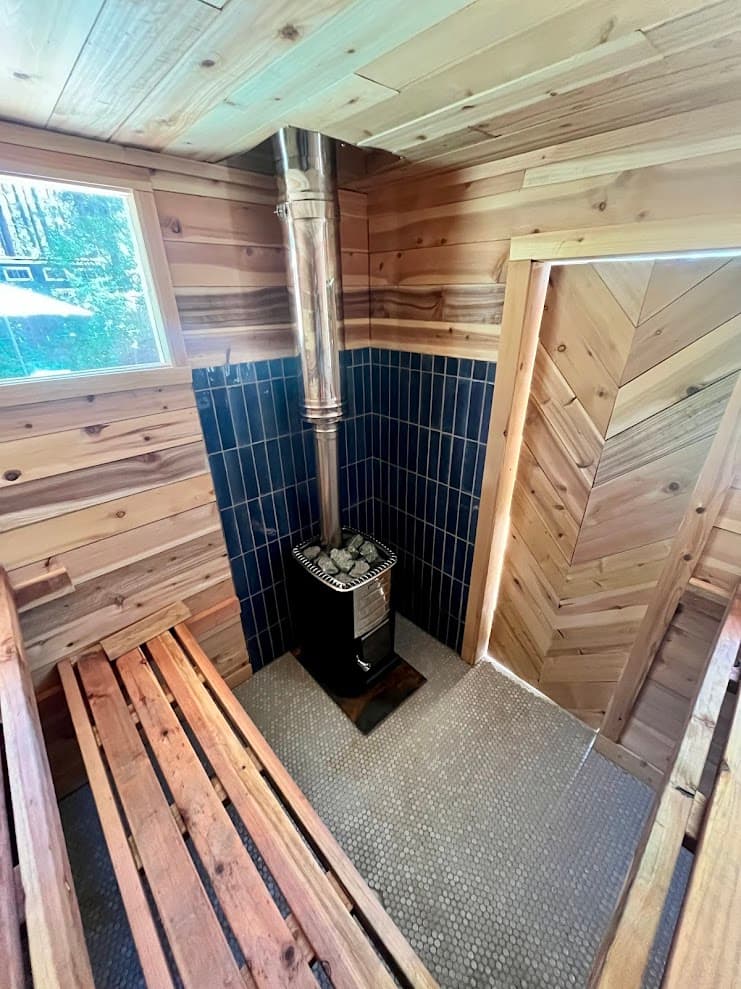
A dry sauna is a room heated to roughly 170-200°F by an electric heater or wood stove, with humidity that sits around 5-10% most of the time. The heater warms a pile of rocks, the rocks warm the air, and the hot air circulates around your whole body. That's convective heat, and it's what makes a sauna feel like a sauna.
The name came from gyms and spas, where the sauna sits next to a steam room. Next to a room at 100% humidity, the sauna looks dry. So it got called the "dry sauna," and the steam room got called the "wet sauna."
But a dry sauna isn't designed to stay dry. In a proper Finnish sauna you pour water on the hot rocks, which sends a wave of steam (löyly) through the room. Humidity spikes for a minute or two, the heat on your skin jumps, then the room dries back out. That dry-humid-dry cycle every few minutes is the whole experience. More on that in löyly explained.
So when someone says "dry sauna," they almost always mean a traditional sauna. The word "dry" is describing the baseline, not a rule.
Dry Sauna Temperature and Humidity
Here are the real numbers for a well-built dry sauna:
- Air temperature at head height: 170-200°F (traditional Finnish range runs 176-221°F)
- Base relative humidity: around 5-10%
- Humidity during a löyly burst: briefly much higher, then falls back as the ventilation clears it
- Foot bench temperature: ideally 130-160°F, warm enough to keep the lower bench hygienic
Those numbers sound extreme until you understand why they work. Dry air at 190°F feels far gentler than humid air at 140°F, because your sweat evaporates and cools you. That's why you can sit in a dry sauna for 10-15 minutes but a 120°F steam room feels oppressive fast.
It's also why the temperature at your feet matters as much as the number on the thermometer. In a poorly designed sauna you can have 190°F at the ceiling and 120°F at your ankles. That's the "hot head, cold feet" complaint, and it's a design problem, not a heater problem. See sauna temperature and sauna humidity for the deeper breakdowns.
Trusted by homeowners across Tahoe and beyond
Dry Sauna vs. Steam Room
These are completely different rooms, not two settings on the same one.
A steam room runs at about 100-120°F with humidity near 100%. There's no heater with rocks. Instead, a steam generator pumps vapor into a sealed, tiled room. The heat you feel comes from moisture condensing on your skin, which is why a 110°F steam room feels so heavy. You can't really sweat effectively because nothing evaporates.
A dry sauna runs at 170-200°F with low base humidity, has a heater and rocks, is lined with wood, and lets you control the moisture yourself by throwing water.
The construction differs too. Steam rooms need waterproof tile or stone, a sloped ceiling so condensation doesn't drip on you, and a dedicated drain. Saunas need wood interiors, insulation, a foil vapor barrier, and ventilation that moves air through the room. You can't convert one into the other without rebuilding it. Our dry sauna vs. steam room comparison goes through each difference.
Dry Sauna vs. Infrared Sauna
Infrared cabins get marketed as dry saunas a lot. They are dry, but they're not saunas in the traditional sense.
An infrared cabin uses panels that radiate heat directly at your body. The air only gets to about 110-140°F. There are no rocks and no water, so there's no steam and no humidity cycle at all. And because the heat comes from panels, it's directional: you warm on the side facing the emitters, not all the way around.
The appeal is cost and convenience. Infrared cabins often plug into a standard 120V outlet and cost a fraction of a built sauna. The trade-off is the experience. If you want heat that wraps around you and the option of löyly, you want a traditional dry sauna. Infrared vs. dry sauna covers it in more depth.
Can You Pour Water in a Dry Sauna?
Yes. This is the most common question we get about the term, and the answer surprises people.
If your "dry sauna" has a traditional heater with rocks on top, it's designed for water. Ladle it slowly onto the rocks, a little at a time. The rocks flash it into steam. Check your heater's manual first, but nearly every traditional electric heater and every wood stove is built for this.
The exceptions:
- Infrared cabins. Never put water on infrared panels.
- Some gym saunas. Some commercial saunas post "no water" signs because the heater is undersized, the rock pile is shallow, or management is worried about the controls. That's a facility rule, not a sauna rule.
- Heaters with very little rock. If water hits the heater body instead of rocks, you get a harsh, spitting fog instead of soft steam. That's a sign the rock pile is too shallow, not that water is the problem.
On that last point: the quality of the steam depends almost entirely on how much rock the heater holds. A typical wall-mounted electric heater holds around 20 lbs of rock. A wood stove often holds 100-300+ lbs. More rock gives softer, more even löyly. If you're building a dry sauna and care about the steam, the heater choice matters a lot. Our guide to sauna heater stones explains why.
Dry Sauna Benefits
The benefits people associate with sauna come from the core temperature rise of sitting in real heat, not from the "dry" part. The research that gets cited most (cardiovascular health, recovery, sleep, stress) comes almost entirely from Finnish studies of traditional saunas used several times a week, which is exactly what a dry sauna is. We've summarized the evidence in sauna health benefits.
Two things are worth knowing. First, the body heats much faster in convective heat at 180°F than in an infrared cabin, so a 15-minute round does a lot of work. Second, a dry sauna where the heat reaches your whole body does more than one where your head cooks and your legs stay cool. Design affects the benefit, not just the comfort.
Standard caution applies: hydrate, keep rounds to 10-20 minutes, skip alcohol, and talk to your doctor if you have a heart condition or are pregnant.
How to Build a Dry Sauna at Home
A good home dry sauna comes down to a short list of things done right.
Size and ceiling height. Plan on 100-105 cubic feet of volume per person and a 7.5-8 foot interior ceiling. 6'x8' works for most families; 8'x8' if you have the room.
Bench height. Put the top bench about 40-48 inches below the ceiling, with the next bench 16-20 inches lower. The goal is feet at or above the top of the heater. This single detail fixes most cold-feet problems.
Heater sizing. Electric heaters run roughly 1 kW per 45 cubic feet in a well-insulated room. A 6'x8'x7' room needs 6-8 kW and a dedicated 240V, 40-50 amp circuit. Our heater sizing guide has the table.
Insulation and vapor barrier. R-13 or better in the walls, more in the ceiling and in cold climates. Foil vapor barrier on the warm side with seams taped, then a small air gap behind the wood paneling.
Ventilation. This is what keeps a dry sauna dry. Fresh air comes in low near the heater, exhaust leaves low on the opposite wall (ideally with a fan), and a drying vent near the ceiling gets opened after the session. Without it, the steam from each löyly lingers and the room gets heavy and stale. See the sauna ventilation guide.
Wood. Western red cedar, hemlock, or aspen for walls and ceiling. Untreated. No paint, no varnish on surfaces you touch.
Get those six right and you'll have a dry sauna that runs hot, recovers fast between rounds, and makes good steam when you want it. For the full build sequence, see our traditional sauna guide.
Frequently Asked Questions
What is the difference between a dry sauna and a regular sauna?
There isn't one. "Dry sauna" is just another name for a traditional sauna with a heater and rocks. The "dry" separates it from a steam room, which runs at near-100% humidity. A traditional sauna has low base humidity but is designed for you to pour water on the rocks.
How hot is a dry sauna?
A well-built dry sauna runs at 170-200°F at head height. The traditional Finnish range is roughly 176-221°F. Base humidity stays around 5-10% except for short spikes when water hits the rocks.
Is a dry sauna better than a steam room?
They're different experiences. A dry sauna is much hotter but easier to tolerate because your sweat evaporates. A steam room is cooler but feels heavy because the air is saturated. Many people like both, and in a full thermal suite they complement each other.
Can you put water on the rocks in a dry sauna?
Yes, if it has a traditional heater with rocks. That's what the rocks are for. Ladle water slowly onto the stones to create löyly. Never put water on infrared panels, and follow any posted rules in a gym.
Is an infrared sauna a dry sauna?
Infrared cabins are dry, but they're not traditional saunas. They heat your body with radiant panels at 110-140°F, have no rocks, and can't produce steam. A traditional dry sauna heats the air to 170-200°F and surrounds you with convective heat.
Next Steps
If you're planning a dry sauna at home, start with our free sauna design checklist. It covers sizing, bench heights, heater selection, and ventilation in the order you need to decide them. If you'd rather have it designed for your space, our remote sauna design service delivers plans your builder can work from anywhere in the country.