What Is a Sauna? A Straight Answer on Heat, Löyly, and What Counts
Ask ten people what is a sauna and you'll get ten different answers — a hot room, a steam room, an infrared box, that cedar closet at the gym. Most of them are close, and most of them are missing the one thing that actually defines it. A sauna is a wood-lined room heated by a mass of stones, onto which bathers throw water to create steam that controls the humidity and combines with fresh air and heat to create löyly. That last part — the water on hot stones — is the whole point, and it's what separates a real sauna from a box that just happens to be warm.
This matters more than it sounds like it should, because the North American market is full of "saunas" that don't do this, and a lot of people have had a mediocre experience in a poorly built one and decided sauna isn't for them. Usually the problem was the room, not the idea. So it's worth understanding what a sauna actually is before you spend money on one.
The basic definition
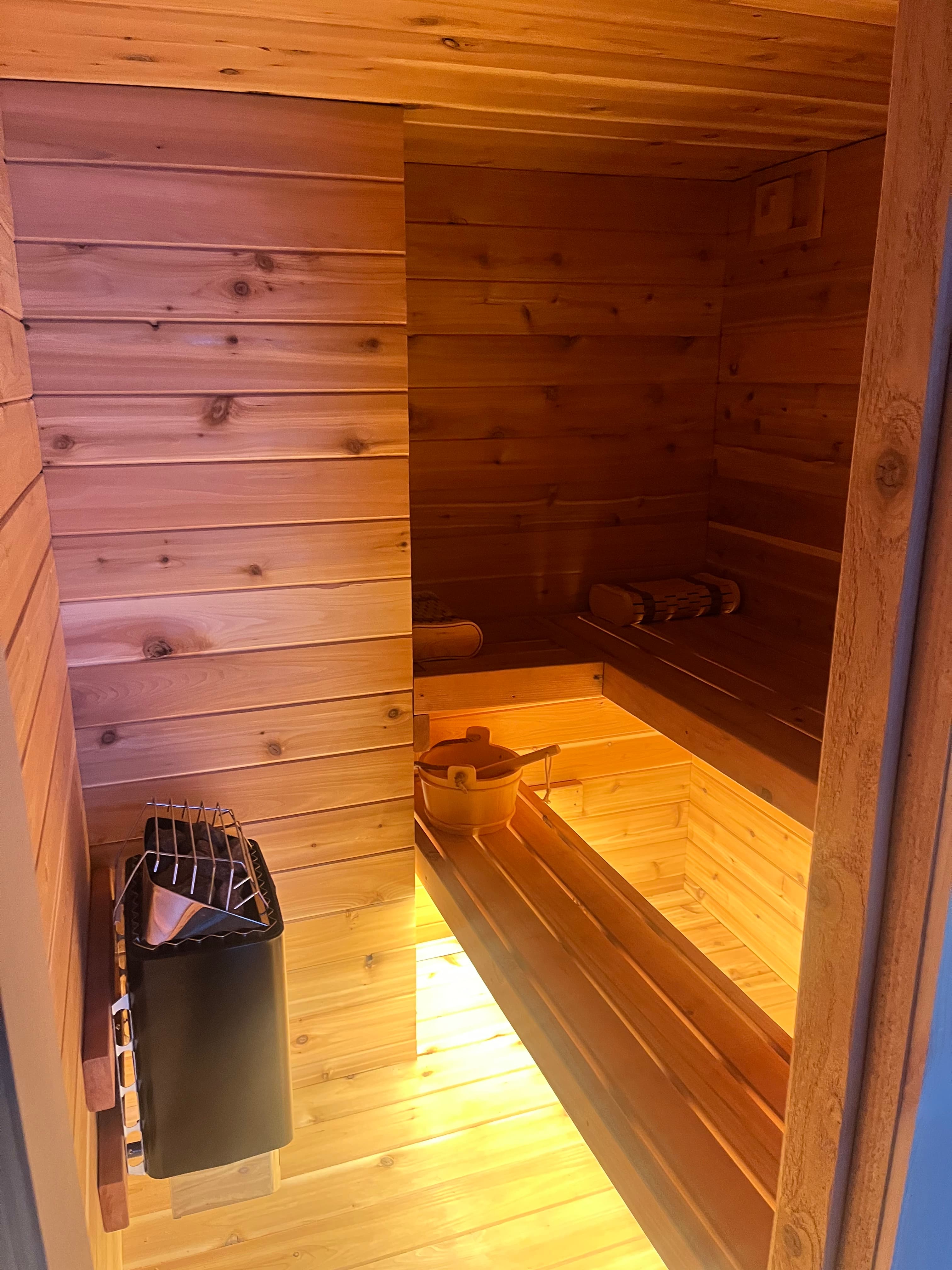
A traditional Finnish sauna has three non-negotiable parts: a well-insulated, wood-lined room; a heater topped with a mass of stones; and water you pour over those stones. The heater — electric or wood-fired — heats the air and the stones. The room reaches roughly 176 to 221°F at head and shoulder height. When you ladle water onto the hot stones, it flashes into steam, and that burst of humidity moving through the hot air is what you feel as a wave of soft, enveloping heat.
That steam-on-stones event is called löyly, and it's the defining feature. Without it, you have a hot room, not a sauna. A well-designed sauna sits at a low base humidity — around 5% — with temporary spikes every time someone throws water. You get a rhythm of dry, then humid, then drying out again, every few minutes. That cycling is a big part of why a good sauna feels alive and a bad one feels like sitting in a warm cupboard.
How a sauna actually works
The heat in a sauna is convective, which is a technical way of saying the air carries the heat to your body evenly from all directions. This is different from radiant heat, where a source beams heat at you from one side. Convective heat is why a properly built sauna feels even and comfortable rather than like one side of you is roasting.
Because heat rises, the top of the room is the hottest and the floor is the coolest. This is called stratification, and managing it is most of what good sauna design comes down to. The goal is to get your feet at or above the midpoint of the heater's stones, so your whole body sits in the even, hot zone — what we call the löyly cavity — instead of having a hot head and cold feet. That's why bench height matters so much, and why the size and layout of the room isn't just about how many people fit.
The other half of a working sauna is ventilation. Fresh air has to come in and stale, humid air has to leave, on the order of 10 to 15 air changes per hour. Skip this and you get high CO2, stuffy air, and steam that never really becomes löyly — because, as the saying goes, steam added to stale air is just steam added to stale air. Ventilation is the single most common thing North American saunas get wrong.
So a real sauna is really four things working together: an insulated wood room, a heater with enough stone mass, benches at the right height, and proper airflow. Get all four right and the room does what it's supposed to. Miss one and you get a "hot box" that technically gets warm but never feels like a sauna.
Trusted by homeowners across Tahoe and beyond
The main types of sauna
Not every hot room is the same, and the differences are worth knowing before you buy or build.
Traditional Finnish sauna. The gold standard, and the only type that produces true löyly. Cedar-lined room, stone-topped heater, water on stones, convective heat, 176 to 221°F. When people say "dry sauna," this is almost always what they mean — a traditional sauna is dry at its base humidity, with wet bursts when you throw water. There's no such thing as a separate "dry sauna" product; it's just a traditional sauna described from the wrong angle.
Wood-fired vs. electric. These are both traditional saunas — the only difference is the heat source. A wood-fired sauna uses a stove and gives you the ritual of building a fire, which suits outdoor and rural builds. An electric sauna uses a heater you can put on a timer or control from your phone, which suits indoor and attached builds. Both produce real löyly.
Steam room. Often confused with a sauna, but it's a different thing entirely. A steam room runs cooler — around 104°F — at near-total humidity, heated by injected steam rather than a stone-topped stove. There's no löyly and no water-on-stones. It complements a sauna in a thermal suite but doesn't replace it. We break down the differences in dry sauna vs steam room.
Infrared cabin. Marketed as a sauna, but by the strict definition it isn't one. An infrared cabin uses radiant heaters to warm your body directly rather than heating the air and stones, and it can't produce löyly. It's a real thermal experience with its own following, just a fundamentally different one. If you're cross-shopping, the honest comparison is in infrared vs traditional sauna.
Barrel and kit saunas. These are traditional saunas in form, but the common versions have design problems — benches set too low, too little volume per person, weak ventilation — that keep them from delivering a proper experience. They can be a real sauna if built well; most off-the-shelf versions aren't. The idea is right; the execution usually isn't.
What makes a sauna a good sauna
Knowing what a sauna is doesn't tell you whether a given one is any good. The difference between a proper sauna and a hot box comes down to a handful of things:
Enough room. You want at least roughly 100 cubic feet of air per person. Cram people into too little volume and CO2 climbs fast, the air goes stale, and people cut sessions short without knowing why.
Benches at the right height. Your feet need to be level with or above the top of the heater stones. This one rule — sometimes called the law of löyly — is what prevents cold feet, and it's the thing cheap saunas violate most often.
Real insulation and air sealing. Heat and humidity have to stay in the room to work, which means a well-built, tight envelope. A weak spot — like an oversized glass door — undercuts everything else.
Good ventilation and good stones. Fresh air moving through, and enough quality stone mass on the heater to produce soft, even steam. Skimp on either and the löyly falls flat.
When all of that is right, a sauna delivers what people actually come for: a deep, even heat, a rhythm of steam and cool-down, and the well-documented health benefits that come from regular heat exposure. When it's wrong, you get a warm room that never quite works, and the person walks away thinking they don't like saunas.
Frequently Asked Questions
What is the difference between a sauna and a steam room?
A sauna is a wood-lined room heated by stones, running hot (176 to 221°F) at low base humidity, where you throw water on the stones for bursts of steam called löyly. A steam room runs much cooler (around 104°F) at near-total humidity, heated by injected steam with no stones and no löyly. They feel completely different and serve different purposes.
Is an infrared sauna a real sauna?
By the traditional definition, no. An infrared cabin heats your body directly with radiant panels instead of heating the air and stones, and it can't produce löyly, which is the defining feature of a sauna. It's a legitimate thermal experience, just a different one — closer to a heat lamp than to a Finnish sauna.
What temperature should a sauna be?
A traditional sauna runs roughly 176 to 221°F measured at head and shoulder height, with lower temperatures nearer the floor. Most people sit somewhere in the 180 to 200°F range and adjust by moving to a higher or lower bench. We go deeper on this in our guide to sauna temperature.
Do you need water and plumbing for a sauna?
You need water to throw on the stones for löyly, but you don't need plumbing. Thousands of traditional Finnish saunas have no plumbing at all — a bucket and ladle is enough. Plumbing is a convenience for showers and cold plunges in a larger setup, not a requirement for the sauna itself.
What makes a sauna "dry" versus "wet"?
A traditional sauna is naturally dry at its base humidity and becomes temporarily wet each time you throw water on the stones — so "dry sauna" just means a normal traditional sauna. A "wet sauna" usually refers to a steam room, which is a different product entirely with no stones and constant high humidity.
Next steps
If you now know what a sauna is and you're thinking about building one, the next question is what kind fits your space, your climate, and how you'll use it. That's the part worth getting right before anything else. Start with our sauna design checklist, read up on how to use a sauna once it's built, or reach out about a remote sauna design if you want help turning the idea into an actual plan your builder can work from.