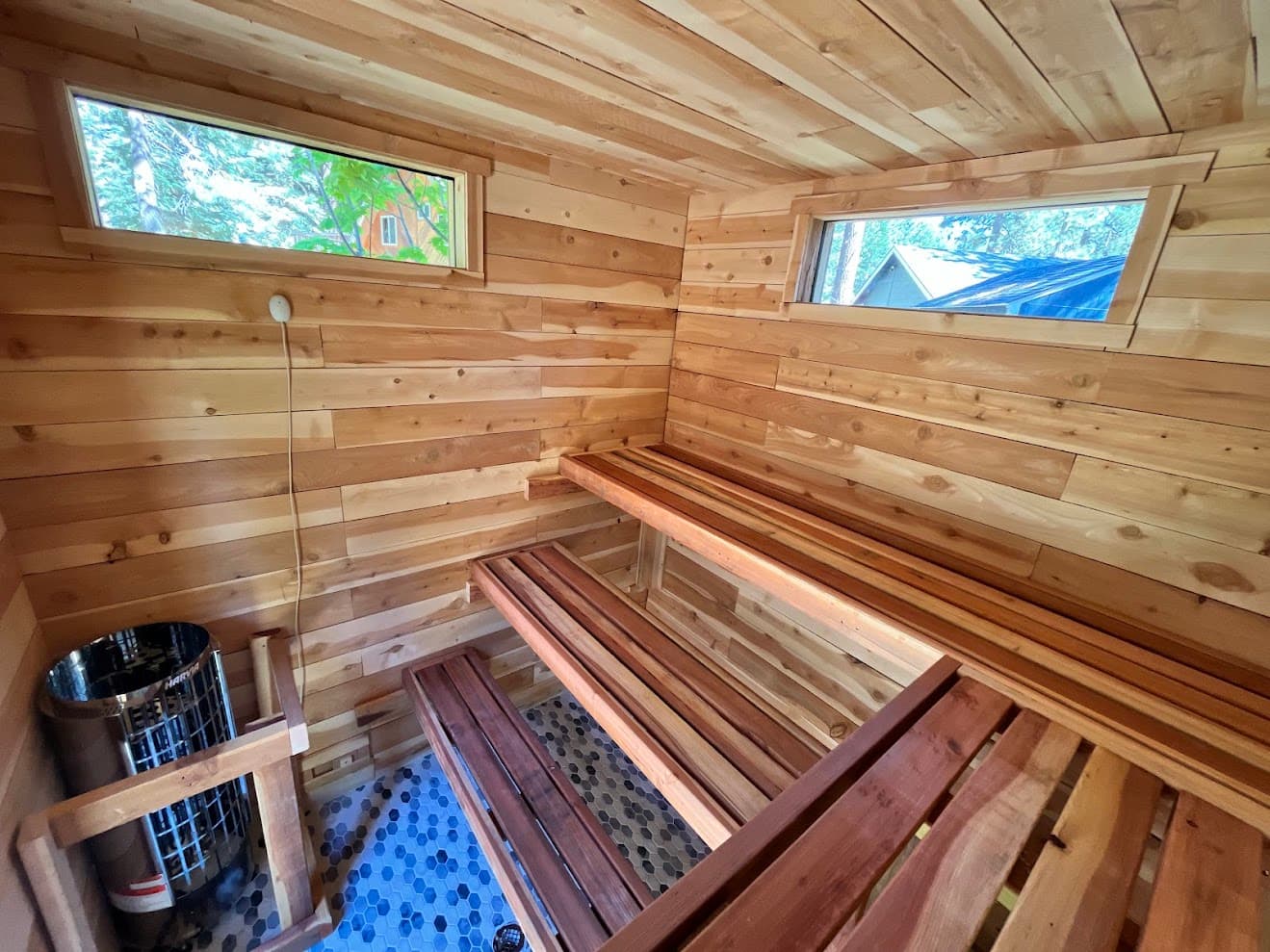
Home Sauna: How to Choose the Right Type, Size, and Location Before You Buy or Build
Most people shopping for a home sauna start with products: a barrel on a pallet, an infrared cabin from a big box store, a cedar kit with a glass front. That's backwards. The product is the last decision. The first ones are where it goes, how many people use it, and what kind of heat you actually want, because those three answers rule out most of what's for sale.
This guide walks through the home sauna decisions in the order we make them when we design one. It links out to deeper posts on each topic, so treat it as the map rather than the whole territory.
Decision 1: What Kind of Heat Do You Want?
There are two very different things sold as a "home sauna," and they're not interchangeable.
A traditional sauna is an insulated wood room with a heater and a pile of rocks. The heater warms the air to roughly 170-200°F, and you pour water on the rocks to get a burst of steam (löyly). The heat wraps around your whole body. This is what Finns mean by sauna, and it's what we design.
An infrared cabin uses panels that radiate heat directly at you. The air stays around 110-140°F, there's no rock pile and no steam, and the heat is directional, so you feel it mostly on the side facing the panels. The appeal is real: they plug into a 120V outlet, cost $1,000-3,000, and fit almost anywhere.
The trade-off is the experience. If you've been to a real sauna and that's what you want at home, an infrared cabin will feel like a different product, because it is. We break the differences down in detail in infrared vs. traditional sauna. The rest of this guide assumes a traditional home sauna.
Decision 2: Indoor or Outdoor?
This choice drives cost, permitting, and how often you'll use it.
Indoor home saunas go in basements, garages, spare bathrooms, closets, and home gyms. You're building a sealed, insulated box inside an existing structure, so there's no foundation, roof, or siding. That keeps costs down. The constraints are ceiling height (you want 7.5-8 feet inside the sauna), a dedicated 240V circuit, and somewhere for the ventilation to exhaust. Moisture is the main risk indoors, so ventilation and a vapor barrier aren't optional. Our indoor sauna guide covers the details, and there are dedicated posts for garage saunas and basement saunas.
Outdoor home saunas are small buildings. You need a foundation, a roof that sheds snow and rain, exterior siding, and a power run (or a chimney for wood). They cost more, but they give you something indoor saunas can't: the walk out into cold air between rounds. If you live somewhere with real winters, that cooldown is half the experience. See how to build an outdoor sauna for the full build.
A useful gut check: will you use it in February? An indoor sauna off the primary bedroom gets used on weeknights. An outdoor sauna at the far end of a snowy yard gets used on weekends. Both are fine, but be honest about which one fits your life.
Trusted by homeowners across Tahoe and beyond
Decision 3: How Big Should a Home Sauna Be?
Size by who actually uses it, not by the biggest number of people you can imagine.
- 1-2 people: 4'x4' to 4'x6'
- 3-4 people: 6'x6' to 6'x8'
- 4-6 people: 8'x8'
- 6+ people: 8'x8' and larger
For most households we land on 6'x8' or 8'x8'. An 8'x8' is the sweet spot when space allows. It fits four to six on the top bench, lets two adults lie down, and uses standard material lengths efficiently.
Don't go too small to save money. Every person in a sauna needs about 100-105 cubic feet of air volume to keep CO2 from building up and making the room feel stuffy. A cramped sauna also costs more per square foot than a slightly bigger one, because the heater, door, and electrical are fixed costs. Our sauna size guide has layouts for each size.
Ceiling height matters as much as floor area. Plan on 7.5-8 feet inside. Lower ceilings heat up faster but push your head into the hot zone while your feet sit in cooler air. Higher ceilings let you raise the benches so your whole body is in the heat.
Decision 4: Kit, Prebuilt, or Custom?
Kits run about $3,000-10,000 and show up on a pallet. They're the fastest way to own a sauna. The problem with most North American kits is design, not build quality: benches too low, not enough volume, no ventilation plan, too much glass. Those are the things that make a sauna feel weak. If you buy a kit, check bench height and ventilation before anything else. We go deeper in should I buy a sauna kit.
Barrel saunas deserve their own warning. They're popular because they look great and ship as a kit, but the curved shape puts the benches near the floor and leaves very little volume per person. Head-to-feet temperature differences of 60°F or more are common, which means hot head, cold feet. Most barrels we see get used hard the first year and sporadically after that.
Custom builds cost more in design time but let you control what actually matters: bench heights relative to the heater, ceiling height, ventilation, and insulation. A well-designed custom indoor sauna can cost about the same in materials as a mid-range kit. The difference is getting the proportions right.
Decision 5: Electric or Wood Heater?
For an indoor home sauna, electric is the answer. No chimney, no smoke, no clearance headaches inside your house, and it's controllable from a panel or your phone.
For an outdoor sauna, it's a real choice. Wood stoves carry far more rock mass (100-300+ lbs vs. about 20 lbs in a typical wall-mounted electric), which gives softer, more even steam. They also take 1-2 hours to heat and need a chimney, clearances, and usually a permit. Electric heaters get you there in 30-60 minutes with zero tending.
Size an electric heater at roughly 1 kW per 45 cubic feet in a well-insulated room, then adjust up for glass, outdoor exposure, and cold climates. A 6'x8'x7' room is about 336 cubic feet, which lands at 6-8 kW. Our heater sizing guide has the full table.
The Electrical Most People Don't Budget For
Almost every traditional home sauna needs a dedicated 240V circuit. Most 6-9 kW heaters need a 40-50 amp breaker, and 10 kW and up typically need 60 amps. That means a licensed electrician, and possibly a panel upgrade if your service is already full.
Budget $500-2,000 for installation, more if it's a long trench to an outdoor sauna or a panel upgrade. Check your panel before you fall in love with a heater. More on this in sauna electrical requirements.
The Three Details That Decide Whether You'll Use It
We see a lot of home saunas that technically work but feel off, and they almost always fail on the same three things.
Bench height. The top bench should sit about 40-48 inches below the ceiling. The goal is to get your feet at or above the top of the heater, so your whole body sits in the heat. Low benches are the number one cause of cold feet. See sauna bench height.
Ventilation. A sauna without a ventilation plan gets stuffy after one round. The setup we use is fresh air in low near the heater and exhaust low on the opposite wall, ideally with a small fan pulling air out. Add a drying vent near the ceiling that you open after sessions. Details in our sauna ventilation guide.
Insulation and vapor barrier. Use R-13 or better in the walls (more in cold climates), foil vapor barrier facing the hot side, and an air gap behind the paneling. Skimp here and the sauna takes forever to heat and never quite holds temperature.
Get those three right and a modest home sauna will outperform an expensive one that ignored them.
What a Home Sauna Costs
Rough ranges we see for a traditional home sauna:
- Indoor DIY build: $3,000-6,000 in materials for a 3-4 person room, plus electrical
- Indoor professionally built: $10,000-20,000 depending on size and finish
- Outdoor kit: $5,000-15,000 installed, plus foundation and electrical
- Custom outdoor sauna: $15,000-40,000+ for a properly built, insulated cabin
As a reference point, a recent indoor garage build we designed (6.5'x6.5', three people) came in at $3,000-4,000 in materials with an 8 kW heater, cedar interior, and two-tier benches. It heats to 180-200°F in about an hour.
For line-by-line numbers, see how much does a home sauna cost. For whether it pencils out for your household, is a home sauna worth it walks through the math.
Where Remote Design Fits In
Most people don't have a sauna builder down the street, and a general contractor who's never built one will default to whatever looks reasonable. That's how you end up with benches at chair height and a vent in the wrong place.
That's the gap our remote sauna design service fills. We design the sauna for your specific space (size, bench layout, heater, ventilation, electrical spec) and hand you or your contractor plans they can build from, wherever you are. If you're doing it yourself, our DIY sauna guide covers which phases to take on and which to hire out.
Frequently Asked Questions
How much does it cost to put a sauna in your home?
A traditional indoor home sauna typically costs $3,000-6,000 in materials if you build it yourself, or $10,000-20,000 professionally built. Add $500-2,000 for a dedicated 240V circuit. Outdoor saunas run higher because you're adding a foundation, roof, and exterior.
Can you put a sauna in any room of your house?
Almost, as long as the room can fit a sealed insulated box with about 7.5 feet of interior ceiling height, has access to a 240V circuit, and has somewhere for ventilation to exhaust. Basements, garages, spare bathrooms, and large closets are the most common spots. Avoid rooms where you can't control moisture.
What size home sauna do I need?
Size for the people who will actually use it regularly. Two people fit in 4'x6', a family of four is comfortable in 6'x8', and 8'x8' is ideal if you want room to lie down or host friends. Plan on 100-105 cubic feet of volume per person.
Is an infrared sauna or a traditional sauna better for home use?
They're different experiences. Infrared cabins are cheaper and plug into a standard outlet, but they run at 110-140°F with no steam. Traditional saunas reach 170-200°F with löyly from water on the rocks. If you want the real Finnish sauna experience, go traditional.
Do home saunas use a lot of electricity?
Less than most people expect. A properly insulated home sauna with a 6-8 kW heater runs about $1 per hour or less at typical U.S. rates. Poorly insulated saunas and barrels can cost two to five times that.
Next Steps
Before you buy anything, run through our free sauna design checklist. It covers every decision in this guide and will show you quickly whether a kit fits your space or whether you need a custom layout. If you want us to design it for you, start with our remote sauna design service. We'll size it, lay out the benches, spec the heater and ventilation, and give you plans you can hand to any builder.